Review: Christian Rizzo’s over-protected eye and Soa Ratsifandrihana’s g r oo v e in the Dance Reflections festival
Graham Watts sees Christian Rizzo’s ‘Sakinan Göze çöp Batar’ and Soa Ratsifandrihana’s ‘g r oo v e’, part of the Dance Reflections by Van Cleef & Arpels festival.
| Title | Sakinan Göze çöp Batar (An over-protected eye always gets sand in it) g r oo v e |
| Company | Dance Reflections by Van Cleef & Arpels |
| Venue | Lilian Baylis Studio, Sadler’s Wells, London |
| Date | 12/13 & 19 March 2025 |
| Reviewer | Graham Watts |
The itinerant Dance Reflections festival by Van Cleef & Arpels occupies several of London’s dance theatres between 12 March and 8 April, bringing contemporary works of historical significance (by such luminaries as Trisha Browm and Merce Cunningham). These exemplars in the canon of modern dance are interwoven with new(ish) work by the next generation of choreographers, largely staged in smaller spaces. The pair in this review were both shown in the Lilian Baylis Studio of the Sadler’s Wells complex, possessing just 180 seats for a traditional setting and perhaps half this number when rearranged in the round. Regrettably, even with such small numbers, these shows were not sold out.
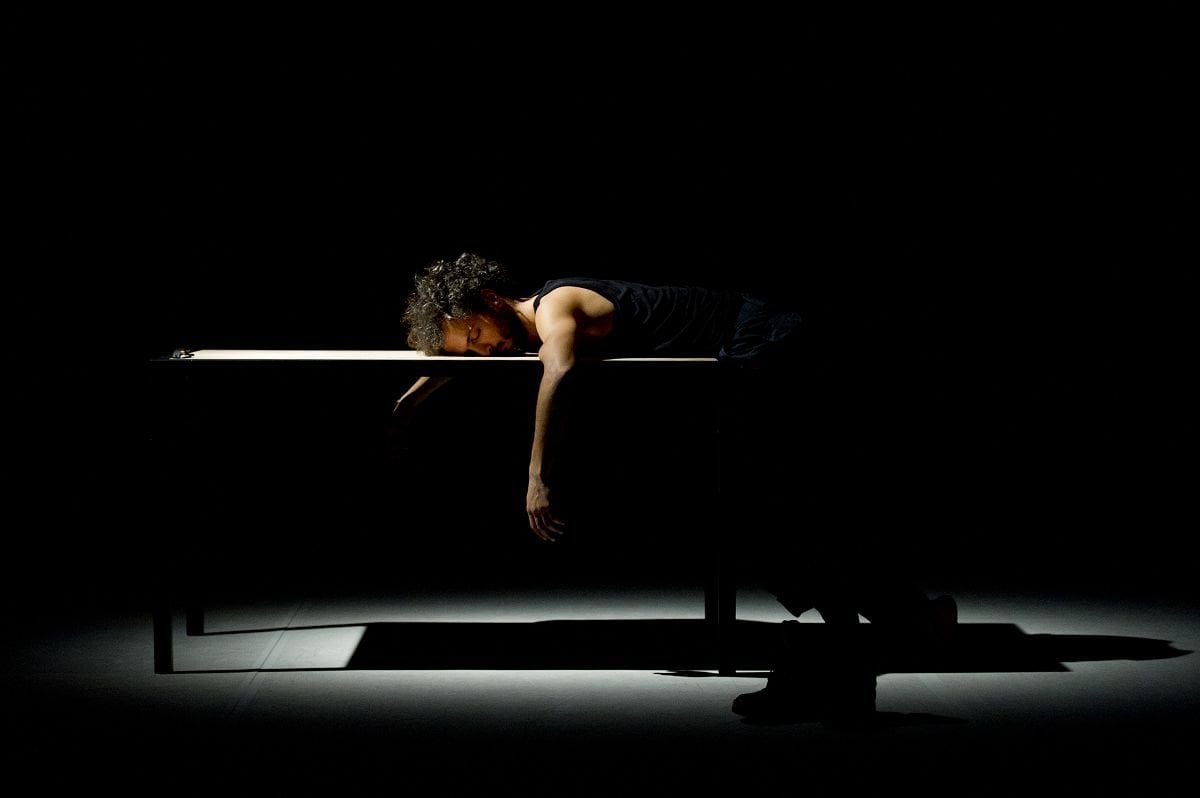
The whole festival opened with Christian Rizzo’s enigmatically titled Sakinan Göze çöp Batar (An over-protected eye always gets sand in it), a solo performed by Kerem Gelebek, first shown back in 2012. This time around, I saw it on consecutive nights and I’m glad that I did because at first viewing I assumed that much of the movement and Gelebek’s diverse activity with props was improvised since it seemed seamlessly spontaneous; but on the return visit to the Lilian Baylis Studio, it became obvious that the movement was tightly choreographed and finely detailed.
The audience took their seats while Gelebek sat, motionless, in dim light, on what seemed to be a large cupboard (later it was disassembled to become a table). As the performance began, with the distant sounds of nature, he appeared dressed for a hike in the countryside, backpack and all. He scattered some stones (taken from inside the backpack) and created a sign from wooden letters: first “HERE”, then “THERE”. The whole stage space is used imaginatively, with transitions in the acceleration and deceleration of movement linked to abrupt changes in music.
Gelebek’s movement included a form of planking and other floor exercises, lunging and fast turns, one way and then reversed, but the main remembered image is of his long legs stretching and scissoring across the space. At various junctures, the sides of the cupboard were removed and placed against the wall (where they absorbed light); Gelebek also removed his socks and rolled them into a ball (his watch and shirt were removed later); an Aloe Vera plant appeared and some books were placed on the table and then brusquely pushed onto the floor, leaving it as a platform for the performer to curl up upon in a final expression of vulnerability.
The choreographer has spoken of the work as a ‘collection of thoughts born from movement’, which aptly describes Gelebek’s 50-minute journey that was cloaked in a slow-moving melancholia as suggested by the title’s expression of life’s continual disappointments. It’s a fascinating piece, performed with an endearing intimacy, that didn’t seem over-long.


That same sentiment did not apply to Soa Ratsifandrihana’s self-performed g r oo v e (the spaces between some letters is intended but also unwittingly indicative of a work that was stretched well beyond the limitation of its ideas). It’s a shame because Ratsifandrihana is a charismatic performer with the courage to take on this highly personal solo in an intimate “in the round” setting. At times, she was just centimetres away from her audience.
Her 45-minute solo started in both silence and darkness, with this absence of sound and light continuing for long enough to make one wonder if there was a technical fault. But, under cover of this void, Ratsifandrihana crept into the square, surrounded on all four sides by three rows (the first of which was cushions on the floor). To say that the opening was slow-moving is an understatement. The initial sound and movement were surprisingly bland, a feeling not helped by the dim lighting and silence. Eventually, there were short bursts of white noise and what initially seemed to be an alarm on a mobile phone being allowed to continue unabated. None of it was appealing.
The most interesting aspect, once visibility improved, was Ratsifandrihana’s jacket (designed by Coco Petitpierre) with strange protrusions from the shoulders. As the movement intensified, Ratsifandrihana removed the jacket and dropped it at my feet. The programme notes told me that her movement contained references to the 19th-century Afindrafindrao dance from Madagascar (Ratsifandrihana’s home island); the Madison line dance that was popular in 1960s America (and one of the first dances that Ratsifandrihana learned); and the quarter-turns of the popper, Pepito.
This collage of movement references was only partly obvious to me but once Ratsifandrihana began to move with these earnest intentions, it became a much better work. Usually, when I feel a work is too long, it’s the ending that needs cutting back but here, editing out the first 10/15 minutes and using some music in place of the white noise and alarms would have made this a much more engaging work.


Graham Spicer, aka ‘Gramilano’, is a writer, director and photographer based in Milan. He was a regular columnist for Opera Now magazine and wrote for the BBC until transferring to Italy. His articles have appeared in various publications from Woman’s Weekly to Gay Times, and he wrote the Danza in Italia column for Dancing Times magazine. Graham was the historical advisor on Codice Carla, the 2023 documentary on Italian ballerina Carla Fracci.
Graham also works as a dance photographer, and his photos have appeared in many books, theatre programmes, and magazines, including Dancing Times, Dance Spirit and Ballet2000, as well as all the major Italian newspapers.
He is a member of the Dance Section of The Critics’ Circle.