
Review: Paris Opera Ballet in Roland Petit’s Notre-Dame de Paris

Matthew Paluch sees Paris Opera Ballet in Notre-Dame de Paris and was appreciative, but not affected by Roland Petit’s ballet.
| Title | Notre-Dame de Paris |
| Company | Paris Opera Ballet |
| Venue | Opéra Bastille, Paris |
| Date | 12 December 2025 |
| Reviewer | Matthew Paluch |
The Nutcracker? Too festive. The Snowman? Too cute. How about something with ravaged group scenes and a hanging? That’s more like it for Christmas – or at least that’s the case at the Paris Opera Ballet.
Currently being performed at the Bastille is Roland Petit’s first piece for the Paris Opera Ballet, Notre-Dame de Paris (1965). We don’t get a lot of Petit in the UK, Carmen of course, so this was my first viewing of the work. I’ve seen images and videos of Etoiles before, especially the females as Esmeralda, but never the complete piece.
Long story short, it’s neither a thumbs up nor a thumbs down, but one of those somewhat satisfying yet slightly frustrating thumbs in the middle experiences. On paper, it’s everything I should like: colourful, minimalist costumes by Yves Saint Laurent, ingenious modernist sets and abstract backdrops by René Alli, and a cinematic score by Maurice Jarre that includes both rampant percussion and dramatic strings.

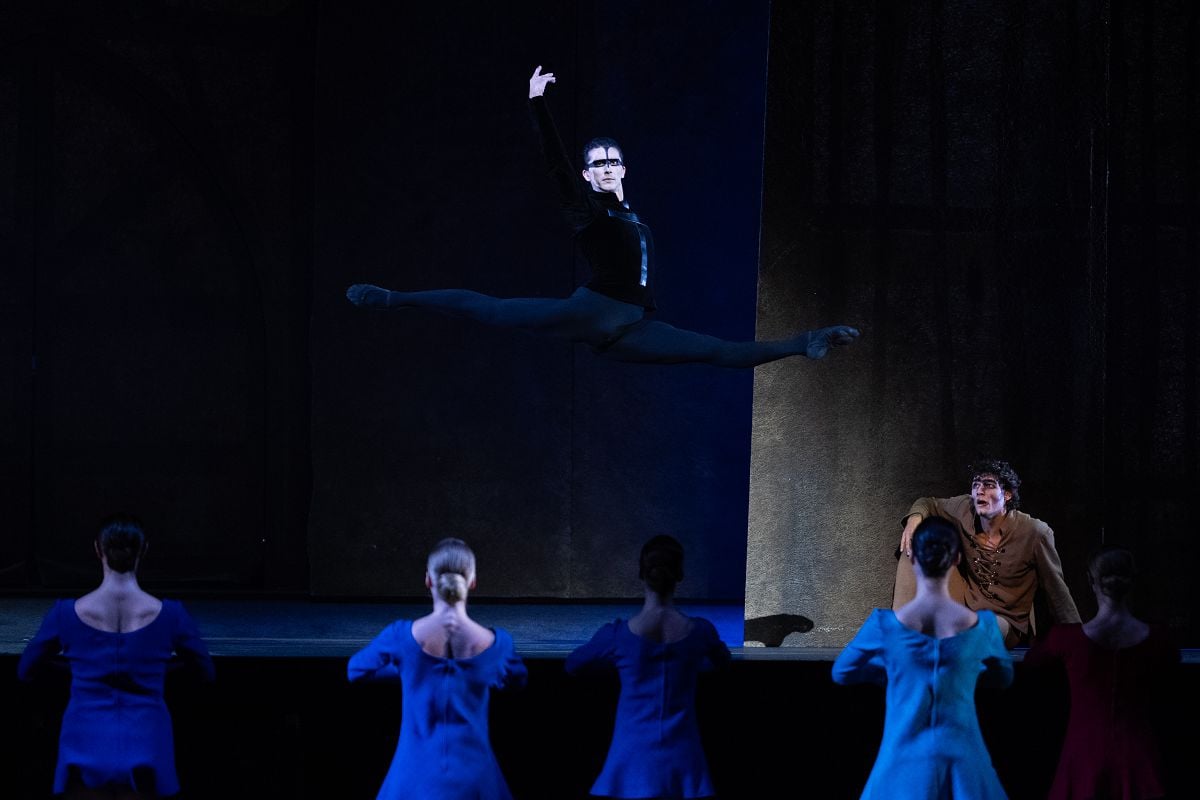
So what’s the problem? The choreography, I’m afraid. Petit is renowned for being highly stylised, and Notre-Dame is no different, but the overall structure and content don’t allow the observer to transport emotionally… well, at least not me. I found the material too repetitive, sections of unison not performed tightly enough and the general emphasis on physicality rather than the depth that dance language can offer. Have we ever seen so many double tours and split jumps in a ballet? Probably not, I’d say… but I haven’t had the “pleasure” of Spartacus at the Bolshoi to date.
There are of course positives to savour and acknowledge. Each of the four main characters is introduced via a solo, and this material is of more value. Quasimodo is all distorted posture and tortured, expressive eyes. Frollo screams religion-informed rigidity and suppression. And Esmeralda is what we were all waiting for – sultry, clean lines and phrases that devour the large stage space with ease. Phoebus is kinda meh; a cartoonish Captain full of himself.
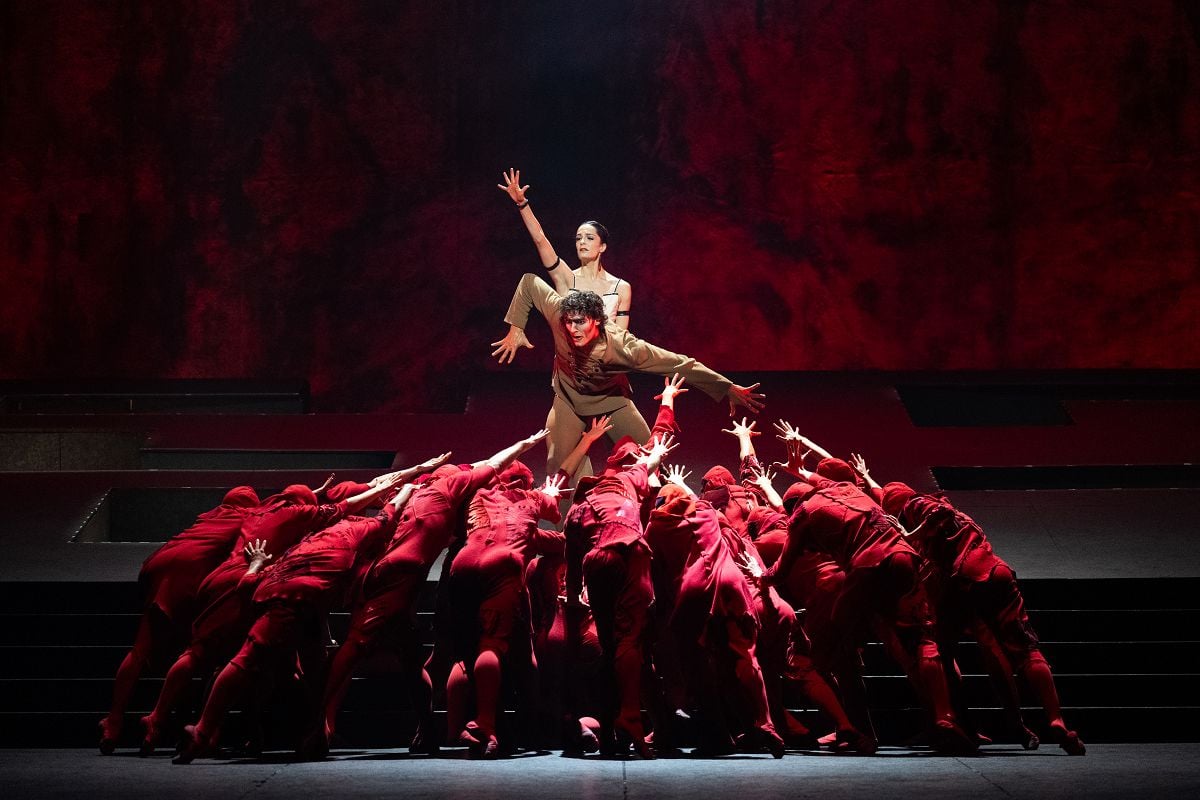
All of the group scenes are about volume (of people) and perpetuity (endless movement). At times this can feel impressive, at others, basic and sloppy. The corps also get some very questionable costuming – red gimp suits, big fake boobs and the cheapest black wigs I’ve maybe ever seen. Mon dieu.
Most people are aware of Victor Hugo’s 1831 novel, Notre-Dame de Paris, and if not, Petit defines the characters and plot clearly so that audience members won’t get lost. Hugo Marchand as Quasimodo was an interesting watch. Here’s the Paris Opera golden boy (well brunette) in a very different situation – no glamour or regality. And Marchand finds perfectly balanced depth in his portrayal of the Hunchback. His body communicates the inherent discomfort, the expressive eyes tell the reality of his ostracised existence.

Pablo Legasa as Frollo gave a powerful performance. The role is complex in the sense that Frollo wants to evoke control and inner peace, but his true emotions are basically the exact opposite. Legasa tapped into the repressed energy and explosive releases with physical prowess. A commanding presence, no doubt.
Amandine Albisson is a double whammy – Esmeralda to a tee, and the quintessential Paris Opera Étoile. Striking looks, perfect proportions, and cooler than cool dancing, she absolutely fits the bill, and one revels in the fact that Esmeralda isn’t a passive victim. That said, I craved more risk in her performance. Everything felt on the safe side – which is of course to a very high standard – but I wasn’t surprised, or moved by what she offered, just pleasantly aware of the skill involved.
The above final sentence encapsulates my overall feeling in relation to the entire evening. Appreciative but not affected. Only during the two main pas de deux did I start to feel my emotional self moving to a higher plane… so it begs the question(s), do I rush back and action more detailed analysis or leave it there? Perhaps I’ll just go to the L’île de la Cité and dream away…


Matthew Paluch was awarded a place at The Royal Ballet School in 1990 where he graduated in 1997. His first four years as a professional dancer were spent working with London City Ballet, Scottish Ballet, K-Ballet and English National Ballet, becoming a full-time member of ENB until leaving in 2006.
Matthew graduated from the Royal Academy of Dance, Professional Dancers’ Teaching Diploma in 2007, and was formerly on faculty at The Royal Ballet School. He completed his Masters in Ballet Studies at Roehampton University in 2011, has been a freelance writer since 2010 and currently works in the Law Sector.
He is a member of the Dance Section of The Critics’ Circle.


philipmcdonlwharton@gmail.com
philipmcdonlwharton@gmail.com