Review: MILANoLTRE Festival in Milan with the Ballet de Lorraine

Graham Spicer sees the Ballet de Lorraine in a double bill – Trisha Brown’s “Twelve Ton Rose” and Marco da Silva Ferreira’s “a Folia”.
| Title | Twelve Ton Rose | a Folia Replica |
| Company | Ballet de Lorraine Andrea Peña & Artists |
| Venue | MilanOltre | Teatro Elfo Puccini |
| Date | 23 September – 19 October 2025 |
| Reviewer | Graham Spicer |
Now in its 38th year, the MILANoLTRE Festival of contemporary dance in Milan has spread its wings and flown from the confines of the three-theatre complex at Teatro Elfo Puccini and has events also at alternative spaces, like Milan’s Science Museum.
I could only fit in three performances this year (this review is of two of those), all at the Sala Shakespeare of Teatro Elfo Puccini, the theatre’s largest space with excellent sightlines and stage for dance.


Let’s start with the bummer… Andrea Peña’s Replica. I saw this work just two days before my colleague Graham Watts saw Andrea Peña & Artists open the Dance Umbrella Festival in London with their show Bogotá. He gave that performance 1½ stars, and I don’t think that the performance in Milan merits much more.
There were two dancers onstage for the hour’s performance: Frédérique Rodier, who is strong in both in body and personality; and James Phillips, who did his job well but communicated little. They were joined occasionally by a technician who moved a ladder, watered plants and tidied up. The performers wore just thongs, socks and trainers.
There was a table on the stage with soil and plants, a strip of grass behind a backcloth made of strips of transparent plastic, a ladder and a suspended chain, some poles with fluorescent strip lighting, plastic water carriers, a sack maybe containing seeds. Water, plants, soil… is this our planet? Eden? Are the performers Adam and Eve? Is the plastic ready to invade and ruin ‘paradise’?
But the stage was hardly a paradise. Maybe the bomb had already hit and this was what had remained. This was all suggested at the beginning of the performance. Then we waited… (and waited and waited) for the plants to be trodden on (of course), the water to be poured around the stage (well, yes), and the earth to be rolled in (obviously). It’s just as well that Peña doesn’t stage murder mystery plays because the audience would roar, “THE BUTLER DID IT!” after the first five minutes.
Whatever, it was well rehearsed and performed with great commitment. At the end, the performers removed their shoes and socks, and in the last seconds, their thongs too. Well, well, well… I never saw that coming either.


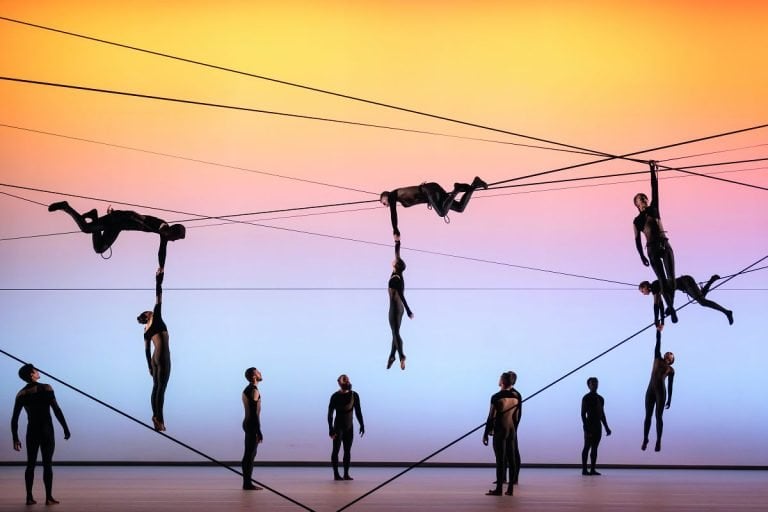
Ballet de Lorraine brought a double bill including Trisha Brown’s Twelve Ton Rose (1996) set to Anton Webern’s Four Pieces for Violin and Piano – its erratic contrasts of tempo and dynamics were certainly a gift to the choreographer.
It’s rare to see a piece by Brown in Italy, and Twelve Ton Rose, although only 25 minutes long, can be viewed as a ‘greatest hits’ compilation, with all her signature moves – casual hops, with changes of direction; swinging, loose-jointed arms; continual turning; rubbery physicality coming from release technique… Two people will come together, three, four, and just as a pattern is discerned, it is broken up, like little children grouping and regrouping in a playground. A word that seems to characterise her choreography is ‘fluidity’ – moving in and out, forwards and backwards, into a group and away again. Another word would be ‘playful’ with movements often seeming improvised. The Lorraine dancers gave a charming performance.
After a short pause came a Folia by Portuguese choreographer Marco da Silva Ferreira.
Here’s a quote from the BBC’s culture section:
La Folia has a long history. Its distinctive chords first developed out of the folk music of late 15th-Century Portugal, where it was used in popular festivals. Its name – ‘folly’ or ‘madness’ in Italian – refers to the frenzied way peasants twirled to the music. In Santiago de Murcia’s Codice Saldivar No 4, Renaissance writer Covarrubias describes La Folia as ‘very noisy’ while another highlights its ‘vivacity and fire’, its dancers ‘making gestures that awaken voluptuousness’.
Some words from this paragraph which can be associated with Silva Ferreira’s piece are “frenzied”, “madness”, “noisy”, “vivacity” and “voluptuousness”. Full house. It is indeed full of all these things.
Corelli’s Violin Sonata in D minor, which has 23 variations on the theme La Folia, is the basis of Luis Pestana’s throbbing score and suggestive soundscape.
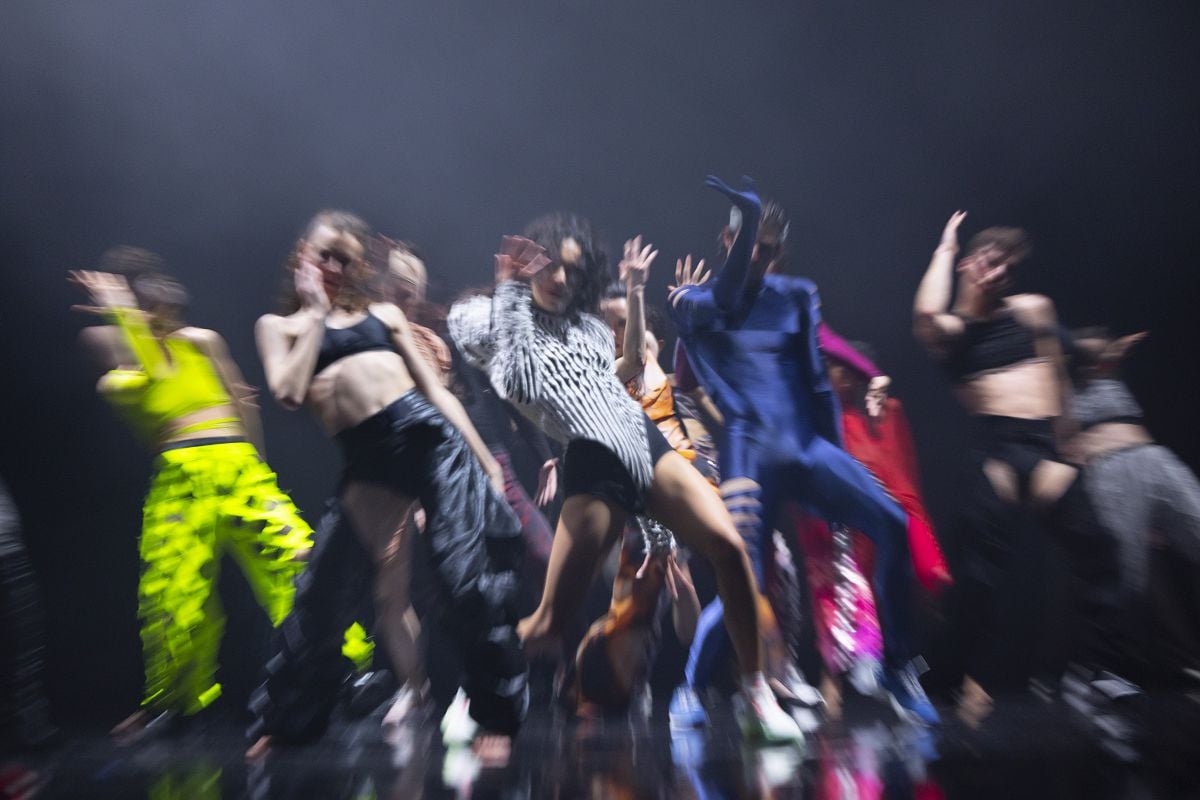
Silva Ferreira’s choreography riffs on the Latin word follis, which meant a ‘leather bag’ and also ‘bellows’, so we see a precisely coordinated piece of upper-body movement with the 22 dancers miming opening and closing bellows in a close half-circle. He takes another meaning, ‘windbag’, which can describe a person who is empty-headed or full of hot air – a fool… cue possessed dancers.
There is voguing and club dancing, and street dance where one dancer at a time enters the circle to show off their moves. The movements are not particularly demanding, but the stamina needed to keep them up incessantly, and often at great speed, is great, with almost all the dancers onstage throughout.
A Folia develops away from the Baroque rhythms to the not dissimilar tribal pounding of a club. The dancers – wearing Aleksandar Protic’s wonderfully exotic, multicoloured costumes – sweat it out during a good ten-minute, no let-up finale. There’s smoke and flashing lights, and the loud music’s bass shakes the theatre seats, and when suddenly there was silence and darkness, the audience took over roaring and whooping its approval. It was a good feeling to leave the theatre with a wide grin on my face.


Graham Spicer, aka ‘Gramilano’, is a writer, director and photographer based in Milan. He was a regular columnist for Opera Now magazine and wrote for the BBC until transferring to Italy. His articles have appeared in various publications from Woman’s Weekly to Gay Times, and he wrote the Danza in Italia column for Dancing Times magazine. Graham was the historical advisor on Codice Carla, the 2023 documentary on Italian ballerina Carla Fracci.
Graham also works as a dance photographer, and his photos have appeared in many books, theatre programmes, and magazines, including Dancing Times, Dance Spirit and Ballet2000, as well as all the major Italian newspapers.
He is a member of the Dance Section of The Critics’ Circle.