
Review: Royal Ballet’s Woolf Works – Seamless Sensations of Embodied Memory

Lucía Piquero sees the Royal Ballet in Wayne McGregor’s Woolf Works – a work resonating with the need to question what and how dance does.
| Title | Woolf Works |
| Company | The Royal Ballet |
| Venue | The Royal Ballet & Opera, London |
| Date | 18 January 2026 |
| Reviewer | Lucía Piquero |
The Royal Ballet restages the highly successful Woolf Works about 10 years after its premiere, and it doesn’t disappoint. In Part I, ‘I now, I then’, there is a tension at the heart of this work between the “pretend-natural” that we often see ballet attempting, and the truly pedestrian. And, somehow, nearly magically, Wayne McGregor hits that sweet spot where his work is at the most naturally expressive.
We feel the weight in Natalia Osipova’s movement, the poignant heartbreak in the duet between Marcelino Sambé and Marco Masciari, the pure joy in the dancing of the younger versions, spearheaded by Leticia Dias. Richter’s music carries us up and down and around until it all comes together, with the sometimes ominous but always nostalgic revolving set a continuous part of our experience.
Somehow, this work embodies memory, and it is not difficult to imagine that we are inside Woolf/Clarissa’s head, looking back, re-feeling. The one thing that was superfluous for me were the projections, beyond the one at the very beginning. As I have previously commented on, perhaps McGregor can trust more in dance as a sole communicator; certainly here there was no need for more. Then again, he also seems to enjoy the struggle between wording and movement, playing with the capabilities and interactions between both in several of his works for the Royal Ballet. The simple complexity here, however, speaks for itself. A great example of this is the final scene, where the exquisite syncopation and orchestration of walks and movement give rise to a quintet full of detail and richness, full of sensation in the moving bodies. And the dancers are so good here that we don’t even see the seams.


As much as I think that Part I is excellent, I cannot really connect to the hyper technological, 90s abstraction that is the second part, entitled ‘Becomings’. Most of the time it feels like one could take these duets and put them in another ballet and they would work equally well. The dancers are amazing, yes, and although some issues of coordination and timing seem to occur at points, we get to see their apparently limitless capacity.
We feel the auditorium shaking with the loud beating of the music, we are illuminated by the LED lights and the lasers that break the fourth wall, crisscrossing both the stage and the house… It’s all very cool, I’m just not sure what it is for. The crafting of the choreography, usually McGregor’s strength, loses power here. We see combinations repeated to the other side, we see accumulation, and yet still I do not know what it is for.
In his defence, however, McGregor must be privy to a secret I’m not – the audience was cheering out of their seats here, much more enthusiastically than in the first part. Perhaps he goes for the detail again, the programme speaks of the light, and the movement being different for the men and the women inspired by Woolf’s Orlando. This focus, however, fails to connect, for me, with some of Woolf’s writing and perspective, and hence falls short of her power in the moment of experiencing.


Part III, ‘Tuesday’, turns back to a more comprehensible, more emotionally resonant realm. Osipova/Clarissa stands still, while what is possibly Woolf’s most well-known and extremely powerful letter to her husband is read aloud – prerecorded – by actress Gillian Anderson. I should correct though – Osipova is not really still, somehow her breathing matches the recording of Anderson’s voice, her hands flick almost imperceptibly with certain words… it’s painfully beautiful to watch.
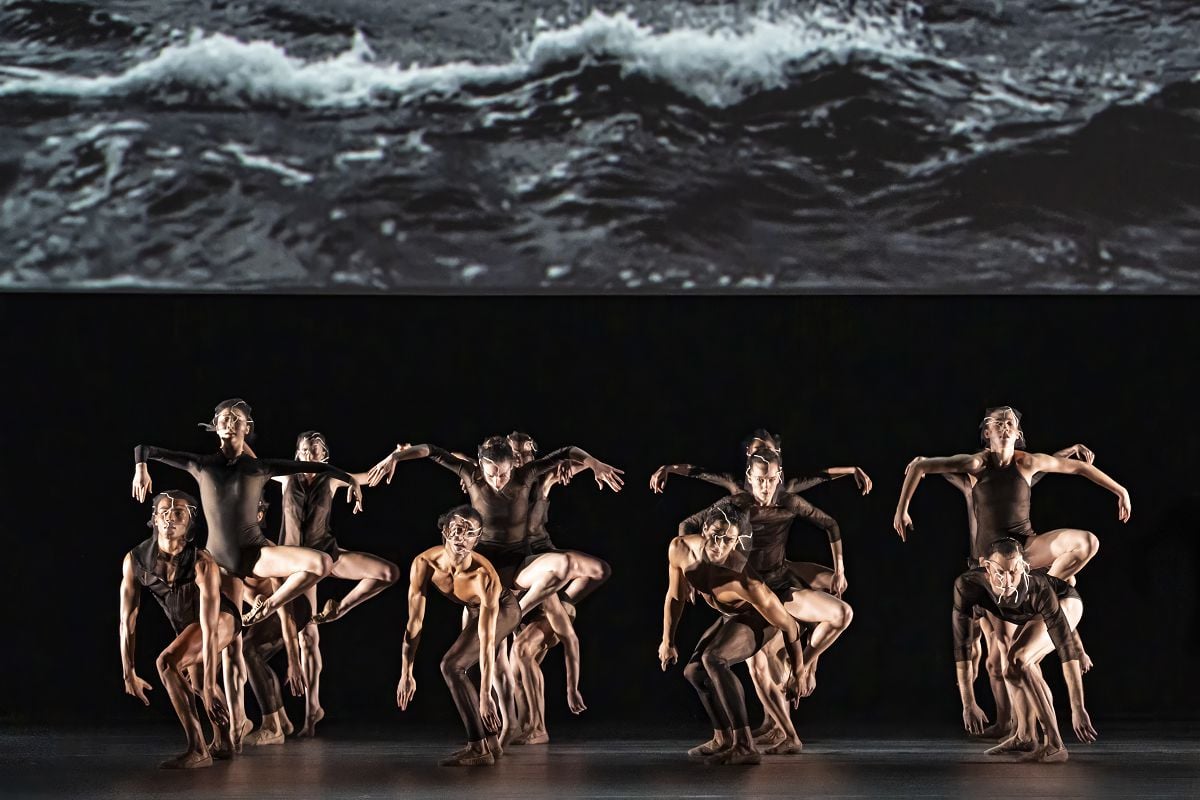
The significance of the water projected above is not subtle, but it is also not unwelcome. A soft, moving, if at points slightly awkward duet follows. This case of movement being slightly out of time, not quite in coordination, happens also in the corps de ballet sections of this part III, but here it doesn’t detract from the feeling; it somehow makes it more human, more real.
After the duet, slowly, the stage fills, first with playing children, then with the company. They go from being slightly disconnected groups to a unison of ronds de jambe facing different fronts. But again, a choreographic device which damaged the second act does not feel out of place here: there is a calm despondency to the repetition of this simple movement. The music and dance build in a shared crescendo, and by the time we are left again with the main couple we feel the heartbreak reverberating, and we rest when Osipova is left to lie down, alone, on an empty stage.


This is definitely a work of ups and downs – well, two very high ups and one down – but I feel like the beauty of parts I and III makes up for the strange and disconnected part II. These are McGregor at his most unusual, embracing tensions between narrative, expression and embodiment, between words and movement, resonating with the need to question what and how dance does. This is where, I feel, he is also at his strongest.

Lucía Piquero Álvarez was born in Asturias, Spain, where she trained in Classical Ballet and read for a BSc in Psychology. She moved to London where she trained in contemporary dance (LCDS), also getting an MA in Choreography (Middlesex University). Lucía has been an independent dancer and choreographer since 2007, her choreographies have been presented internationally and she has been commissioned by choreographic centres, national companies and festivals.
She was lecturer and head of the Dance Studies Department at the University of Malta, and Senior Lecturer at Dance City (Newcastle), and is currently lecturing at Trinity Laban and English National Ballet School. She completed her PhD at the University of Roehampton. Her main research interest is on embodied emotion and cognition in dance, she has presented in conferences and directed workshops and practice research projects internationally, and published articles and chapters in diverse platforms as well as her own monograph.




I do enjoy Lucia Piquero commentary. As a dance writer myself I know how difficult it is to give the reader a clear understanding of what has been seen- to draw them in without elaborate detail. She has the knowledge, the voice and the understanding Bravo
Thank you Judith, I really appreciate your kind words, especially coming from a fellow dance writer!