Review: Carlos Acosta’s Don Quixote with Birmingham Royal Ballet – a frothy delight

Lily Hyde sees BRB’s Don Quixote and is impressed by the lead dancers, the orchestrations, and the design, though disappointed by the corps de ballet.
| Title | Don Quixote |
| Company | Birmingham Royal Ballet |
| Venue | Sadler’s Wells, London |
| Date | 23 April 2026 |
| Reviewer | Lily Hyde |
Miguel de Cervantes’ sprawling epic Don Quixote does not seem like the most obvious source material for ballet – only two chapters feature as the basis for the ballet’s story, the titular character is a secondary role who mostly struts around the stage with a lance, and the lovers, Basilio and Kitri, barely feature in the book.
And yet, Don Quixote has been a source of balletic inspiration for nearly three hundred years, and in this revival of Carlos Acosta‘s 2022 production for Birmingham Royal Ballet, it continues to feel fresh, vibrant, and alive.
The ballet’s story, if it can really be said to have one, is simple. After reading too many chivalric romances, Don Quixote sets out on his own Knightly quest, and on one of his adventures, accompanied by the hapless Sancho Panza, he meets a young couple, Basilio and Kitri, determined to marry despite her father’s wishes. Throw in some matadors, gypsies, and a fairy garden, and you have a delightful, light-hearted ballet – in Birmingham Royal Ballet’s words, a rom-com.


The delights started before the ballet’s brick frontcloth even rose. It’s a rare treat to have the Sadler’s Wells orchestra pit in use, and the fifty-strong Royal Ballet Sinfonia, conducted by Paul Murphy, was on incredible form. The overture’s heavy and sonorous opening strings gave way to a sudden sprightliness that didn’t abate throughout the entire three acts. Exhilarating and dynamic, Minkus’s score has never sounded better.
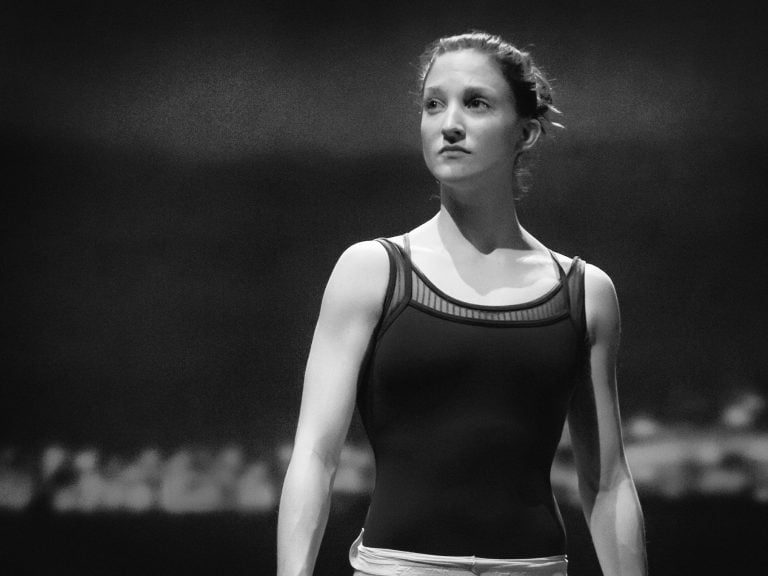
The ballet, and Acosta’s interpretation of it, is incredibly light fare – fish are brandished just as easily as swords as the townspeople mosey and dance about the square. Momoko Hirata’s Kitri was more sweet than feisty, and though her Act 1 variations were danced with ease, with ebullient battements and jumps, she grew stronger throughout the evening. I have never seen a ballerina more at ease doing hops en pointe than she was as Dulcinea in Act 2. She’s an absolute star.


Mathias Dingman was a forceful Basilio, who radiated power and strength as he barreled through the air. He works wonderfully with Hirata, and the pair’s partnership is not only convincing, but dazzling. Their first lift in the first act was so astounding that it shocked the audience into silence.
Joining them was an insouciantly cool Yaoqian Shang as Mercedes, and Max Maslen, whose swaggering Espada seemed as charged as the bulls he fought. Together, the pair matched technical strength with a simmering tension. Rafael Bejarano Vidal’s Gamache was entirely ridiculous, but had a rarely seen presence. Tall and broad, he was a foppish dandy modelled after Louis XIV, with a fantastic cornflower blue wig and matching facial hair. Alfie-Lee Hall’s Sancho Panza was both beleaguered and stalwart, and Jonathan Payn’s Lorenzo was suitably hammy.
As for the Man of La Mancha himself, Rory Mackay gave an incredibly measured performance. More purposeful than crazed, his Don Quixote never veered into caricature, and rather than being the subject of mockery, was met by the other characters with a genuine warmth and affection.

If we are to consider the Garden of the Dryads a dry run for The Kingdom of the Shades in Acosta’s upcoming reworking of Minkus’s other iconic ballet, La Bayadère (retitled The Maiden of Venice), then we can expect very good things; the mere composition when a shimmering curtain of vines raised to reveal the garden was breathtaking. Céline Gittens was a mesmeric presence as the Queen of the Dryads, but her variation was rather stilted, and she seemed to struggle with the Italian fouettés.
Most of the issues lie in the first two acts. Of the changes Acosta has made to this Don Quixote (this is adapted from the production he created for the Royal Ballet in 2013), some are far stronger than others.
Despite also working on Acosta’s 2013 production, Tim Hatley’s production and costume design here feels both a good deal more lived-in and richer. The set’s proscenium arches helped create a sense of scale rarely seen on the Sadler’s Wells stage, and the costumes had beautiful movement and a sumptuous depth of colour – I particularly liked the use of period inauthentic rhinestones.

However, Acosta’s choreographic changes seem a wasted effort. The phantoms that invade Quixote’s study at the start of the ballet feel a bit GCSE Drama, and Amour’s variation, now danced by a male (a very strong and dynamic Tzu-Chao Chou) doesn’t make the best use of the music; the sprightly phrase which historically features a set of forward bourrée en courus, is replaced by a static mime for dance, which felt lacking.
Unfortunately, the biggest issue was with the corps de ballet. Acosta’s choreography is at its best when it makes the most of the sharpness within Minkus’s score, but the corps rarely brought the necessary dynamism to punctuate that.
Most evident in Act One and the gypsy camp of Act 2, there was a real lack of uniformity. Dancers were rarely in time with one another, and there seemed to be no set parameter as to the height of arabesques or the exact positioning of the arms. It looked messy and, unfortunately, undermined what should have been moments of real spectacle. I can appreciate that this was the second of a two-show day, but once noticed, it was increasingly hard to overlook.
The entirety of the third act is dazzling, but that was far more due to the efforts of the principal dancers than it was the corps. Dingman and Hirata’s Wedding Coda was effortless; Hirata’s fan variation was exemplary, her impetuous pause completely earned, and Dingman’s turns in his variations were mesmeric. Their musicality set a standard that sadly went unmet.
Acosta’s production is of an incredible standard and will hopefully serve the company well for years to come. In many respects – its lead dancers, orchestrations by Hans Vercauteren, and production design – it is faultless, and given the calibre of the Birmingham Royal Ballet, I am certain that it can go on to give an impeccable performance. That being said, I am far from disappointed by the performance given. The show is a frothy delight, and when Don Quixote mounted his oak-barrel horse and rode off into the sunset, I was sad to see him go.


Lily Hyde is a cultural and dance writer based in London. Her writing has appeared in The Fence and The Creative Independent, and she runs the cultural newsletter, Falling Upwards. She is currently writing her first novel.