
Royal Ballet and Dance Theatre of Harlem look at Black Dancers in Ballet

Black Dancers in Ballet – Sharing a Rich Trans-Atlantic History
Lydia Wharf attends ‘Black Dancers in Ballet’ with The Royal Ballet, Dance Theatre of Harlem, Jacobs Pillow and the Black British Ballet Project at the Clore Studio, Royal Opera House
Kudos to The Royal Ballet, Dance Theatre of Harlem, Jacobs Pillow and the Black British Ballet Project, for co-presenting this historically significant event, which aimed to explore and showcase the long-standing relationship between Dance Theatre of Harlem and The Royal Ballet. In doing so, it tracked the little-told history of Black British ballet dancers on both sides of the Atlantic, imbuing these narratives with genuine insight – not just in terms of the art form but in hard human truths.
An entertaining blend of live performance, rehearsal snippets and conversation breathed life and learning into this long-standing, trans-Atlantic connection. A tangible sense of the high regard and warmth with which this relationship is held was underlined by the fact that the programme taking place in the Clore Studio was beaming live to Jacob’s Pillow in New York throughout, where an enthusiastic ‘sister’ audience was assembled.


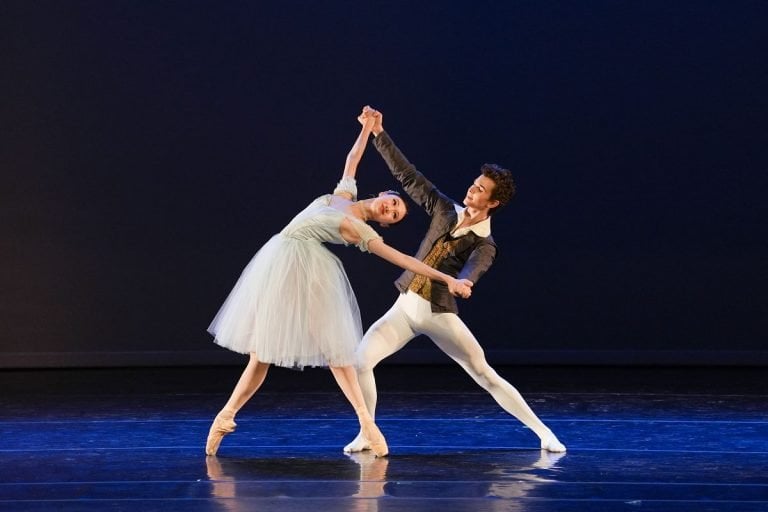
To begin, audiences were treated to a selection of excellent solos performed by DTH guests Kamala Saara and Kouadio Davis, and the RB’s own Joseph Sissens and Marianna Tsembenhoi. These were elegantly delivered throughout, and it was fascinating to consider the nuances of approach that either connected or separated them. Then followed pas des deux in rehearsal, led by the charismatic Artistic Director of DTH Robert Garland, joined by RB Director Kevin O’Hare. Both Directors and dancers clearly enjoyed the exchange, which was peppered with anecdotes, unearthing fond memories.
The central figure and undisputed star of the evening’s show, however, was Arthur Mitchell, Founder and Director of Dance Theatre of Harlem, formerly the first African American to perform with the New York City Ballet and a muse for none other than Balanchine himself. Mitchell is a central, much-celebrated figure in the history of US ballet, his legacy profoundly felt and widely acknowledged. It was a real revelation, however, to learn of his impact here in the UK. Video clips of news broadcasts from the 70s showed Mitchell visiting London, leading ballet classes to keen black dancers, his charisma and passion for the art form making him a persuasive and extremely articulate advocate for a more inclusive, and therefore infinitely richer, art form. However, whilst his presence here undoubtably instigated a critical change in attitude, for the few black ballet dancers training in the British system at the time (Royal Ballet School included), his influence was nothing short of personally transformative. Panel members Julie Felix MBE and Brenda Garratt-Glassman testified with moving candour about how, prevented from accessing training and employment opportunities on home turf, this incredible trailblazer offered an alternative home in Dance Theatre Harlem, where they both thrived professionally and creatively for many years. Garratt-Glassman, told that she was “too brown” for the corps de ballet in England, described the profound experience of walking into “a whole studio full of beautiful black dancers” in the US. Fellow panellist and Artistic Director of the Royal Ballet Kevin O’Hare acknowledged the pain of these ‘difficult’ stories, but stopped short of apologising to Felix for the appalling discrimination she faced whilst a student at the RBS.

Of course, a lack of diversity in UK ballet is still painfully evident, perhaps in part a result of historical whiteness – a total absence of role models is hard to overcome. But as a more diverse company than ever before, the RB is now able to trace personal journeys through its ‘ranks’ – often starting with the ‘Chance to Dance’ programme (launched in 1991), through Associate programmes, the RBS and into the upper echelons of the company. To illustrate this phenomenon, and to highlight the work RB is doing to engage those in ‘community’ settings, a small cast of black ballet dancers who’d arrived at various stages of their journey, had been assembled to talk about it. These included Sissens himself, a soloist with the RB and, recently, an Ambassador for the programme.
Perhaps it’s relevant to note here that, as a former pupil of the school, I had absolutely no idea about the historic connection with DTH, or the impact of brilliant Arthur Mitchell and his work here in the UK, despite poring over images and writing as a student and beyond. And so it’s entirely understandable and frankly delightful that the Royal Ballet is aligning with the work of Dr Sandie Bourne, whose Black British Ballet project aims to document the history and experiences of Black dancers and choreographers in British ballet in the last century. These stories need to be told, perhaps in part to acknowledge the dire experiences of dancers who encountered racism in the UK, but also to warmly remember, celebrate and sustain a relationship that offered a lifeline to them.


Lydia wharf is an independent producer working in contemporary dance theatre, tending to specialise in practices of care, access and inclusion.
She works directly with a range of artists and companies, most recently BirdGang Ltd, Dance Umbrella, Julie Cunningham & Company and Stuart Waters. Lydia has a long, twisty relationship with dance, as performer, writer, advocate and producer.


Hello,
The first photo is Joseph Sissens with Kamala Saara not Marianna Tsembenhoi.
Correction –
joseph sissens is pictured with Kamala Saara of Dance Theatre of Harlem in 1st photo rehearsin “Agon”. Please make sure you get the names correct before publication since there were only 4 dancers. Very unfortunate to write an article and not get details right.
Thank you so much for the correction. I’d just like to point out that no one who contributes to this site is paid, all have full time jobs, and they write or put articles with photos online out of love for the artform. Therefore I think errors can be forgiven because it is surely better to cover and publicise an event such as this than ignore it because the press office didn’t caption the photos. Often there is very little time to proof read and useful corrections such as this help to put those errors right.
I enjoyed the report on this interesting collaboration. Just wanted to point out that the caption for the topmost photo is in error: the ballerina is Kamala Saara of DTH, not Marianna Tsembenhoi.
Thank you so much for pointing this out.