Review: Tanz Luzern’s ‘Hemmige’ – absolutely and universally loved

Graham Watts sees Tanz Luzern’s ‘Hemmige’: “A rousing standing ovation went on for many minutes.”
| Title | Hemmige (Inhibiting) |
| Company | Tanz Luzern |
| Venue | Luzerner Theater, Switzerland |
| Date | 21 June 2024 |
| Reviewer | Graham Watts |
A profound sense of otherness permeates this new production of Hemmige at Tanz Luzern, and it is an ambiguity of identity that approaches the work from many angles, beginning with the work’s creator.
Muhammed Kaltuk is a choreographer who was hitherto unknown to me, as I suspect also to the vast majority of dance afficionados outside of Switzerland. On the singular and powerful evidence of Hemmige, I suggest that he shouldn’t stay a Swiss secret for much longer. Kaltuk’s personal sense of otherness comes from growing up in a life that contrasted Swiss-German schooling with a family home that was fundamentally based on Turkish traditions and culture. At 34, he sees himself as Swiss but doesn’t have a Swiss passport. It is a classic othered persona (reflecting for example similar circumstances in Akram Khan‘s Bangladeshi heritage and British life).
Kaltuk discovered hip-hop at the age of 14 and formed his own company, MEK, in 2017. Hemmige exhibits his rare gift of making dance through a movement language that appears fresh and not in any way recycled. It is contemporary movement that is both tightly structured and dislocated; highly rhythmic with pulses that seem to jerk through the dancers’ bodies, especially effective when – as is often the case – the ensemble move as one. The hip-hop elements flavour the movement rather than overwhelm it. One can appreciate the dancers’ isolation of muscle groups in accents of locking and popping and they all assimilate this largely alien style into their performance with uniform and complete success.

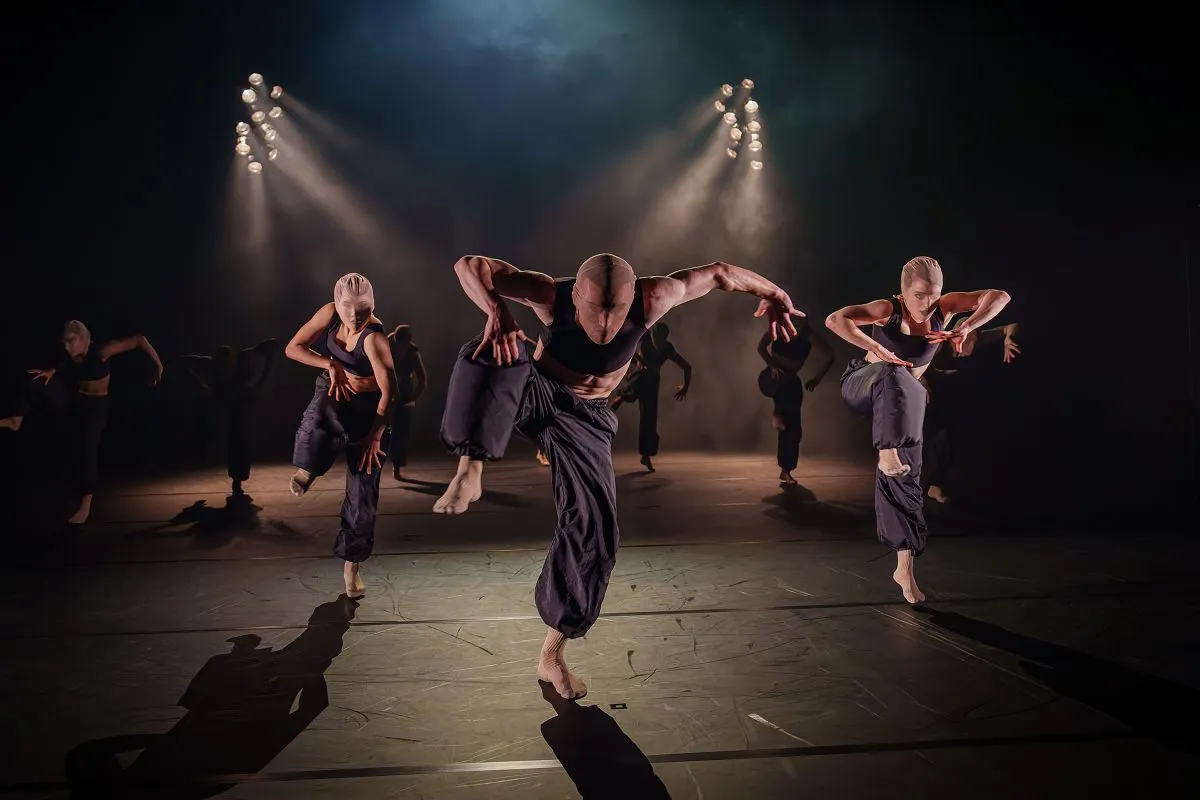
Herein lies another aspect of otherness because Kaltuk’s roots in hip-hop have emerged from the street but here he is presenting theatre and there is a fundamental contradiction between the street battle and the proscenium show. One suspects that in Hemmige, this inconsistency was overcome by the Tanz Luzern artistic director, Wanda Puvogel, acting as Kaltuk’s dramaturge. In any event, there were many aspects of the work that appealed to the notion of a battle: the dancers’ mainly black clothing (short vest tops and baggy tracksuit bottoms, toned midriffs on show), the tightly coordinated group sequences and the fundamental notion of two groups squaring off.
While Hemmige has no detailed story, the general narrative is all about otherness since it concerns a character’s belief that he/she/they are wrongly identified as a member of one group and his/her/their efforts to switch sides. My gender identification is deliberately fluid since Kaltuk insisted that the roles were not gender specific. Over the season of performances in Luzern, several dancers took these lead roles but on this night they were performed by a guest dancer, Emma Spinosi from Brittany who has been a member of Rambert 2 (she is a graduate of the Rambert School) and Ballet Preljocaj, and company dancer Ching Heng Huang, formerly a dancer with Cloud Gate Dance Theater of Taiwan. The eclectic range of skills provided by his Taiwanese training was very much in evidence.
The dance ensemble comprised eleven performers, which with guests and allowing for some injured dancers in the company – including Tanz Luzern’s only hip-hop specialist, Tanaka Roki, and British dancer, Phoebe Jewitt – is virtually the entire company. Another émigré Brit, Matthew Prichard was distinguished in the ensemble not just by his height but also in the rarity of wearing a blue jacket. Another sense of identity failure was provided by some dancers wearing stockings, bank-robber style, over their heads.
The most idiosyncratic otherness came via the music. A bespoke electronic score that pulsed with hi-energy beats was created by Gabriel Mareque, another young Swiss innovator who started out training in dance before crossing over into musical composition. But the quirkiness came from a Swiss-German singer-songwriter-poet who died more than 50 years ago (tragically in a car crash on his way to a concert, aged just 36). Half a century later, Mani Matter is still a household name in the Bernese-German speaking areas of Switzerland. His songs are routinely used to teach primary school children the dialect of those cantons and two of them are embedded and repeated in the music, including the one from which the title is derived (the other is mir hei e verein or my name is club).
Matter’s lasting fame is strictly confined to pop culture in the German-speaking part of Switzerland not just because of the language he composed and sang in but also because they make little sense even in that language. Without understanding any of it myself (my own sense of otherness), it seems that he sung, accompanying himself on the guitar, exclusively in the Bernese dialect, using repetitive rhyming couplets that are often untranslatable. I imagine – from a quick study of the titles – a culture of nonsense songs (one apparently translates as A boob, a jerk, an idiot and a cry-baby) albeit with a socio-political or moral undertone.
They are extremely pleasant, easy-listening material and Matter’s dulcet baritone voice was both an extreme contrast and a subtle enhancement to Mareque’s pulsating score. It’s hard to think of equivalents but I guess that Jacques Brel and – if you are British and of a certain age – Jake Thackray come close to a similar style. I came away humming the melody to Matter’s hemmige hei, a song I had never heard before and is now firmly stuck in my head (and on my Spotify playlist)!


And I guess that the last aspect of otherness was how I felt myself since this is a production that is absolutely rooted in everything Swiss-German, a culture that is far from my own experience. It was absolutely and universally loved by the audience that understood every nuance that I did not, rapturously rewarding the creatives and performers with a rousing standing ovation that went on for many minutes. Even though I could not cross over into understanding the work to anything like the same degree, it was nonetheless a very enjoyable theatrical experience (and I loved discovering Matter’s music as much as Kaltuk’s choreography).
One aside is that the closeness of the association between the company and its audience is an object lesson. Puvogel gives a detailed presentation to the audience before every performance (who needs programme notes!); this show was really a 55-minute, one-act performance but, although it was narratively unnecessary, a 30-minute interval was inserted because the audience likes it that way; and, by the same token, the bar is left open after the show and most of the audience remained to continue showing their appreciation.
Many companies and theatres elsewhere (not least in the UK) could learn from this encouragement of intimacy and mutual support.

Graham Watts is a freelance writer and dance critic. He writes for The Spectator, Tanz, Shinshokan Dance Magazine (Japan), Ballet Magazine (Romania), BachTrack and the Hong Kong International Arts Festival and has previously written for the Sunday Express, Dancing Times, Dance Europe, DanceTabs, London Dance, the Edinburgh International Festival and Pointe magazine (USA). He has also written the biography of Daria Klimentová (The Agony and the Ecstasy) and contributed chapters about the work of Akram Khan to the Oxford Handbook of Contemporary Ballet and on Shobana Jeyasingh for the third edition of Routledge’s Fifty Contemporary Choreographers.
He is Chairman of the Dance Section of The Critics’ Circle and of the UK National Dance Awards and regularly lectures on dance writing and criticism at The Royal Academy of Dance, The Place and (until the war) for Balletristic in Kyiv. He was a nominee for the Dance Writing Award in the 2018 One Dance UK Awards and was appointed OBE in 2008.