The Fonteyn 2024 – the Margot Fonteyn International Ballet Competition “an evening, jam-packed with quality dancing”

Matthew Paluch sees The Margot Fonteyn Ballet Competition: “seeing young people flourish because of their own hard work and dedication will never tire.”
| Title | The Fonteyn 2024 |
| Company | Royal Academy of Dance |
| Venue | His Majesty’s Theatre Haymark |
| Date | 8 September 2024 |
| Reviewer | Matthew Paluch |
The Margot Fonteyn International Ballet Competition returned to London’s His Majesty’s Theatre Haymarket on September 8th. The Fonteyn, formerly known as The Genée, started in 1931 and was renamed in 2019, but the original premise stays the same – to be the Royal Academy of Dance’s flagship annual event ‘dedicated to promoting and rewarding standards of excellence in young ballet dancers internationally’.
The mission statement goes further confirming: ‘this is achieved by offering candidates the unique opportunity to work with world-renowned choreographers and professionals, as well as the chance to perform on an international stage’. Which all sounds ideal in theory.
Elsewhere ballet competitions haven’t been getting the best press of late. Dr Geraldine Morris was looking at the situation back in 2008 asking pressing questions then, perhaps even more relevant today, like can they be considered damaging to the future of ballet? Are they concerned with artistry or mere technique? Christopher Powney, former Director of The Royal Ballet School, released a public statement in 2018 sharing some serious concerns about the ballet competition circuit:
“student training is now so often being fast-tracked for these competitions in a way that I believe can be unhealthy”
“some competitions foster a culture that fails to encourage the development of artists – where technique is emphasised over artistry and students seek to reach extremes before they have mastered the basics”
“we see audiences agog at the elaborate physical tricks on display”
I can’t speak for Powney, but feel confident in saying his concerns were more focused on the USA where students as young as nine were, indeed are, competing en pointe. Morris was definitely more Eurocentric, looking at things through philosophical perspectives, but both arguments still feel extremely relevant.
Only recently there was some dancing at the Prix de Lausanne that beggared belief. And by dancing, I mean extreme physicality devoid of any appropriate style. But that’s another conversation – that often gets heated – for another time.
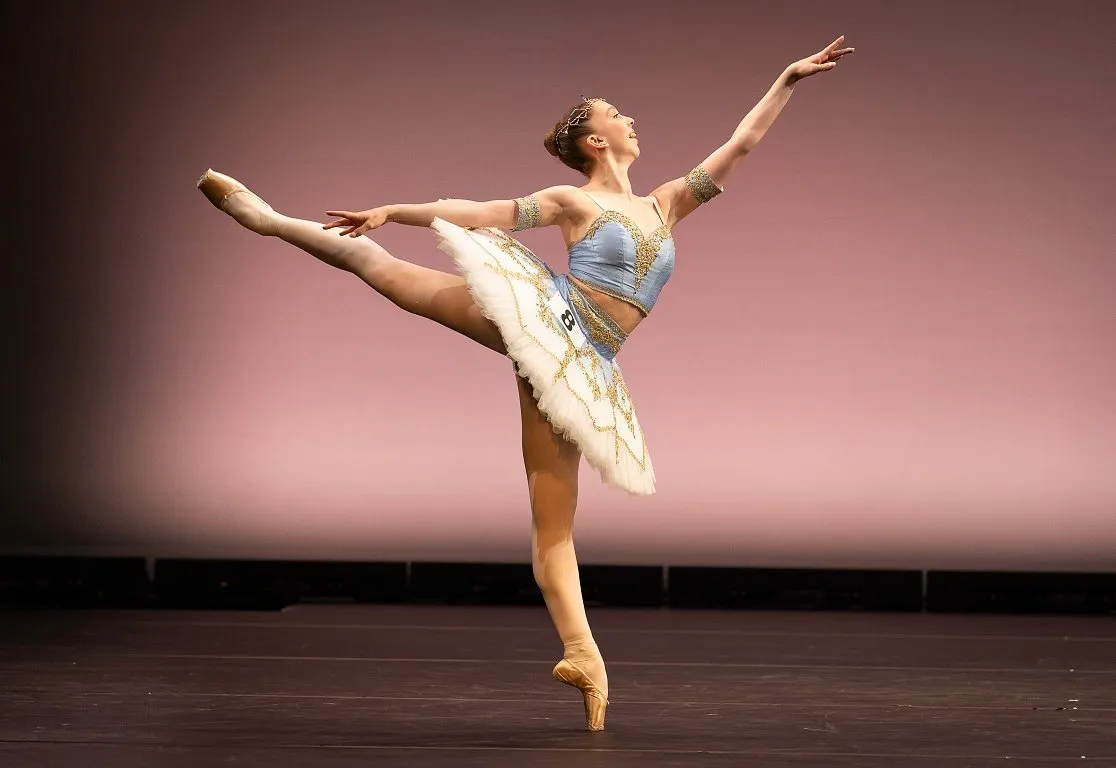
The 63 Fonteyn candidates, from 14 countries, aged 15-19 years by 31 May 2024, and all having successfully passed their RAD Advanced 2 with Distinction (or anticipate that they will by the closing date), started their journey last week at the RAD Headquarters in Battersea. The semi-finals happened over 3 days, and now here we are, at the finals with 12 participants.
No classwork is shown in the final, rather each dancer gets to perform three solos:
Commissioned Variation, choreographed by Andrew McNicol, founding Artistic Director of McNicol Ballet – The RAD has commissioned a choreographer to create two variations for female and male-identifying candidates respectively.
Dancer’s Own Variation – Candidates must prepare a newly choreographed variation no shorter than 1 minute in length and no longer than 1 minute 30 seconds created by themselves, their teacher or a peer to a piece of music of their choice.
Classical Repertoire Variations – Candidates should select and rehearse one variation provided from the list of approved 19th-century and 20th-century Classical Repertoire variations (taken from https://www.thefonteyn.org/ where the list is available).



The candidates were supported during the process by an esteemed faculty:
Alexander Campbell (RAD Artistic Director, and his first Fonteyn in the role)
Isabel McMeekan
Darren Parish
Samira Saidi
Justine Berry
And the judges for 2024 were as follows:
Judges and Faculty Judges
Dame Darcey Bussell DBE
Alessandra Ferri OMRI
José Alves (only judging The Fonteyn semi-finals)
Kevin O’Hare CBE (only judging The Fonteyn finals)
Judges for the Choreographic and Musicality Awards
Dame Monica Mason DBE
Ashley Page OBE
The 2024 finalists were:
Elisha Tan
Age: 16
Nationality: American
English National Ballet School
Lydia Hough
Age: 18
Nationality: British
English National Ballet School
Alfie-Lee Hall
Age: 18
Nationality: British
Elmhurst Ballet School
Matthys de Beer
Age: 17
Nationality: South African
Tanz Akademie Zurich
Samara Greig
Age: 18
Nationality: New Zealander
Rambert School of Ballet and Contemporary Dance
Chelsea Potter
Age: 18
Nationality: Australian
Elmhurst Ballet School
Ernesto Young
Age: 17
Nationality: Australian
Alegria Dance Studios
Nicolas Pereira da Silva
Age: 18
Nationality: British
Royal Conservatoire of Scotland
Christie Anderson
Age: 20
Nationality: British
Art of Motion International Dance Laboratory
Tahlia Szumowski
Age: 17
Nationality: Australian
Queensland College of Dance
Sophia Hudson
Age: 18
Nationality: Australian
Tanya Pearson Academy
Antonia Maria Cramb
Age: 18
Nationality: British
Royal Conservatoire of Scotland
Both of the Commissioned Variations, choreographed by Andrew McNicol, were a big success. McNicol tapped into neoclassical ballet in a useful way, demanding core principles from the dancers but allowing them to colour somewhat outside of the lines. And the time element is key here – as the dancers only have a short while with the choreography one can presume we see them at their most genuine as there’s been little opportunity for mannerisms to set in through over rehearsing.
Some went there, outside the lines, while others couldn’t, which is par for the course, but those that didn’t seemed overly concerned with form as opposed to exploring the possible feeling of the movement. This undoubtedly comes down to teaching emphasis – what their initial, or regular teachers deem most important. For some that’s still clearly the plastique, which is a mistake for me. Yes, we crave high-level execution, but none of it means anything if the dancer isn’t living their work in the moment. That’s dancing I believe.
My only criticism would be blue lighting for men and pinky hues for women. Aren’t we beyond this level of literalism yet? Clearly not everywhere. And this was the case for the duration of the performance. Snooze…
Dancer’s Own Variation is an interesting moment, allowing for individuality and creativity to come to the fore. The range of styles and emphases is very encouraging, as is the importance of music. Whether taking the rhythm or the melodic line as the inspiration, each different offering seemed to use the music as its springboard for the choreography. This is only good news.
The Classical Repertoire Variations segment also faired rather well. This can be the moment that things unravel, as the work is generally telling, but across the board, there was a high level of dancing full of tasteful, communicative performance. I find some of the 19th-century choreography a little 2D in nature, especially after the Commissioned and Dancer’s Own sections, however, overall it was a collection of 12 refined, and alive in nature solos.
The star turn came down to Harris Beattie and Saeka Shirai of Northern Ballet. The pair performed the Balcony pas de deux from Christopher Gable’s Romeo and Juliet. Beattie won the Genée gold medal back in 2017, in fact, he won all three top awards (Choreographic and Audience Choice) on the night, a feat that hasn’t been accomplished before or since.
Disclaimer: I had the joy of teaching Harris for a short period when he was 15, so I’ve known of his talent for a while. That said, it’s wonderful to see the artist he’s become and continues to be. If there’s such a thing as a natural dancer, Harris is one. And with maturity, his dramatic flair is showing more and more gravitas. Shirai is a beautifully delicate, precise dancer, and as the star-crossed lovers they brought emotional and physical passion to the forefront of Gable’s individual reading. And how intelligent to programme something narrative-led within an evening of largely abstract dance.

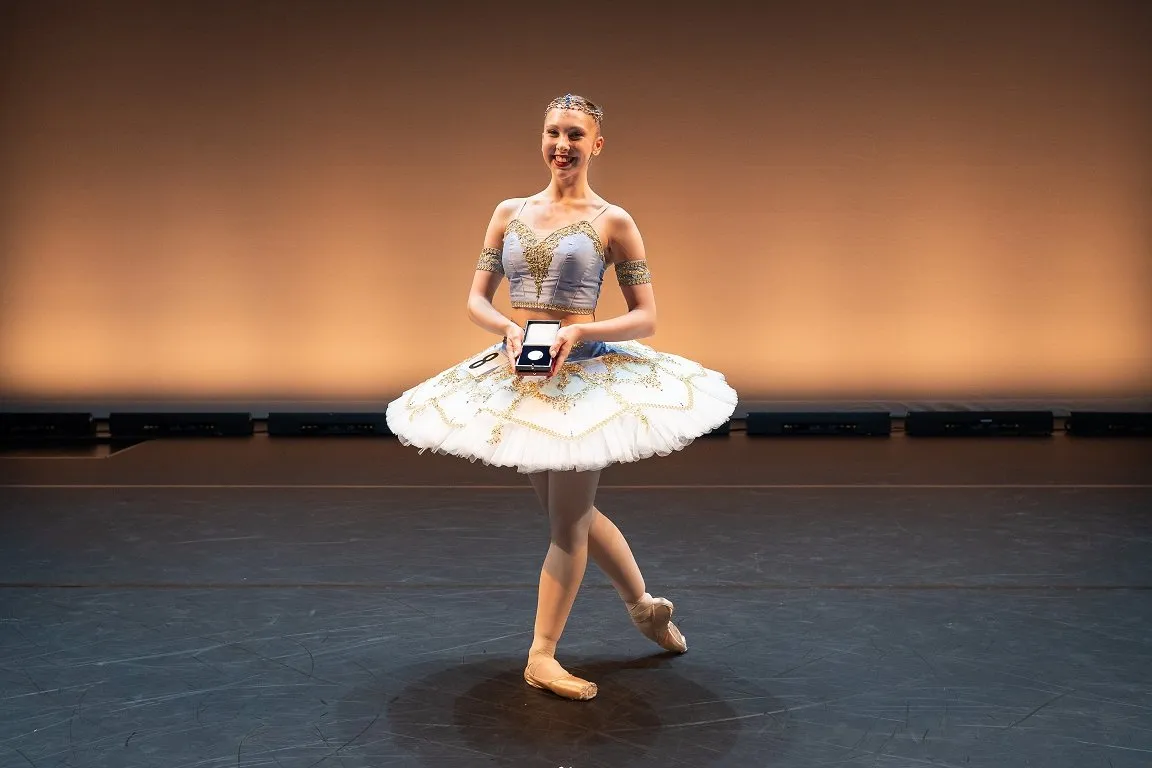

Drum roll please… The 2024 Fonteyn winners are:
The Dancer’s Own Choreographic Award was selected at the semi-finals and went to Ernesto Young.
The newly introduced Musicality Award went to Christie Anderson.
Bronze medal – Ernesto Young and Alfie-Lee Hall
Silver medal & Margot Fonteyn Audience Choice Award – Lydia Hough
Gold medal – Antonia Maria Cramb
With five Brits, four Australians and one representative each from New Zealand, South Africa and America things aren’t feeling as global as they could. Aspects to consider here are travel (of course), the RAD’s current reach, and the standard of students globally, i.e. teaching.
I’ve taught at numerous RAD summer schools over the years and it’s disappointing to see some countries not represented, Japan and Italy in particular where the RAD seems to thrive. I hope the RAD powers-that-be do some research, with the available statistics, for possible causes, and moving forward develop troubleshooting strategies.
It was an enjoyable evening, jam-packed with quality dancing. The current model of The Fonteyn is a winner, allowing for individuals – not show pony clones thank god! – to thrive in an important, world-stage setting. And seeing young people flourish because of their own hard work and dedication will never tire.
I believe that the producer of The Fonteyn, and former Artistic Director of the Royal Academy of Dance, Lynn Wallis is responsible for the introduction of both the Commissioned and Dancer’s Own concepts, so if the Fonteyn is ever renamed, my vote is for ‘The Wallis’… no questions asked.
On a closing note – representation. I’d appreciate it if RAD Executive management would consider who the judges are for the next Fonteyn. No disrespect to this year’s panel, but there was a glaring hole as no one came from RAD lineage. Tim Arthur (RAD CEO) shared a video at the end of the performance commending and recognising the important role of the dance teacher. This reiterates the point – the panel of judges should feature someone from a primarily teaching background and not only ex-professional dancers who also all happened to be in the Royal Ballet companies. Without teachers there are no dancers, so let’s include them at all levels of the art form, even the absolute pinnacle.

Matthew Paluch was awarded a place at The Royal Ballet School in 1990 where he graduated in 1997. His first four years as a professional dancer were spent working with London City Ballet, Scottish Ballet, K-Ballet and English National Ballet, becoming a full-time member of ENB until leaving in 2006.
Matthew graduated from the Royal Academy of Dance, Professional Dancers’ Teaching Diploma in 2007, and was formerly on faculty at The Royal Ballet School. He completed his Masters in Ballet Studies at Roehampton University in 2011, has been a freelance writer since 2010 and currently works in the Law Sector.
He is a member of the Dance Section of The Critics’ Circle.