Review: La Dame aux camélias at La Scala with Martina Arduino and Timofej Andrijashenko

Matthew Paluch sees John Neumeier’s La Dame aux camélias in Milan – Martina Arduino’s Marguerite has no affectation or mannerisms and feels genuine and human.
| Title | La Dame aux camélias |
| Company | La Scala Ballet |
| Venue | Teatro alla Scala |
| Date | 11 October 2024 |
| Reviewer | Matthew Paluch |
I say Milano, you say?
La Scala hopefully. Anyway, that’s where I found myself on Friday night just gone. In the city for the weekend, I realised months back that the ballet was on and reached out to Gramilano of course.
The teatro is currently shrouded due to renovations, which isn’t the biggest loss as the exterior is on the plain, built for purpose side of architecture. Inside is a different matter however. Once beyond the initial Loggia, it’s a warren of a place, all small corridors and doors, and more doors.
When you eventually find the auditorium, well it speaks for itself. Vast verging on barn-like, the six levels of boxes in the classic horseshoe shape seem to go on forever. As people enter and take their seats there’s lots of greetings. It’s clearly a regular crowd, or perhaps this is the Milanese society that basically go to everything.
Endless elegant women arrive, all dressed with understated garishness, and the whole atmosphere works. What doesn’t work so well is the presence of smartphones. Even after the recorded message in both Italian and English at the start of the performance, audience members still do as they wish; taking pictures at the most inappropriate time (there isn’t an appropriate one) and filming so they can show the world where they are via social media. During the three-hour ballet not once did a member of staff chastise an unruly observer… and we wonder why they have no fear in blatantly breaking the rules. This needs dealing with ASAP. As some people actually go to the theatre to watch live performance, not through someone else’s cheap phone. Mamma Mia.
And yes I did say three hours, but fear not, as the seats at La Scala are perhaps the comfiest I’ve ever experienced at a theatre. Disclaimer: I was in a very good seat in the stalls, so I can’t comment on the level 6 experience this time… but I’ve been there before for a Baroque opera – don’t ask.
Currently in season is John Neumeier‘s La Dame aux camélias (1978). It’s been in the repertoire since 2007, acquired for Alessandra Ferri’s first farewell, and continues to be a vehicle of sorts for dancers cast in the main roles. Based on the 1848 novel by Alexandre Dumas, it follows the trials and tribulations of Marguerite Gautier, a courtesan who finds true love (with Armand Duval) but finds the choices she’s made won’t allow for a change of lifestyle. Of course, the underpinning is deeper when considering the roles of women in 19th century Europe, and the whole narrative is also shaped by Marguerite’s ill health – consumption – but you get the picture.
In fact, said picture is one-dimensional to say the least within a balletic framework. And by Act 3 I was totally over it. How many times can the story, or Neumeier, keep taking us to the same place? We get it. And if there’s nothing else to say I wouldn’t… which suggests the need for a serious edit.
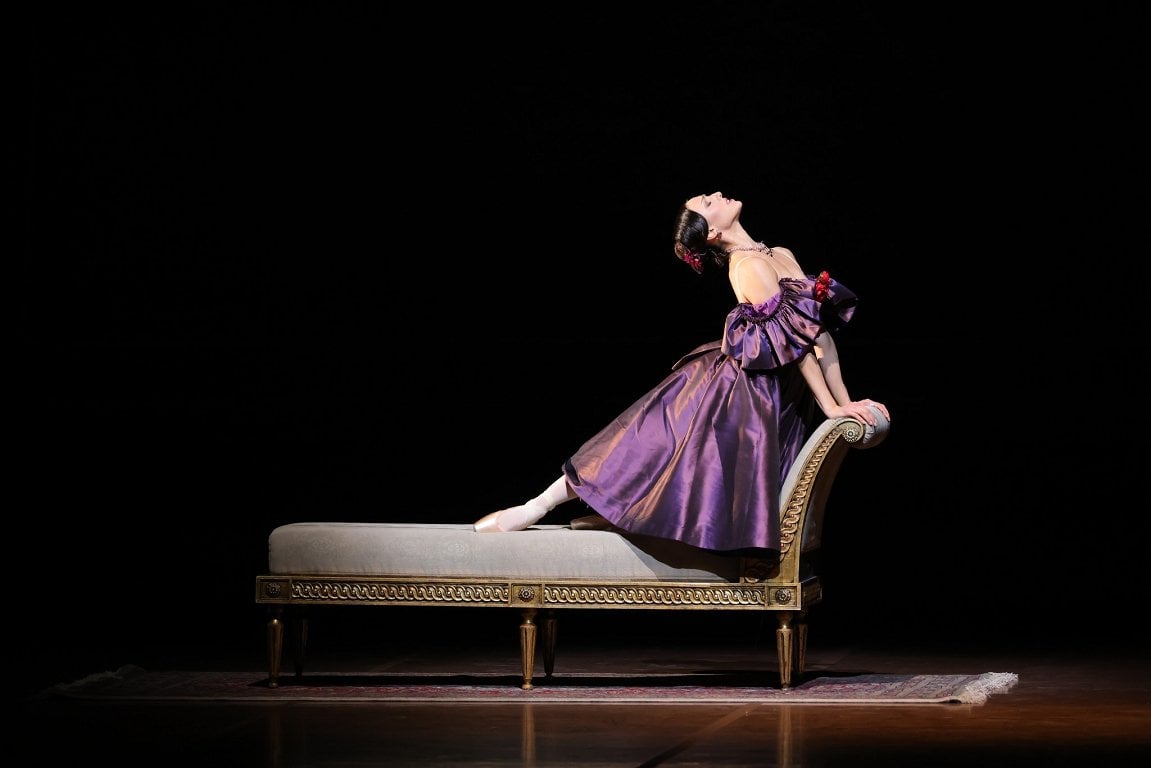


Ashton approached things more concisely in 1963 for Marguerite and Armand created on Margot Fonteyn and Rudolf Nureyev. The ballet is much shorter (forty minutes) and uses an orchestral arrangement of Franz Liszt’s B minor piano sonata and designs by Cecil Beaton to support the intense experience. It’s the go-to of how any long-winded love story should be told – succinctly with high drama.
Neumeier uses Chopin, and I’m afraid to say I couldn’t get another Ashton ballet out of my head as A Month in the Country (1976) uses a lot of the same pieces… and to much better effect IMHO. Based on the Ivan Turgenev play, it also looks at the complexities of love, but gets on with it.
The biggest issue with La Dame aux camélias is that three hours is way too long to focus on only two characters. Neumeier did his best chucking in Manon Lescaut for some extra meat, and numerous empty group dances – ballrooms, hunts etc – but in the end the pointlessness of 90 percent of the ballet highlights what’s actually going on – a lot of very well-dressed nothing.
Perhaps I’m being mean. I appreciate the parallels between Marguerite and Manon, but once would be enough, and there are interesting moments in some group scenes – an arresting Darius Gramada as Gaston Rieux in Act 2 for example. However, generally speaking, it’s self-indulgent verging on boring in totality. With the only contingent not so, Jürgen Rose’s sparse set – basically none – acting as a minimal backdrop elevating character emphasis.

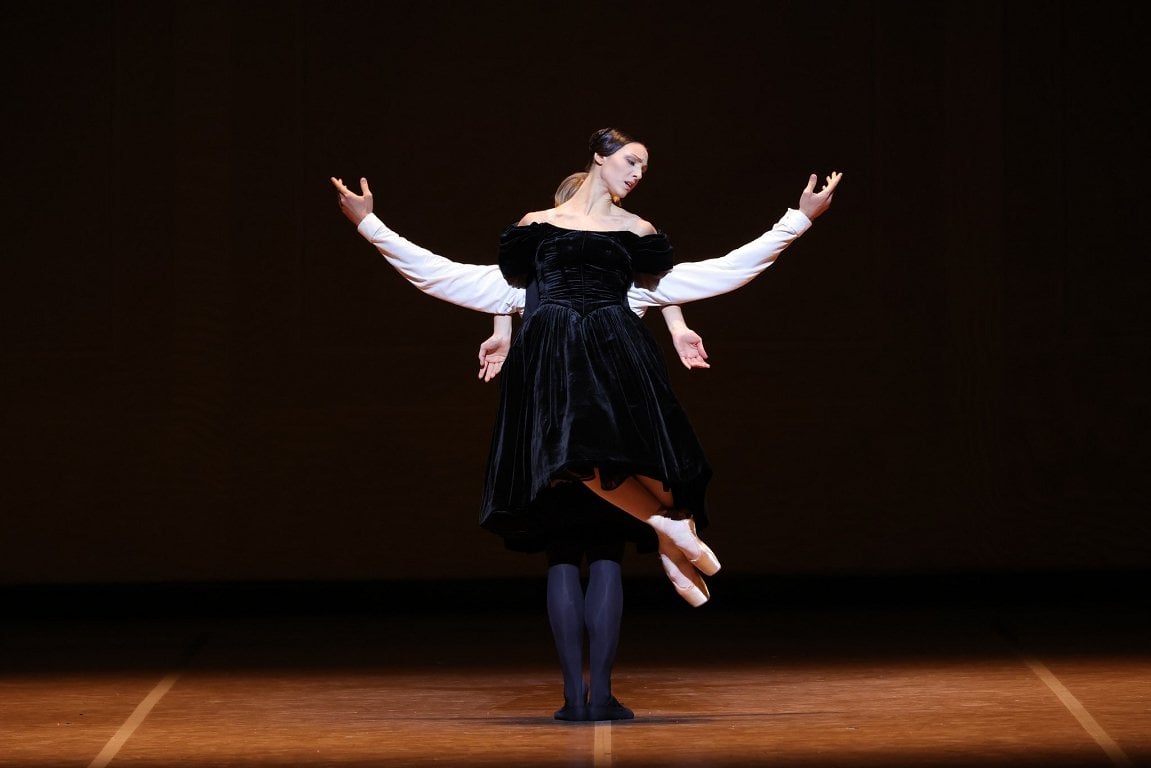
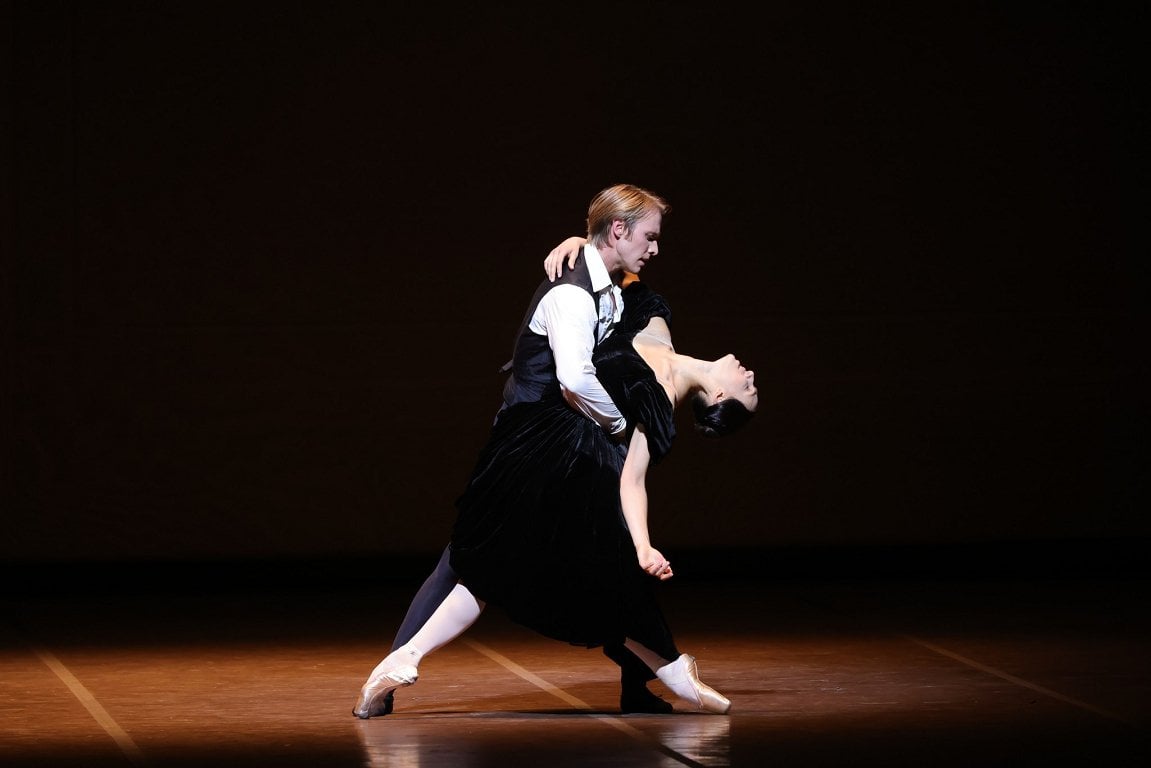
The cast I saw featured a new, young (28) Marguerite. Martina Arduino was doing only her second show of the role, and it didn’t look the case at all. She’s an ideal Marguerite in looks, and has a simplicity in interpretation I really appreciate. This may be because it’s early days, but she currently communicates the role with little to no affectation or mannerisms. Her Marguerite feels genuine and human. I so enjoyed watching her on stage when she wasn’t dancing, seeing the character live within every moment rather than just when she’s doing “something”. This of course is down to Neumeier also, so kudos in relation to the stagecraft of the production, but as discussed, there’s ample time, to say the least, for contextualisation.
Armand was Timofej Andrijashenko (29), who also looks very much the part. His Armand is a mixture of puppy-dog infatuation and immature arrogance which seems just about right. He came into his own in Act 3 (yes I was still awake) as beforehand something felt amiss. Narrative ballets need dramatic physicality – a punch-like finish, pained suspension, yet Andrijashenko wasn’t quite getting there in the beginning. Phrases included the odd hop or flat ending, but as confirmed, he got there in the end.
Whatever the overall experience left me with, no one can deny the value of Neumeier’s pas de deux for the two main protagonists. Act 1 addresses the duplicity of Marguerite’s existence. She keeps trying to offer Armand the Courtesan through froth and nonchalance, but as he only sees the real her, she’s forced to drop the mask. Arduino does this with such ease it ends up being a pas de trois. A very worthwhile scene.
Act 2 sees two key pas de deux for Marguerite. The first with Armand witnesses the two in the initial depths of passionate love. Neumeier shows Marguerite at peace with herself, relaxed even, and this is communicated via lifts where she’s carried horizontally, as if lying down. I saw someone floating on clouds, and quite literally with all of the chiffon and tulle Marguerite is bedecked in thanks to Rose again.
The second duo is with Armand’s father who’s basically telling Marguerite to stay away from his son for his own sake. Lifts still feature but now we see Marguerite as a rigid statue. Shocked into traumatic paralysis by what she’s being asked to do, and what it means for her own emotional wellness.
All three of these pas de deux are super work. It’s just a shame that duration and repetition makes them feel like a distant memory by the end of the evening.
Come Act 3 I’d lost my mojo, so found the main Marguerite and Armand pas de deux a tad trite – it’s fundamentally more of the same with the melodrama turned up. The later confrontation scene is of more interest, but the good stuff is easily lost as Neumeier’s group scenes tend to be on the busy side.
Speaking of the group, there was some good dancing on show. High energy abounded, but I couldn’t really find any of the opposite which felt like an overall imbalance. I also noticed some poor partnering at times. Neumeier’s corps de ballet numbers aren’t easy, but one expects a little more accomplishment than what was often on display. Concerning representation – this is a big subject that I won’t unpick here – but the stage and auditorium at La Scala had very little, to no presence of anything other than whiteness. This is a bizarre reality for someone who lives in London circa 2024, and asks numerous questions in relation to the school and company’s current outreach programmes.
In closing, if you’re looking for an inoffensive, predictable, beautiful night at the ballet look no further. If however you’re looking for more – the search continues. Ad maiora.

Matthew Paluch was awarded a place at The Royal Ballet School in 1990 where he graduated in 1997. His first four years as a professional dancer were spent working with London City Ballet, Scottish Ballet, K-Ballet and English National Ballet, becoming a full-time member of ENB until leaving in 2006.
Matthew graduated from the Royal Academy of Dance, Professional Dancers’ Teaching Diploma in 2007, and was formerly on faculty at The Royal Ballet School. He completed his Masters in Ballet Studies at Roehampton University in 2011, has been a freelance writer since 2010 and currently works in the Law Sector.
He is a member of the Dance Section of The Critics’ Circle.