Review: National Dance Company Wales in Frontiers – ‘Skinners’ and ‘August’

Graham Watts sees a double bill from National Dance Company Wales, “a company true to its values of routinely presenting new and interesting contemporary dance”.
| Title | Frontiers: Skinners | August |
| Company | National Dance Company Wales |
| Venue | The Place, London |
| Date | 8 October 2024 |
| Reviewer | Graham Watts |
Frontiers appears to be a term in vogue to describe dance programmes, since these Welsh Frontiers, followed hot on the heels of an eponymous programme at Sadler’s Wells by the National Ballet of Canada, less than a week previously. Any similarity between the two shows begins and ends with that title.
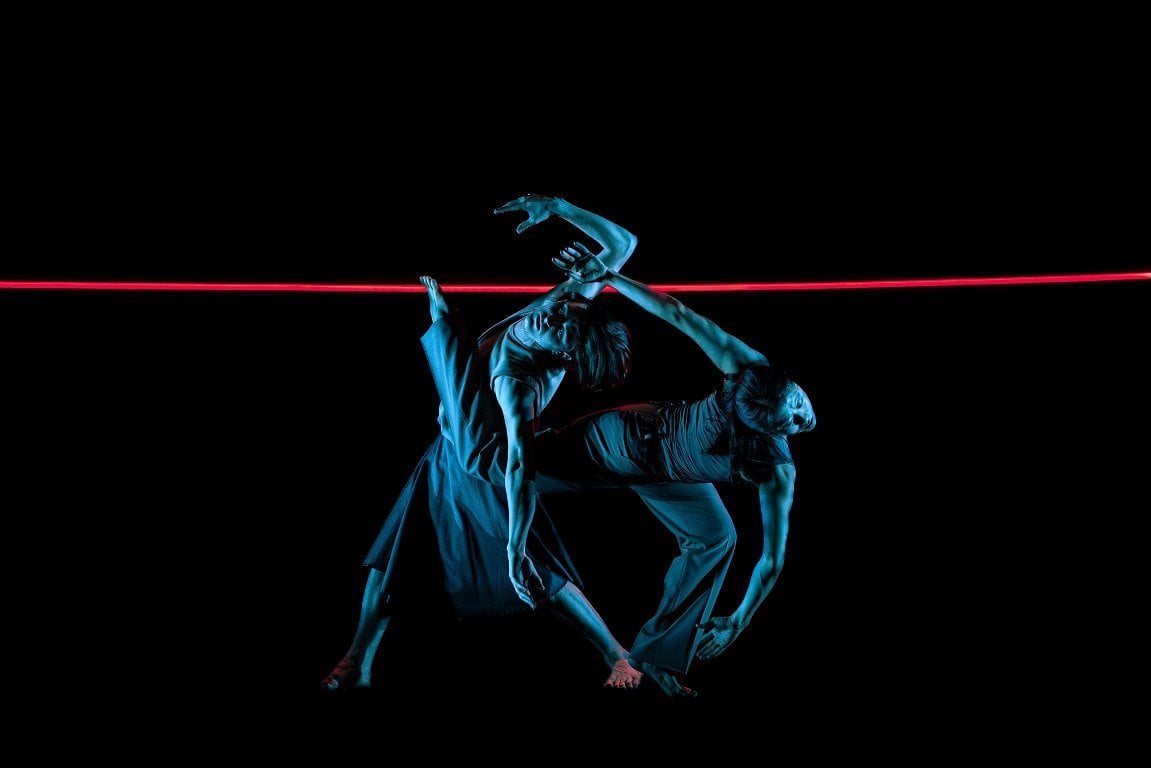
The two pieces that comprised the Frontiers of National Dance Company Wales were each led creatively by a simple design concept. In Skinners, choreographed by Melanie Lane, it was an unusual, if not unique, costume design, initially comprising gauze facemasks and full kaftans that resembled large sheets -– not unlike the suits that freefall skydivers use – with body-sized facsimiles of costumes imprinted against the human form; while in Matthew William Robinson’s August, the costumes (designed by George Hampton Wale) seemed no more than everyday casual wear, and it was a lighting bar stretched above head height across the stage that was the principal design element. The fluorescent tubes changed, both in colour (although predominantly orange), and intensity, ranging from a solid bright line to individual elements traversing the bar, sometimes like a Pacman gobbling up the blackness on a journey of illumination; and at others, like a pulsing arrow shooting through the dark space. The dancers appeared mesmerised by the light, almost as if a primeval tribe worshipping the sun.
Apart from this design distinction, the two pieces – each of around a half-hour duration – shared a similar quality of rawness in the dancers’ movement. Some of the running in transition and preparing to come together in group synchronicity seemed a tad uncertain, as if it had not been rehearsed sufficiently in that space. Set against this, there was a deliberate rough edge to the physicality of the choreography in both works.
Lane is an Australian/Javanese choreographer and performer and although her work has been seen in Europe (mostly in Germany) it is, I believe, new to the UK. The opening sequence of dancers marching in formation – in those peculiar sheet-based uniforms – appeared almost as a caricature of the worst form of macho Britishness: the swagger of a gang of right “geezers” returning from the pub or approaching the football stadium. Although the programme note about her piece gives very little away, it references the blurring of reality and avatars in a digital age, teetering on the precipice of a future that is both thrilling and terrifying and questioning how to return to a human environment from technology-driven fantasy. It’s by no means the first work to take such inspiration and it surely won’t be the last. All this explains the outlandish costumes – representing the AI avatar – which are eventually shed to reveal the dancers’ humanness in a variety of dancewear (one dancer wore a neck to ankle leotard with long oval cut-outs at the thigh and the men were largely topless).
The distinction of the costuming across the two sections of Lane’s work appeared literal to her theme. In the “avatar” costumes, the dancers often performed movements that seemed mechanically drilled into them, whereas once they shed the costumes, (as if peeling away those fictional skins to rejoin the physical world), their movement became much more sinuous and angular. Skinners displays an integration of several creative talents, not least in Don Aretino’s arresting costume design and Lane’s extensive movement language. Yamila Rios’s distinctive music blends acoustic sounds – voice and cello were evident – against an electronic background.


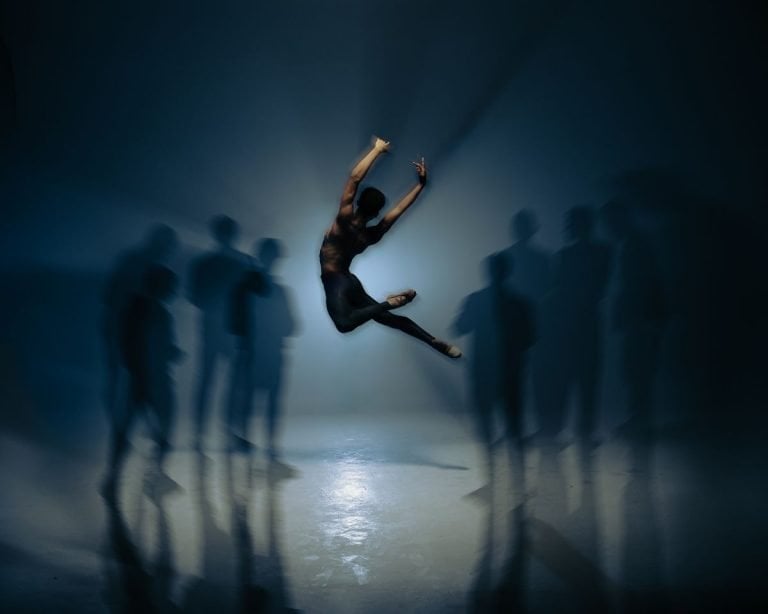
Matthew William Robinson is now the departing artistic director of NDCWales since he will leave to take up artistic leadership of ZfinMalta, in January 2025. The Welsh company is due to announce his successor anytime soon. It’s one of the best jobs in British contemporary dance and so hopefully the company was inundated with excellence in applications. Robinson has developed his own movement style, which to this unfamiliar eye seems to involve a lot of torsion; the dancers routinely twist their bodies on the floor, standing and in the air.
Without external help, it is hard to discern a particular theme in August but the choreographer himself has talked of it as coming ‘from a really personal place’ as a non-biographical reflection following the death of his father. With that explanation, the reason for the work’s underlying poignancy becomes clear. Robinson has collaborated with his composer, Torben Sylvest, on past projects and the music and movement was developed in tandem. Sylvest has plenty of platinum-standard form in dance (Ivan Blackstock’s TRAPLORD, Botis Seva’s BLKDOG and Inside the Blind Iris being just a few past works). That experience shows in an eclectic and pulsating score, which sounded, in turns, both lyrical and like listening to an excited heartbeat while suffering extreme tinnitus.
I was disappointed that The Place’s small auditorium was nothing like full for this annual excursion to London. There’s a lot going on, but they deserved better. Here is a company true to its values of routinely presenting new and interesting contemporary dance and I hope this policy continues under the next artistic director, whoever that may be.



Graham Watts is a freelance writer and dance critic. He writes for The Spectator, Tanz, Shinshokan Dance Magazine (Japan), Ballet Magazine (Romania), BachTrack and the Hong Kong International Arts Festival and has previously written for the Sunday Express, Dancing Times, Dance Europe, DanceTabs, London Dance, the Edinburgh International Festival and Pointe magazine (USA). He has also written the biography of Daria Klimentová (The Agony and the Ecstasy) and contributed chapters about the work of Akram Khan to the Oxford Handbook of Contemporary Ballet and on Shobana Jeyasingh for the third edition of Routledge’s Fifty Contemporary Choreographers.
He is Chairman of the Dance Section of The Critics’ Circle and of the UK National Dance Awards and regularly lectures on dance writing and criticism at The Royal Academy of Dance, The Place and (until the war) for Balletristic in Kyiv. He was a nominee for the Dance Writing Award in the 2018 One Dance UK Awards and was appointed OBE in 2008.