Review: Gandini Juggling’s Heka – synchronised juggling was mesmerising
Graham Watts sees Heka by Gandini Juggling – Can you combine magic and juggling? Juggling always had the upper hand.
| Title | Heka |
| Company | Gandini Juggling |
| Venue | The Place, London |
| Date | 31 January 2025 |
| Reviewer | Graham Watts |
Who is Sean Gandini? What is magic? Were there really mirrors behind the flash curtains? Is the sign language interpreter actually interpreting or simply making gestures? How do you combine an art (juggling), which has to be seen with another (magic), the mechanics of which have to be unseen to enjoy the illusion?
This latest show from Gandini Juggling asks many such questions in a work that is as much philosophical as it is about show business. As further emphasis the first man to declare himself to be Gandini (and – actually – is Gandini) quoted a mantra of illusion from Jean-Eugène Robert-Houdin, the impressive double double-barrelled name of a nineteenth-century Frenchman, popularly described as the father of modern conjuring, which translates as “say what you don’t do; do what you don’t say”, which seems an apt description of the process of conjuring.
Heka [the Egyptian goddess of magic] is a homecoming of sorts because the company’s early performances (as Gandini Juggling Project) included a stint at Resolution, The Place’s annual festival of new choreography, and in a programming sleight of hand, this brief run of Heka – 30 years’ later – fitted neatly into the week-long gap of the 2025 Resolution programme.
In over 30 projects – some in collaboration with others – since its formation, this unique company has used the art of juggling to sit alongside and enliven many other art and musical forms: in dance Gandini has worked with Bharatanatyam, ballet and even a production (Smashed) that was inspired by the work of Pina Bausch. The decision to make a work combining juggling and magic came about from a throwaway comment in a conversation with Gandini that suggested it couldn’t be done!

You can see why that challenge was made because juggling is all about showing and seeing the skill – and these seven performers are all outstanding jugglers – whereas magic is the exact opposite insofar as the skill lies in what the audience doesn’t see. Adding to the philosophy of misdirection, upon which illusion is enabled, Gandini – a tall man with a mop of curly hair, wearing either a red or a white suit – regularly comes to the front of stage to throw out philosophical challenges to the audience. He is comfortable in a self-effacing, sardonic style of delivering vocal text (a mix of description, historical context and anecdotal tales) that is both amusing and sometimes challenging. From time-to-time other performers pretend to be him, including Tedros Girmaye in a costume-changing finale.
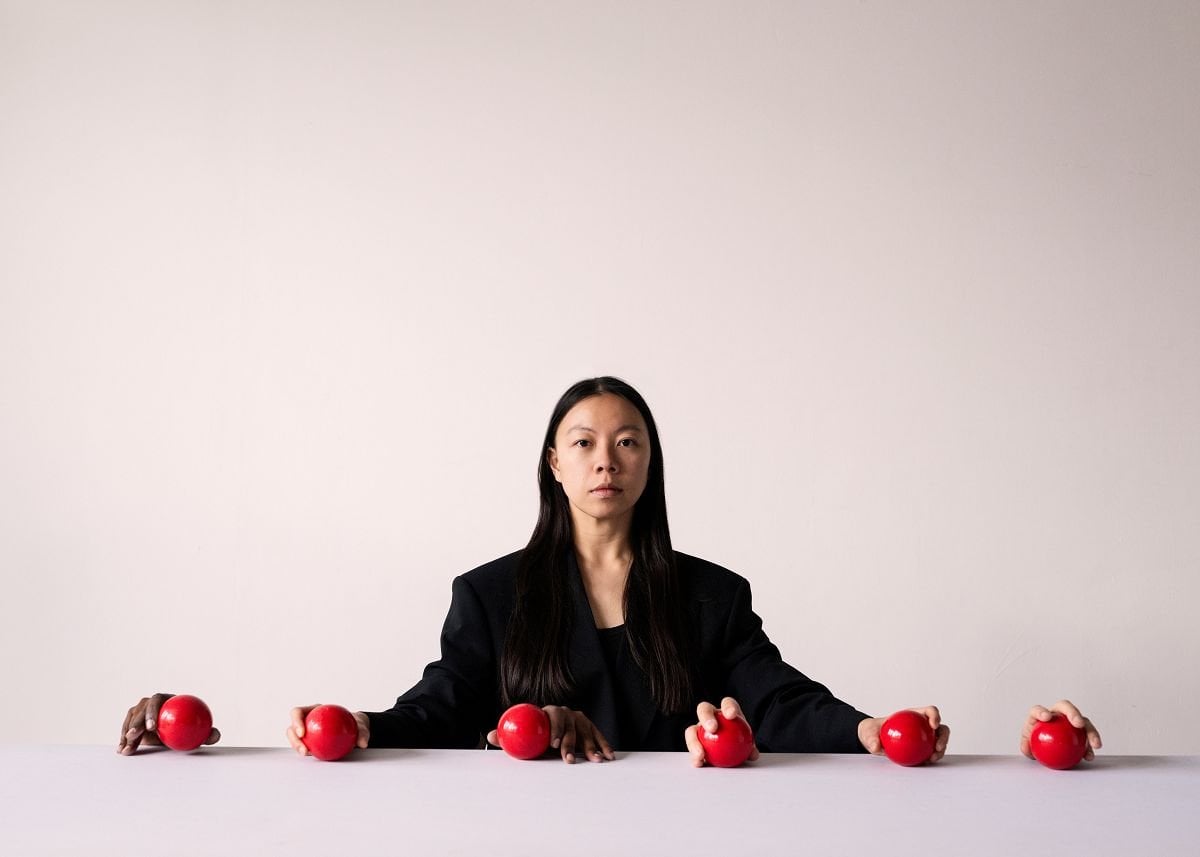
I kept reminding myself that these performers are skilled jugglers and not magicians, the latter skills were fast-tracked in a hot house learning environment and, given that background, the magic was impressive if low-level. They didn’t make an elephant or a car disappear, but hands, arms and legs were suddenly (and regularly) disembodied, starting in the opening scene where performers sat at a table with their limbs apparently moving away from the host body; and balls and hoops thrown into the air changed colour or (in the case of the balls) apparently disappeared into mouths or inexplicably multiplied.
The process of making magic was also to some extent deconstructed because the mechanics of almost every trick were, in some way, evident. In an amusing postscript during the audience Q&A, a member of the Magic Circle talked about the essential requirement of secrecy, to which Gandini’s comic myth-busting reply was “we all knew other people were under the table”! Similarly, hoops that were mysteriously free-floating in the ether were obviously held on invisible wires and the process of manipulating the hoops around the wires was rather more laboriously undertaken by a juggler than one would expect from a…. well, Member of the Magic Circle!
Part of the illusion came in the performers’ general dark clothing and Guy Hoare’s often very dim lighting. Splashes of colour (predominantly red) enlivened the movement and there was an undoubted cabaret feel, helped by those garish, reflective curtains.
In addition to one-time street performer Gandini (the real one, that is) in his comedy ringmaster/MC role, the ensemble included the other company founder, Kati Ylä-Hokkala (who Gandini alleged has not spoken for a year), Kate Boschetti (who opened the show as the person losing her arms at the table), the aforementioned Girmaye (whose smile was infectious), Doreen Grossman (who Gandini introduced as coming from Eastern Germany), Jose Triguero and Yu-Hsien Wu. They were all engaging performers and superb jugglers (in all the hundreds – thousands? – of balls and hoops going from hand to hand I counted just two that hit the floor). The ensemble, synchronised juggling was mesmerising in its unified tempo.
Can you combine magic and juggling? Well, clearly Gandini has risen excellently to that throwaway challenge but, unsurprisingly, juggling always had the upper hand.

Graham Watts is a freelance writer and dance critic. He writes for The Spectator, Tanz, Shinshokan Dance Magazine (Japan), Ballet Magazine (Romania), BachTrack and the Hong Kong International Arts Festival and has previously written for the Sunday Express, Dancing Times, Dance Europe, DanceTabs, London Dance, the Edinburgh International Festival and Pointe magazine (USA). He has also written the biography of Daria Klimentová (The Agony and the Ecstasy) and contributed chapters about the work of Akram Khan to the Oxford Handbook of Contemporary Ballet and on Shobana Jeyasingh for the third edition of Routledge’s Fifty Contemporary Choreographers.
He is Chairman of the Dance Section of The Critics’ Circle and of the UK National Dance Awards and regularly lectures on dance writing and criticism at The Royal Academy of Dance, The Place and (until the war) for Balletristic in Kyiv. He was a nominee for the Dance Writing Award in the 2018 One Dance UK Awards and was appointed OBE in 2008.