
Review: International Draft Works 2025 at the Royal Opera House
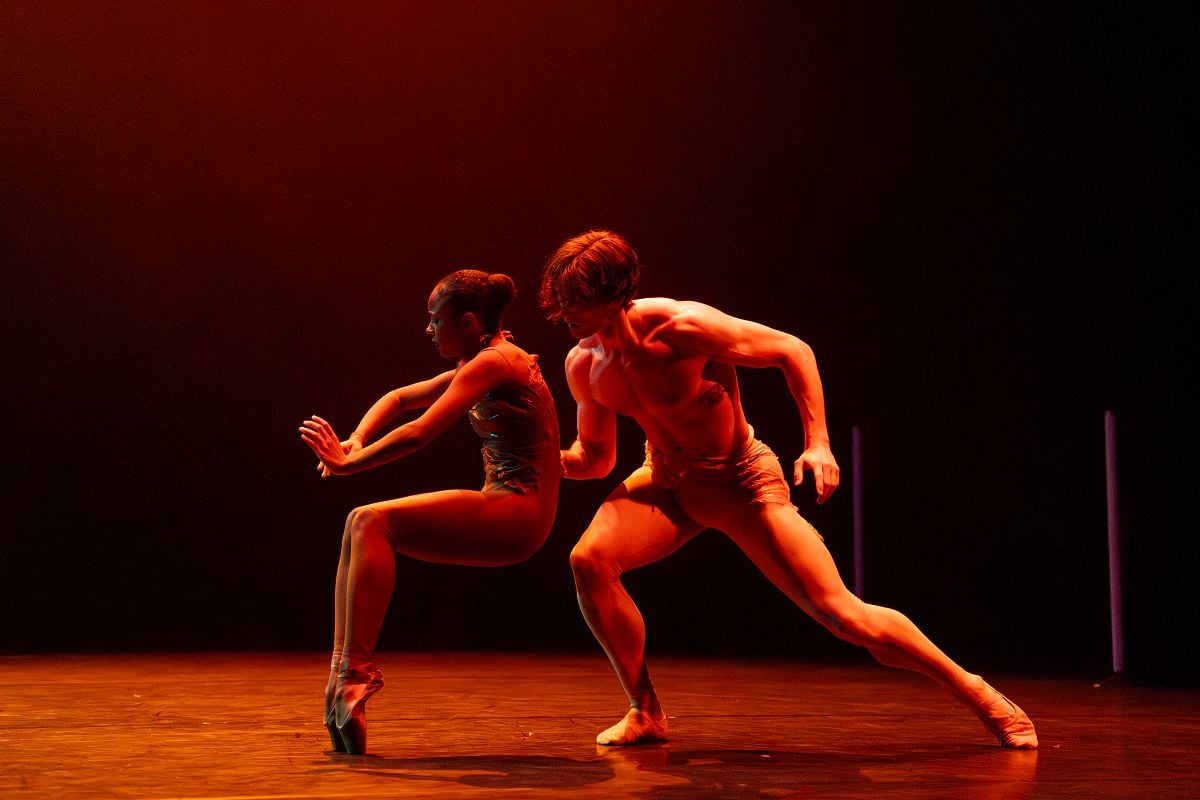
Graham Watts sees this season’s International Draft Works hosted by the Royal Ballet and Opera, an evening that was “both random and refreshing”.
| Title | International Draft Works |
| Company | Various |
| Venue | Linbury Theatre, Royal Opera House |
| Date | 9 April 2025 |
| Reviewer | Graham Watts |
This year’s platform for emerging choreographic talent, traditionally hosted by The Royal Ballet and curated by its creative producer, Emma Southworth, brought together work by two homegrown talents, two more from the UK and four from overseas. The resultant composite of eight short ballets, developed in isolation from one another, was both random and refreshing.
In keeping with the overall ethos of the platform, fusions and collaborations were the dominant concept, beginning with Burden, an explosive mix of hip-hop and ballet by Lars de Vos of Dutch National Ballet, created as a collaboration between the Dutch junior company and ISH Dance Collective. Following a slow start of synchronised undulating shoulders, Herrold Anakotta and Soshi Suzuki set a high standard for the works to follow with impressive acrobatic power moves and locking, suggesting imagery of timelapse photography and rewinding.
Northern Ballet came next with Sky Above, Voices Within by George Liang, another male duet danced by company member Kevin Poeung and Ruben Reuter, an English actor with Down syndrome, who in addition to being a Channel 4 news reporter has previously danced with Northern Ballet in Romeo & Juliet. Lit from the side, the pair’s synchronisation, especially in complex “armography”, was excellent. It doesn’t appear that Reuter has ever had pre-professional vocational dance training, in which case his performance was even more impressive. The performance ended when Poeung put his arm around his partner’s shoulder as they walked offstage. It was a gesture of mutual support and congratulations which we all shared.

Stuttgart Ballet followed with Heartquake, easily the most classical piece in the programme, choreographed by Emanuele Babici. His work opened with two women – Yana Peneva and Abigail Willson-Heisel – dressed in Romantic costumes, subsequently joined by a man (Serhii Zharikov), very similar in dress and demeanour to the lone male figure in Les Sylphides. Danced to a trio of Rachmaninoff’s Etudes, the work is a riff on the eternal triangle with one of the women becoming the man’s favourite while the second disgruntled dancer tried to intervene. Although it made a refreshing relief in a largely contemporary programme, it also bordered on twee at times.
The Royal Ballet’s Ashley Dean took the audience into the interval with In Absence, which was the largest work in scale, comprising six dancers, beginning with a duet before branching out into a separate quartet. Dean has an eye for spacing and structure, although more clarity in the lighting would have been preferred, and the overall impact of the choreography was less memorable than other works.

The opening of the second half was the piece that had travelled the farthest: Mpho by Tumelo Lekana for Joburg Ballet. The title means ‘gift’ and the work performed by a trio of women dancers in pointe shoes and a multi-tasking musician (Peter Mpho Mothiba) who also composed the music. I’m sure that his second forename is a coincidence but his music, delivered on a wide range of instruments, including swirling what looked like a washing machine hosepipe around his head, was certainly an important gift to the work. It mimicked many ambient sounds from the African bush, including birdsong, against the occasional recorded noise of thunder. The pointe shoes seemed a tad incongruous against the traditional African costuming.
Kit Holder is from Birmingham Royal Ballet but his dancers in Capriccio, another male duet, are from Acosta Danza, illustrating the close ties between the two companies. Alexander Arias and Paul Brando began the work with their heads conjoined in the twisted fabric of a large sheet. For a while I felt that the entire work would be danced with that extreme limitation, but the material was removed and their very athletic, very Cuban duet continued unhindered. It was an exhilarating piece that I can see gracing many a gala in future.
I had the privilege of seeing a rehearsal of Pages by Cina Espejord of Norwegian National Ballet in Oslo, a few days prior to this performance, which is an unfair advantage over other works. Espejord has presented the history of a relationship in six brief sections, like chapters in a book (that imagery further enhanced by the sound of pages turning to introduce each section). The “chapters” are separated by brief periods of darkness. Espejord’s choreography is dominated by partnering and passionate lifts (she made the work while Norwegian National Ballet were preparing Kenneth MacMillan’s Manon, and the influence of that style seemed clear). Hats off to Nora Augustinius for singing to close the work, after several minutes of energetic dance without time to recover her breath. It was a brave effort, and I get the idea of it signposting the end of the relationship, but it was a difficult ask. Josh Nagaoka, a Royal Ballet School alumnus, was an excellent partner and the pair danced with an arresting passion.

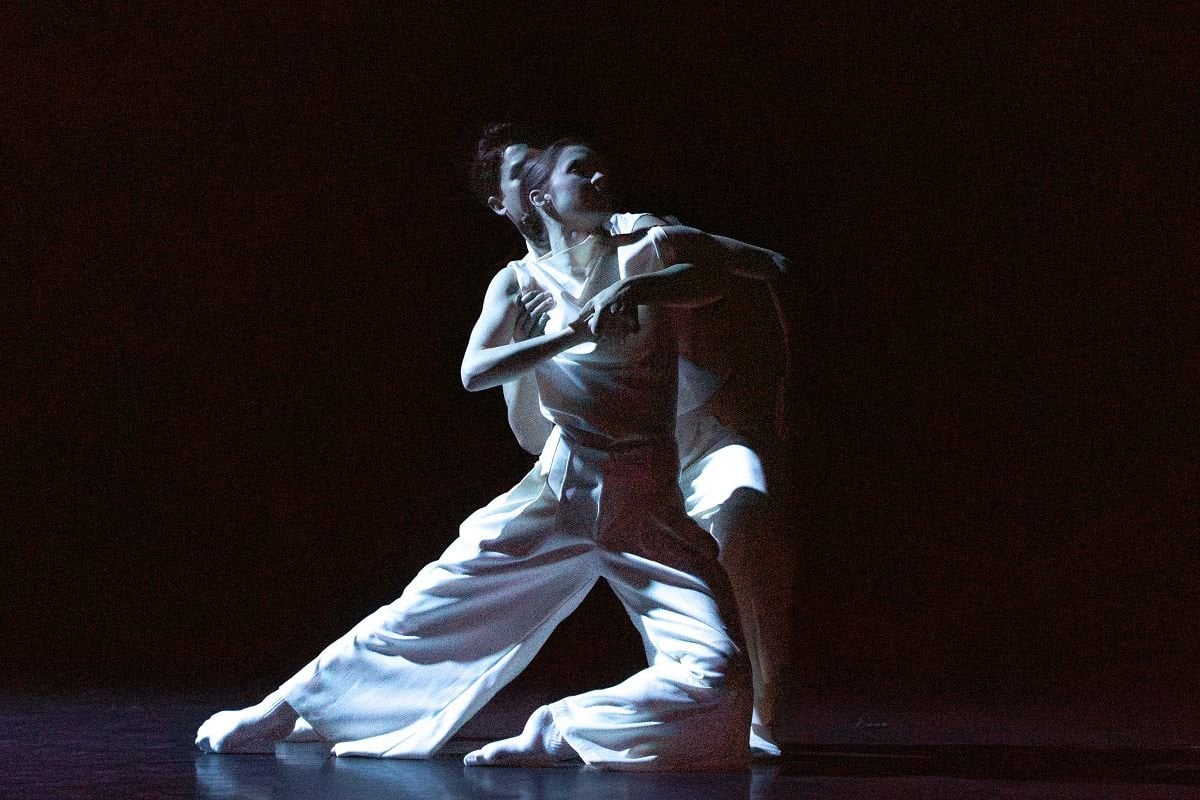
The programme closed with Marcelino Sambé‘s Almost Human, a piece that took as its theme the time before Lilith was exiled from Eden, prior to Eve’s creation. The work has a vintage feel: it would not have surprised me to have been told that it was an experimental chamber piece made in the 1950s. Unsurprisingly, an apple featured prominently and the costumes, whilst still sufficiently modest, were also appropriate to the ideal of Eden. Lukas B. Brændsrød was an imposing presence as Adam, ably supported by Rebecca Myles Stewart (Eve) and Viola Pantuso (Lilith). It was a complex work and difficult to unravel in a single viewing but also certainly worth revisiting.
The evening was a rich mix of different styles although I can’t attest to having seen much genuine innovation. I imagine that each piece was produced on a shoestring, sandwiched between the time commitments of the choreographers and dancers within their own companies, and with those limitations in mind, I think there were several ideas that are worthy of further development.
International Draft Works – image gallery by Andrej Uspenski




Graham Watts is a freelance writer and dance critic. He writes for The Spectator, Tanz, Shinshokan Dance Magazine (Japan), Ballet Magazine (Romania), BachTrack and the Hong Kong International Arts Festival and has previously written for the Sunday Express, Dancing Times, Dance Europe, DanceTabs, London Dance, the Edinburgh International Festival and Pointe magazine (USA). He has also written the biography of Daria Klimentová (The Agony and the Ecstasy) and contributed chapters about the work of Akram Khan to the Oxford Handbook of Contemporary Ballet and on Shobana Jeyasingh for the third edition of Routledge’s Fifty Contemporary Choreographers.
He is Chairman of the Dance Section of The Critics’ Circle and of the UK National Dance Awards and regularly lectures on dance writing and criticism at The Royal Academy of Dance, The Place and (until the war) for Balletristic in Kyiv. He was a nominee for the Dance Writing Award in the 2018 One Dance UK Awards and was appointed OBE in 2008.


Emanuele Babici is a male choreographer.
Thank you for the observation. We have corrected the text.