Review: Carmen.maquia with Ballet Hispánico – exciting performance by impressive dancers
Graham Watts sees Carmen.maquia with Ballet Hispánico on tour, though not all its dancers were given visas to enter the UK.
| Title | Carmen.maquia |
| Company | Ballet Hispánico |
| Venue | Curve Theatre, Leicester |
| Date | 16 May 2025 |
| Reviewer | Graham Watts |
It’s both an oddity and a considerable achievement that the only UK performances of New York’s celebrated Ballet Hispánico have taken place in Leicester, as part of Let’s Dance International Frontiers (LDIF), a vibrant celebration of dance from the African, Caribbean and Latin American Diaspora now in its fifteenth year. LDIF is presented by the Serendipity Institute for Black Arts and Heritage, led with great energy and enthusiasm by Pawlet Brookes MBE.
Both Serendipity and its LDIF product deserve many accolades, one of which must be the unique presentation of Eduardo Vilaro’s extraordinary company to a UK audience. Launched by the late Tina Ramirez in 1970, it is a formidable cultural institution in the USA, and it seems fitting that its introduction to a UK audience should come via another cultural innovator in Serendipity and LDIF. This is Ballet Hispánico’s second headlining season in Leicester, following it’s Covid-delayed fiftieth anniversary celebration as part of LDIF 2022.
My personal connection with Ballet Hispánico began during the pandemic when the company compensated for the lack of live performances by going online with some excellent offerings: their “watch parties” included a remarkable Noche Unidos (United Night), which featured repertoire excerpts plus the unforgettable premiere of a new song by Gloria Estefan, performed live from her beachfront home, and a highly personal contribution from Rita Moreno, indelibly engraved as a film musical great for her roles as Zelda in Singin’ in the Rain and Anita in West Side Story. Amongst works by Annabelle Lopez Ochoa and Carlos Pons Guerra, I recall a double bill of Club Havana (by Pedro Ruiz) and Gustavo Ramírez Sansano’s unusual interpretation of Carmen.maquia, which had been filmed in September 2015 (a year after its Ballet Hispánico premiere).
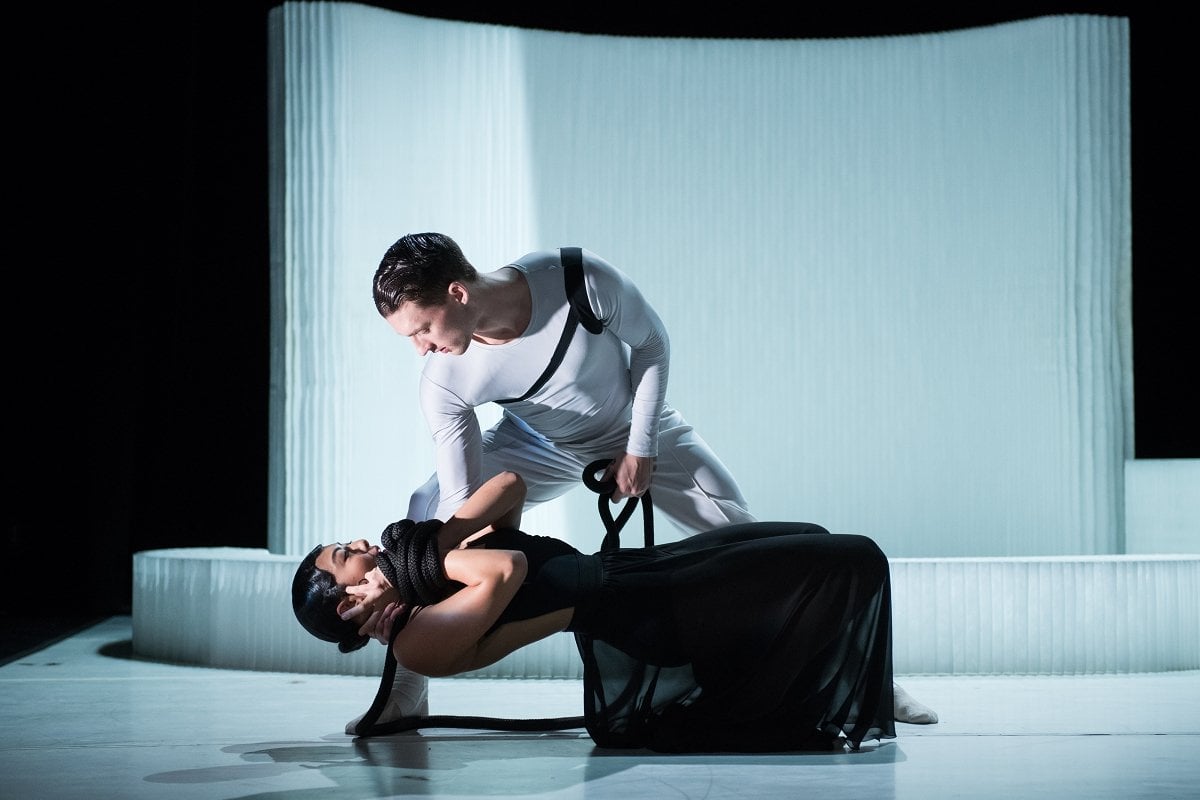
It was, therefore, a pleasure to have the opportunity of seeing Sansano’s innovative interpretation in live performance. The narrative journey is familiar although the modern setting is far from traditional. The artistic concept behind Luis Crespo’s set design is to build upon Picasso’s love of both Carmen and the bullring by essentially providing a blank, pure white canvas for the action to appear like brushstrokes. I was not a fan of the flimsy corrugated plastic panels that were moved around by the dancers to indicate enclosures from a prison cell to what seemed to be a garden fence! Set against this, David Delfin’s costume designs were simple but sexy and effective: the women’s dresses appearing to be backless due to the flesh-coloured back panels, and the male soldiers’ tunics bearing a black diagonal stripe to indicate a military sash.

It’s an unfortunate fact of life that resource constraints inevitably meant a recorded score, which is a mix of various works by Georges Bizet (including, of course, instrumental excerpts from his Carmen) and the Carmen Fantasy by Pablo de Sarasate. The sound amplification seemed a little grating at times.
Sansano’s choreography and its exciting performance by these impressive dancers was the best of the production. The expressive duets were appropriately aligned to the narrative intent and although I often found the group movement to be a jumble of simultaneous ideas, I admired the mix of drama, with a close integration of poignancy and humour. The early catfight between Carmen and another factory woman was hilarious, even more so through being knifeless!
I understand that not all of Ballet Hispánico’s dancers were given visas to enter the UK and a degree of cast changing was required as a result, but nonetheless the performances were outstanding. Amanda del Valle – a petite Cuban American dancer – was suitably enigmatic and radiant in the title role, and Amir J Baldwin was equally impressive as the psychologically-embattled Don José. The closing duet in which (hopefully, a spoiler alert is unnecessary) the latter kills Carmen is beautifully choreographed and performed – again thankfully knifeless – as she “dies” by melting into his arms. It was an effective and poignant finale.
Amanda Ostuni was gorgeous as the loyal Micaela – her duet with Baldwin was an outstanding highlight, and Omar Rivera was appropriately heroic as Escamillo. The corps de ballet provided an excellent framing for the main characters to shine, bringing humour and scale to the ballet, including a number of vocal contributions.
Incidentally, the titular addendum of maquia is a diminution of tauromaquia, a term to describe the art of bullfighting, which Ramírez Sansano adopted by replacing tauro with Carmen in a deliberate attempt to distance his work from the plethora of Carmens in the worlds of opera and dance. It proved to be a successful aspiration since this is certainly a Carmen unlike any other.
Huge thanks and congratulations are due to Pawlet Brookes and LDIF for giving the UK this tantalising glimpse of an outstanding company with the hope that it may be possible to see Ballet Hispánico and more of its outstanding repertoire elsewhere in the UK and Europe. They are surely worthy of a major tour.

Graham Watts is a freelance writer and dance critic. He writes for The Spectator, Tanz, Shinshokan Dance Magazine (Japan), Ballet Magazine (Romania), BachTrack and the Hong Kong International Arts Festival and has previously written for the Sunday Express, Dancing Times, Dance Europe, DanceTabs, London Dance, the Edinburgh International Festival and Pointe magazine (USA). He has also written the biography of Daria Klimentová (The Agony and the Ecstasy) and contributed chapters about the work of Akram Khan to the Oxford Handbook of Contemporary Ballet and on Shobana Jeyasingh for the third edition of Routledge’s Fifty Contemporary Choreographers.
He is Chairman of the Dance Section of The Critics’ Circle and of the UK National Dance Awards and regularly lectures on dance writing and criticism at The Royal Academy of Dance, The Place and (until the war) for Balletristic in Kyiv. He was a nominee for the Dance Writing Award in the 2018 One Dance UK Awards and was appointed OBE in 2008.