Review: Dance Umbrella 2025, ‘Change Tempo’ and ‘Siren Dance’ – “it was hard to imagine a greater contrast than between this odd couple”

Graham Watts sees a Dance Umbrella event with Lilian Steiner in Siren Dance and La Chachi and Lola Dolores in Random Taranto and has very mixed feelings.
| Title | Siren Dance | Random Taranto |
| Company | Lilian Steiner | Maria del Mar Suárez (La Chachi)/ Lola Dolores |
| Venue | Barbican Pit, London |
| Date | 8 October 2025 |
| Reviewer | Graham Watts |
This new initiative from those good folk at Dance Umbrella, although rather prematurely credited as the festival’s signature mixed bill, pits (appropriately, in the Pit) two performances that have been randomly paired together to create the idea of a changed tempo from one to the other. For this first outing, it was hard to imagine a greater contrast than between this odd couple.
The evening began with a self-choreographed solo by Stockholm-based Australian dancer, Lilian Steiner, which, in keeping with the programme’s theme, held a significant change of tempo even within her Siren Dance, although the association between those two halves of her work was unfathomable.
She began with a repetitive three-step motif, concluding each trilogy en pointe, as she slowly traversed with a slight diagonal slant across the stage and back again, wearing a tulle skirt over narrow-legged pale blue trousers, rather like Capri pants. I wondered fancifully if this faux classicism was a nod towards the famous diagonal repetitive steps in La Bayadère’s Kingdom of the Shades, but there was no other helpful, supportive clue in movement, costume or music.
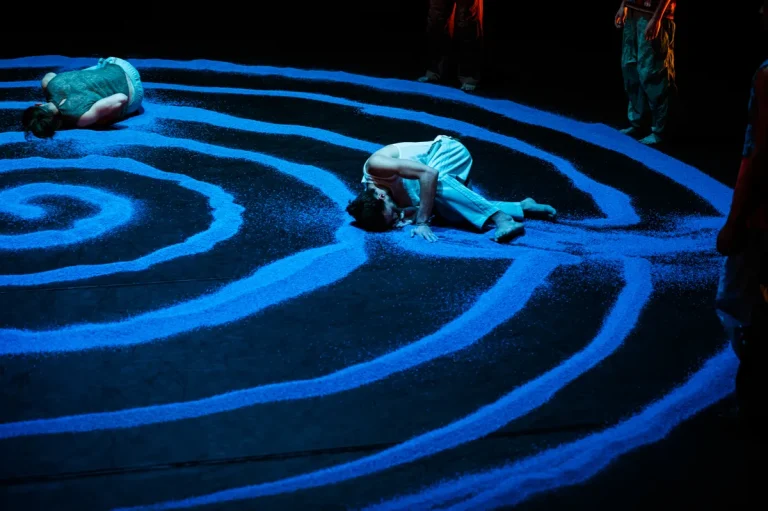
Although I had tired of this repetition long before it ended, it was still preferable to the long, drawn-out break between the two parts of her piece when Steiner pulled a clothes rail from behind the black curtains that enclosed the stage and oh-so-gradually changed her costume in dim light. The outcome was a surreal, patterned mermaid ensemble, with the lower half of Steiner’s body enveloped in the siren’s tail. Inevitably, this led to a preponderance of floor-based, slithering movement, mostly performed in no more than half-light. The inference of a seductive, mythical Siren luring a ship to its doom seemed clear but how this second part related to the pointe-based work of the earlier iteration went well beyond my comprehension.


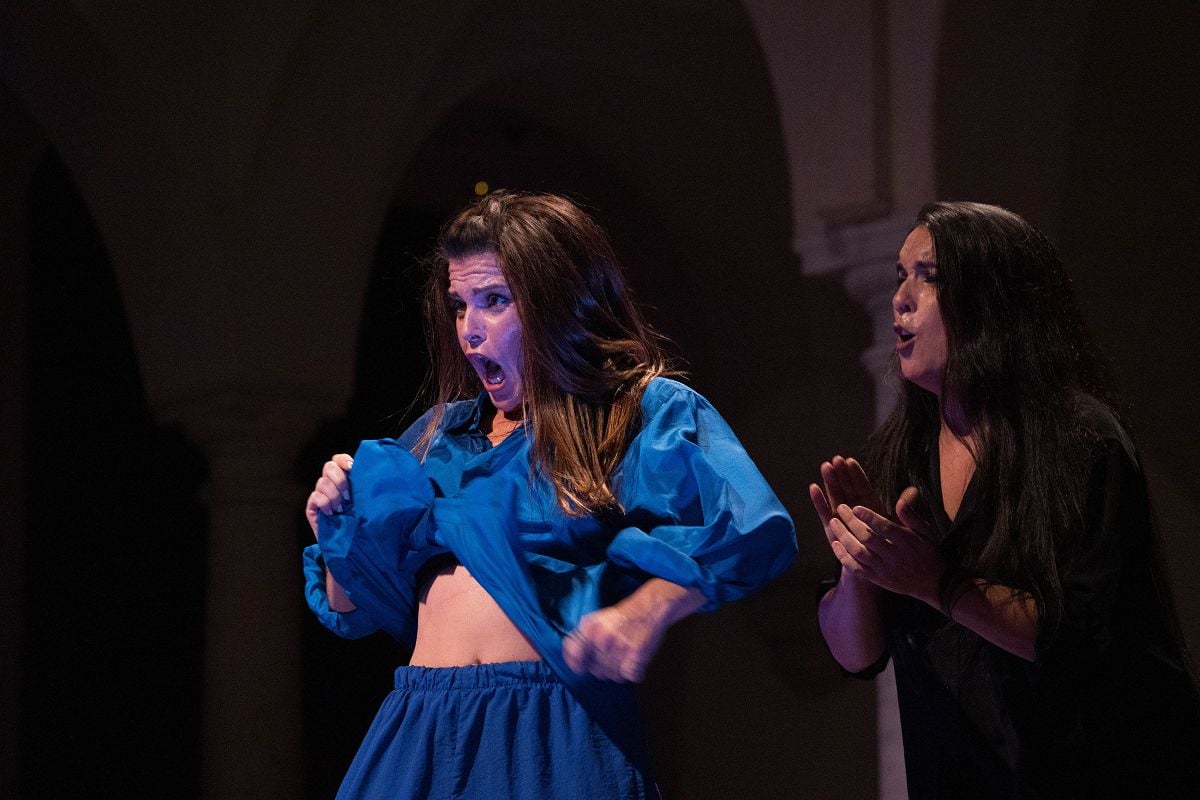
Random Taranto not only changed the tempo but upped it significantly from the get-go, with the two performers, Maria del Mar Suárez (known as La Chachi) and Lola Delores, seated on pink plastic chairs, placed downstage at stage right, and staring uninterestedly into the audience. La Chachi ate sunflower seeds, roughly spitting or throwing the husks to the side of her chair, while Delores routinely rolled cigarettes with a filter, humorously shaking each cigarette before putting them into a bag. Although this went on for a while with several seeds consumed and roll-ups constructed, the repetition didn’t fall towards boredom on account of the silent comedy in the women’s expressions and their total lack of association with one another.
This all changed when the pair began to hum in unison, gradually building up volume, and La Chachi started to dance, dressed in something akin to a blue prison boiler suit with a white sleeveless vest underneath. The arresting impact of her zapateado (footwork) was significant in the intimacy of this small venue, replicating the feel of a tablao if not the style of one, with the sound of Dolores’ singing and palmas (rhythmic handclapping) as the only accompaniment to the drumming of La Chachi’s shoes in this comedic mix of flamenco and contemporary dance.
Taranto is a flamenco style with a strong rhythmic 2/4 musical time signature, which, although having its roots in Andalusian mining communities of the nineteenth century, was popularised by the great Carmen Amaya in the mid-twentieth century. That simple compás (rhythm) was evident in La Chachi’s percussive feet and the excellent singing of Dolores appeared to be cleverly deconstructed evocations of the music that one might encounter in the tablao. She was much more than a supporting cantaora (singer) to the dance steps of La Chachi, sometimes dancing herself, in a performance conversation between the pair.
A drawback for Siren Dance was that Steiner mostly performed either with her back to the audience or writhing on the floor; even the few times where she was front-facing, the lighting was so dim that no sense of intimacy or association with her audience was developed. Despite watching her perform from no more than two or three metres’ distance, I wouldn’t be able to describe her. By contrast, the charismatic duo of La Chachi and Dolores brought an arresting personal appeal to their work, which concluded with the pair sitting back on their pink chairs as Dolores finally lit one of those roll-ups, albeit just momentarily, before the blackout.


Graham Watts is a freelance writer and dance critic. He writes for The Spectator, Tanz, Shinshokan Dance Magazine (Japan), Ballet Magazine (Romania), BachTrack and the Hong Kong International Arts Festival and has previously written for the Sunday Express, Dancing Times, Dance Europe, DanceTabs, London Dance, the Edinburgh International Festival and Pointe magazine (USA). He has also written the biography of Daria Klimentová (The Agony and the Ecstasy) and contributed chapters about the work of Akram Khan to the Oxford Handbook of Contemporary Ballet and on Shobana Jeyasingh for the third edition of Routledge’s Fifty Contemporary Choreographers.
He is Chairman of the Dance Section of The Critics’ Circle and of the UK National Dance Awards and regularly lectures on dance writing and criticism at The Royal Academy of Dance, The Place and (until the war) for Balletristic in Kyiv. He was a nominee for the Dance Writing Award in the 2018 One Dance UK Awards and was appointed OBE in 2008.