Review: Dutch National Ballet’s triple bill – Paquita | Carmen | 5 Tangos

Matthew Paluch sees Dutch National Ballet in Paquita | Carmen | 5 Tangos – we lucked out with the brilliant casting.
| Title | Paquita | Carmen | 5 Tangos |
| Company | Dutch National Ballet |
| Venue | Het Muziektheater, Amsterdam |
| Date | 19 February 2026 |
| Reviewer | Matthew Paluch |
How wonderful to see Amsterdam’s Muziktheater packed to the rafters for February 19th’s performance of the triple bill Paquita/Carmen/5 Tangos. Mixed programmes aren’t guaranteed sell-outs… but the Dutch audience seems more than supportive of Dutch National Opera & Ballet’s programming.
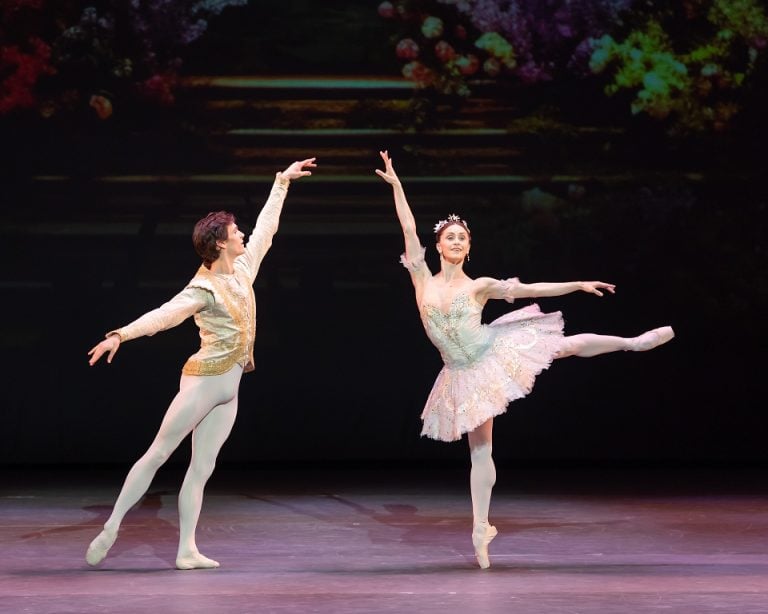
I was excited to see Paquita. We don’t often find it on London stages, but I’m afraid overall it was rather a non-event. The standard of dancing by the corps de ballet and soloists was more than acceptable, but no one was wowing me off my chair.
Paquita, or rather the Grand Pas Classique section, needs a lot of oomph in order to stand on its own – and this wasn’t apparent. The work was executed but lacked obvious style and glamour. The barren set (François-Noel Cherpin) didn’t help matters in relation to atmosphere, and in fact it made the already huge Muziktheater stage seem endless. I’d argue the vibe in the auditorium was also very sedated. So thank goodness Riho Sakamoto arrived as Paquita herself and gave us hope, and then some.
She absolutely brought the much-needed style and glamour by the bucketload, as well as (verging on) a faultless technique. Her demeanour is a very piquant balance of confidence and arrogance, and as she sailed around in consecutive triple en dedans pirouettes, she seemed as cool as a Spanish cucumber. ¡Olé!


The surprise of the evening was the Carmen by Ted Brandsen, the current Artistic Director. Choreographed in 2000, it isn’t genre-defining, but overall it’s a fresh work full of movement, energy and good storytelling. His characters are less obvious than those found in other versions, but their depth and complexity feel more than apparent. Bravo also to Andrew Carter and his simple, yet powerful set design. One really felt underneath the railway lines where real life actually happens.
I think we also lucked out with the casting. Anna Tsygankova as Carmen was subtly intoxicating, reconfirming her experience and value as a seasoned performer. Vsevolod Maievskyi as Escamillo brought incredible stature to the proceedings but still needs to fine-tune some acting and technical aspects. I’ve long been a fan of Erica Horwood, and this fact remains… but the night belonged to Giorgi Potskhishvili as José.
Potskhishvili is a one-in-a-generation type of artist. He isn’t a textbook classical dancer, but what he brings to the table is unbridled power, passion and a demand to be watched, whatever he is doing. Carmen also allowed me to understand that he has an interest in, and skill for, drama, so now I feel even more envious of the Dutch audiences that get to savour all of his performances. Come and guest in London Giorgi!


Closing the bill was Hans van Manen‘s 5 Tangos. This masterpiece by a master choreographer needs little explanation, but I can confirm – seeing it again is more than a pleasure; it’s an honour.
The vast orchestra switched with the Carel Kraayenhof Ensemble to play the Piazzolla, who sounded amazing, and the minimal set and costume design by Jean Paul Vroom feels as powerful as ever, likewise Jan Hofstra’s emotive lighting design.
It was another brilliant casting situation with Maia Makhateli and Young Gyu Choi leading the troupe. The charisma between the couple was palpable, and Choi specifically bought into the dynamic van Manen’s language offers. He was in his element, and I believe the lead male solo is one of the best out there. Why don’t more people use this on the gala circuit? It’s such a strong, standalone piece. And timelessly brilliant!
I’d also like to acknowledge Conor Walmsley and Jan Spunda who brought genuine tension to the male duo – but of course, without van Manen, they wouldn’t even have the opportunity.


Van Manen sadly passed away in December last year, and his loss is a huge deal for both dance and Holland. However, what a legacy he left behind. 5 Tangos was created in 1977, and some 50 years later, it feels as relevant as ever. Van Manen had the rare gift of being able to create emotion through his movement, and though it seems an obvious relationship to acknowledge… it doesn’t often present itself. So long may his seminal legacy continue to be experienced.

Matthew Paluch was awarded a place at The Royal Ballet School in 1990 where he graduated in 1997. His first four years as a professional dancer were spent working with London City Ballet, Scottish Ballet, K-Ballet and English National Ballet, becoming a full-time member of ENB until leaving in 2006.
Matthew graduated from the Royal Academy of Dance, Professional Dancers’ Teaching Diploma in 2007, and was formerly on faculty at The Royal Ballet School. He completed his Masters in Ballet Studies at Roehampton University in 2011, has been a freelance writer since 2010 and currently works in the Law Sector.
He is a member of the Dance Section of The Critics’ Circle.