Review: Scottish Ballet’s Mary Queen of Scots – celebrating Scots and Ballet

Kathrina Farrugia-Kriel sees Mary Queen of Scots, a new and intriguing work from Scottish Ballet.
| Title | Mary Queen of Scots |
| Company | Scottish Ballet |
| Venue | Sadler’s Wells, London |
| Date | 5 March 2026 |
| Reviewer | Kathrina Farrugia-Kriel |
It’s been a week of sorts for ballet. On social media, actor Timothée Chalamet audaciously suggested that no one cares about ballet anymore. Not quite, Mr Chalamet. Ballet communities have taken to his criticism on social media to set the record straight. (Has anyone counted how many times Chalamet has been reposted, tagged, or named in responses on various platforms? His socials, and that of ballet companies, artists, fans, have certainly caught traction this week).
In the same week Scottish Ballet brought their much-awaited production, Mary Queen of Scots, to Sadler’s Wells (5-8 March).
Scottish Ballet’s 2025 creation is led by a creative team of James Bonas (Dramaturgy) and Sophie Laplane (Choreography), Mikael Carlson and Michael P Atkinson (composition), Soutra Gilmour (Set and Costume Design), Bonnie Beecher (Lighting Design) and Anour Brissel (Projection and Video Designer). At large, Mary Queen of Scots is a striking production – the music score is sophisticated (so many leitmotifs from Tudor music, reworked as motifs in a broad range of music numbers to support the development of the narrative); the set design is intriguing with a three-sided wall that is raised and lowered to reflect key elements in the story line; and the contemporary insight into Tudor-inspired costume designs. It was a bold and brave undertaking, one that delivers on many fronts but also leaves some pertinent questions on the essence of ballet: setting aside the complexities in the creative collaborations, where lies the choreographic development?


The drammaturgy around the recollections of Elizabeth I’s near-death moments, including regret (and jealousy, too?) in her relationship with Mary Stuart form the foundations of the narrative. The programme notes are so very detailed in history, with guidance on the characters, a luxury for audience members.
Unlike her older cousin, Mary had it all – she was crowned Queen of Scots, Queen of France, had three marriages, and the ultimate source of her cousin’s jealousy – Mary gave birth to an heir.
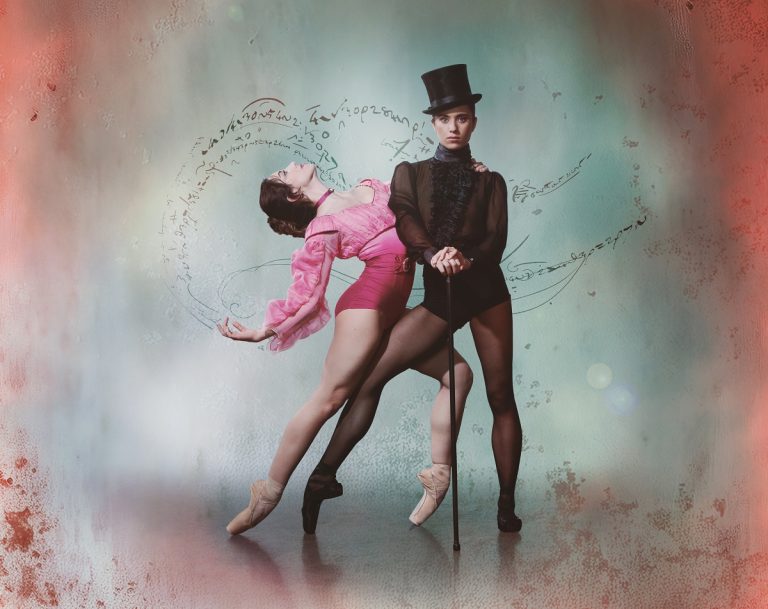
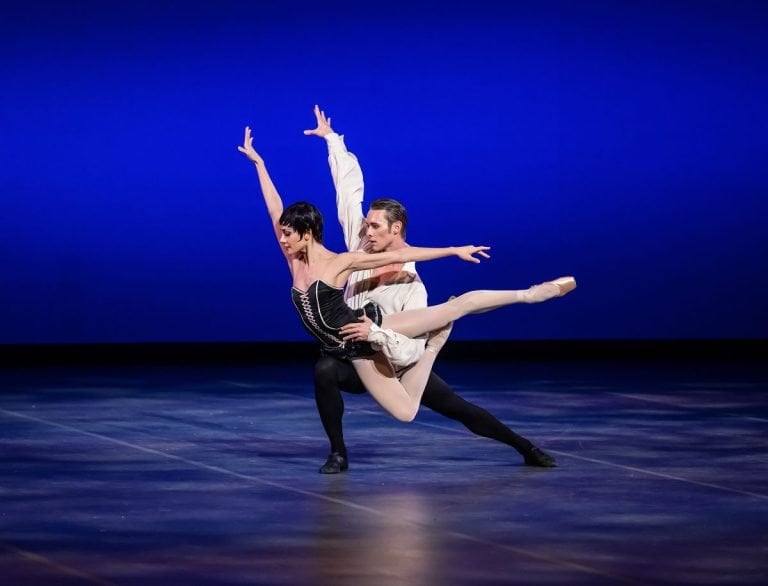
When the ballet opens, Bonas and Laplane introduce this older, fragile Elizabeth (Charlotta Ofverholm), who moves between sorrow and regret, to delusions in her final hours. Ofverholm gives a strong performance – the ‘underwear’-themed costume wasn’t a pleasant part of the design. A ‘Younger Elizabeth’ (Harvey Littlefield) offers a strong presence – height, hair and plenty of legs. Roseanna Leney’s entrance sets the tone for Mary’s story; the storytelling through movement takes us through the early stages of youth, marriage to a young Dauphin (James Garrington is light and frivolous in his youthful moves), and her connections with the key male and female figures in her life. Darnley (Evan Loudon), Rizzio (Burno Micchiardi), and Walsingham (Thomas Edwards) are strongly developed characters in the ballet.
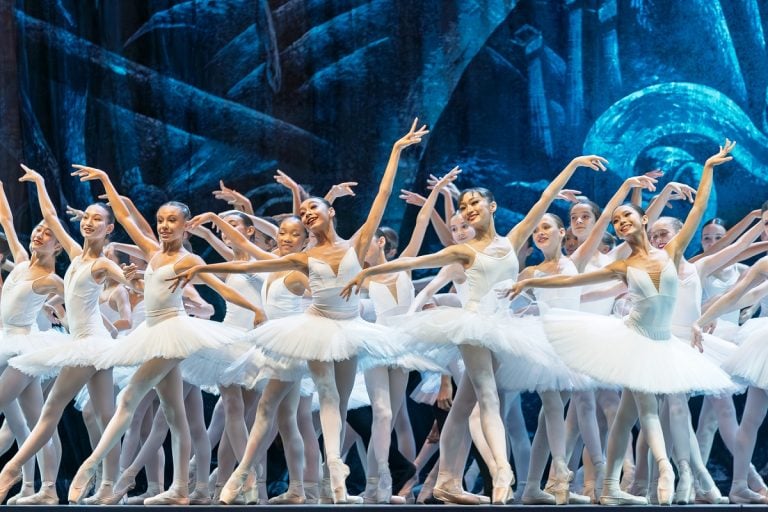
The Four Marys (Melissa Parsons, Danila Marzilli, Alice Kawalek and Hannah Cubitt) are curious beings. Disappointingly, the choreography for these four women is underdeveloped. The same can be said for the Proxies; the choreography felt quite generic (almost ‘filler’ choreography, with two very striking dancers performing very visually pleasing balletic movements as Leney and Littlefield look on). Take away the props (illuminated doors) within the visually effective mise-en-scene; what is left of the choreography within the performance? Alas, not much depth.


The choreography for the court ladies and men, in coutured purple coat-dresses, was more memorable. The eccentric black/orange wig-props, which if you turn upside down shifts to either a hair do sported by Mary or by Elizabeth, is enigmatic. This humour, or tongue-in-cheek moment, by-passed me – was this another filler moment?
The true shining star of the production is Jester (Kayla-Maree Tarantolo), who brought choreographic wit to the relationships with Elizabeth, and Mary’s young child, James, who strangely grows in various stages as a white balloon (known as ‘JAMES’) and matures into an androgenous but clearly female-presenting, human-sized ‘James’ that pranced around as it was inflated, happy with its black bowler hat. Again, representation (whether intellectualised or referential) is as problematic as the black/orange wig-props. Then again, the use of the three-walled set design to signpost key ideas isn’t lost on the audience, as is the code from the numerous letters exchanged between Mary and Elizabeth.
Mary Queen of Scots delivers on a key moment in time – that ballet is alive, and its creatives are exploring history to celebrate the legacy of a Scottish Queen and the arrival of the Stuarts in England. As a ballet, it packs a punch on educating audiences about Scottish histories, but its inconsistencies could be reimagined to strengthen what is already an intriguing ballet.


Dr Kathrina Farrugia-Kriel is a dance scholar, educator and published author. She is a graduate of the Royal Academy of Dance (2003), the Universities of Durham and Surrey, and London Metropolitan University (2013). Her doctoral research focussed on Bronislava Nijinska’s Les Noces (1923), and the re-imaginings by contemporary choreographers Angelin Preljocaj and Mauro Bigonzetti. Kathrina is a former director of the Society of Dance History Scholars (now Dance Studies Association). Her scholarship on ballet histories has been published in peer-reviewed anthologies and journals, as well as newspapers, high-end magazines, and online blogs. She has authored a book on the legacy of Nathalie Poutiatine and ballet in Malta (Fondazzjoni Patrimonju Malti, 2020) and co-edited an extensive and pioneering anthology titled The Oxford Handbook of Contemporary Ballet (Oxford University Press, 2021).