Review: PCK Dance’s Into the Light – the celebrity pairing of James Pett and Travis Clausen-Knight

Graham Watts sees James Pett and Travis Clausen-Knight with Isabelle Evans – a rare opportunity to see them in a full-length show.
| Title | Into The Light |
| Company | PCK Dance |
| Venue | The Place, London |
| Date | 10 April 2026 |
| Reviewer | Graham Watts |
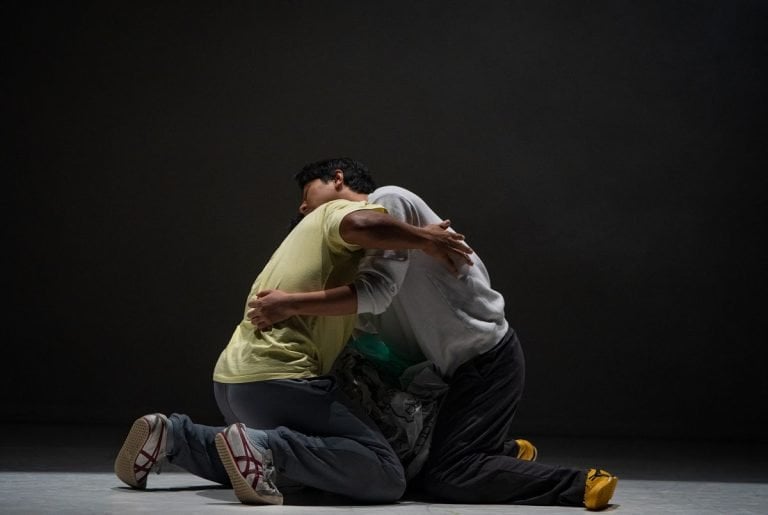
James Pett and Travis Clausen-Knight, performing together as PCK Dance, have become the closest that independent contemporary dance has to celebrity. They are on the A-List for the major ballet galas, having this year already performed back-to-back world premieres of AE in the Deca Dance evening at Cadogan Hall for Ballet Nights, closely followed by Postscript, to the music of Vivaldi, for Ballet Icons at the London Coliseum. In July, they will create a new work to dance with Royal Ballet Principal Melissa Hamilton at Grange Park Opera.
The two dancers have pedigree, both having been members of Company Wayne McGregor and their choreographic and directorial excellence has already been recognised with a nomination for Best Independent Company in last year’s National Dance Awards and has elicited commissions for new work in Zagreb, Monterrey and Santiago where their Bodies of Division won El Circulo de Criticos de Arte Award for Best Dance production in Chile.
PCK Dance is now the Company in Residence at Eden Court Theatre in Inverness, and so this double bill was a rare opportunity to see them perform more than gala cameos at a London venue in a full-length show, and they didn’t disappoint.


Although it doesn’t matter, it’s hard to categorise Into the Light. Is it one full-length work with an interval? The brief programme note seems to suggest that this is so. Or is it two separate pieces, the first entitled VESSEL, followed by In the Absence, which, given the separated titles and creative distinctions of the two halves, might also be the case.
At first sight, VESSEL seemed to be a development of that world premiere, AE, at Ballet Nights, since there were certain design and thematic similarities, and as on that occasion, Pett and Clausen-Knight were joined onstage by Isabelle Evans, an exciting new addition to their team. However, on further research, it is a redevelopment of a duet that PCK Dance first created in Italy. The electronic music was composed by Sean Pett and performed live by him from the side of the space.
It isn’t surprising that PCK Dance are in demand to create work for major ballet galas because their choreography, created jointly by Pett and Clausen-Knight, is always smooth and elegant, rubbing soft edges onto neoclassical movement and lifts. Several poignant and sophisticated duets were embedded in the work, including one that brought it to a conclusion with soft rotations swirling into gradual darkness.
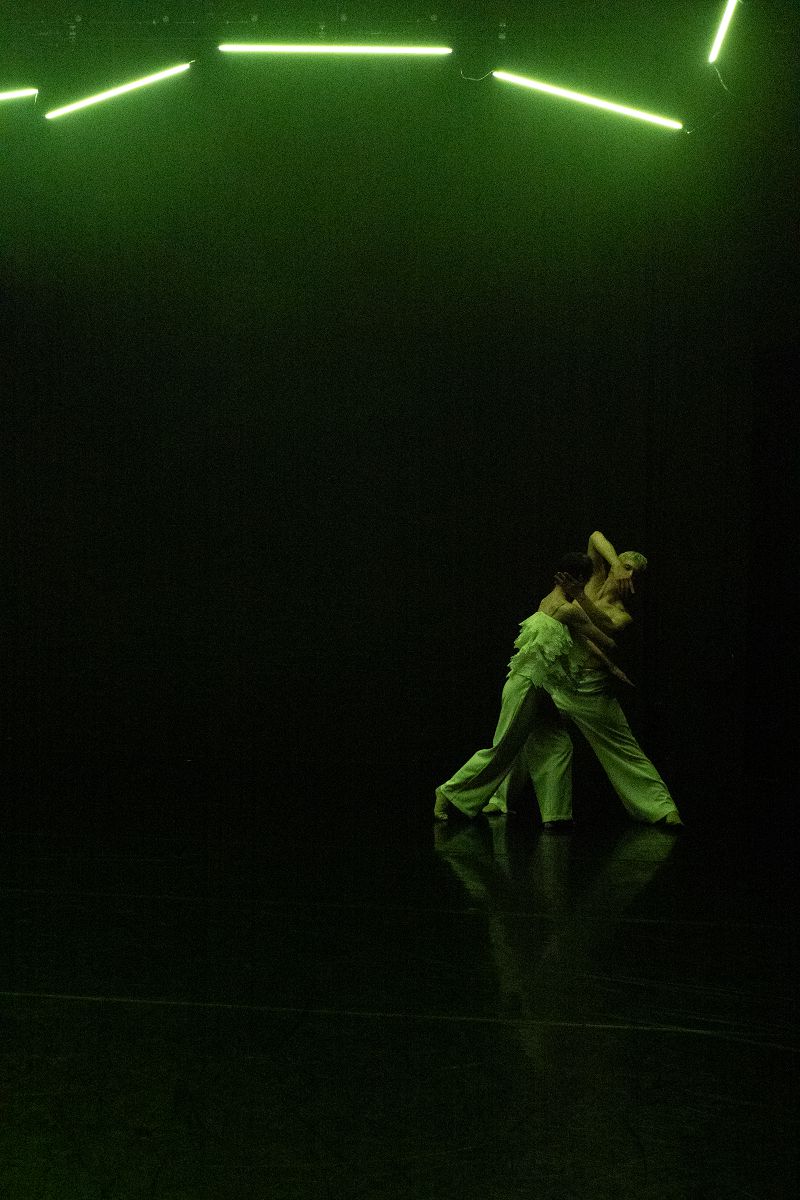
The movement is often fast but always under disciplined control. The three dancers created sculptural shapes in a Spartan setting under an effective lighting design, comprising a canopy of thin LED lights (like slim fluorescent tubes) using technology designed and built by Clausen-Knight (and previously utilised in their work, Nerve Wire), pulsating with a colour range from solid green to alternate black and white flickers and embracing occasional blackouts.
The programme note reflected the intentions of the earlier, briefer episode of AE, with hints at the need for human resilience in the face of an AI-driven future. Ideas of survival and surrender emerged through the movement and the dancers’ expressiveness in that hazy atmosphere. Pett and Clausen-Knight wore only loose-fitting “track pants” and Evans had a strange, frilly bra-top that seemed somewhat incongruous to the sombre aspect of the work.
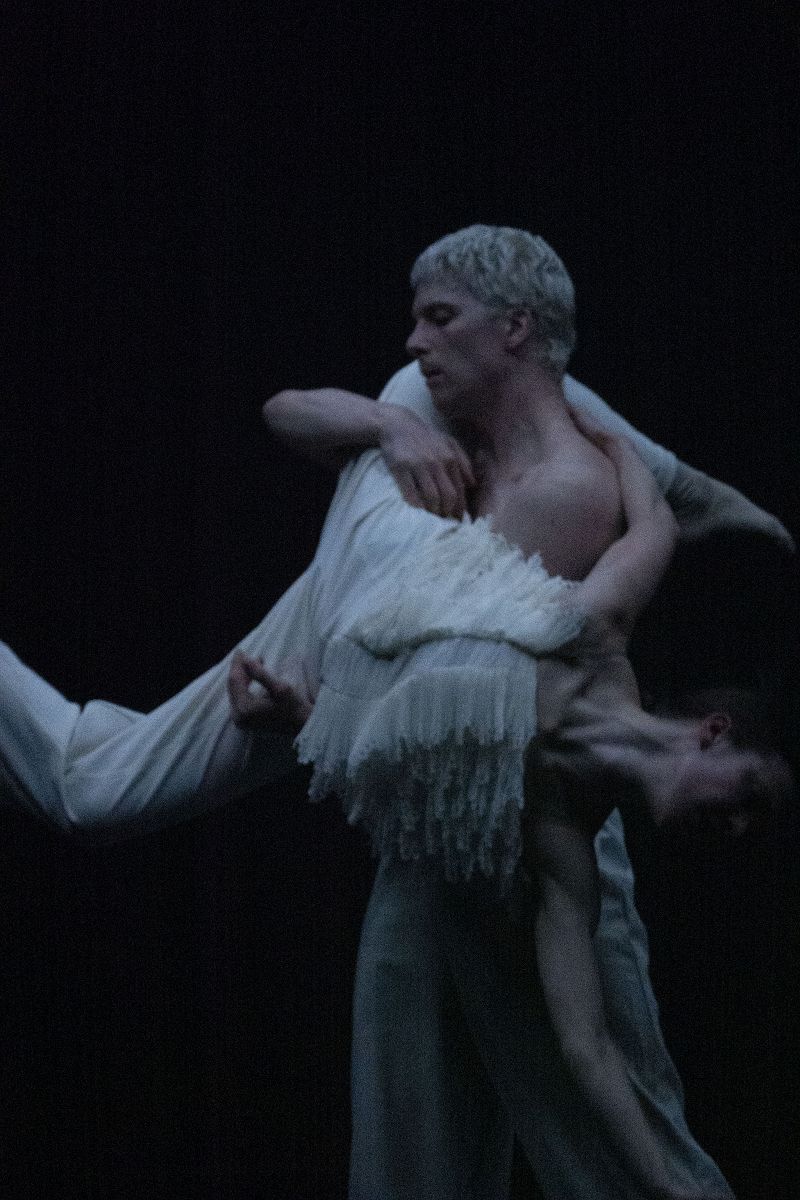


Sean Pett also composed and performed most of the music for In the Absence, but this time, on the piano situated at the back of The Place‘s performance space. The work opened with a recorded track that was separately composed by Greg Haines. The use of original music is a common theme throughout PCK Dance’s repertoire and helps to maximise the holistic environment that seems to come naturally in their work.
This second work was performed without Evans, but in her place the floor was strewn with silver tickertape that was swept aside like glittering sand by the feet of the two dancers, creating swirling patterns on the floor. It seemed like the aftermath of a chaotic post-wedding party.
It was timely to experience this one-night-only event in London by this globe-trotting, close-knit company, which provided yet more evidence of PCK Dance’s emergence as a major force in world dance. Their atmospheric work suited the intimacy of The Place, but having seen them command the space at Cadogan Hall and the London Coliseum as just a duet, I would love to see their next London date at a larger venue such as Sadler’s Wells East.

Graham Watts is a freelance writer and dance critic. He writes for The Spectator, Tanz, Shinshokan Dance Magazine (Japan), Ballet Magazine (Romania), BachTrack and the Hong Kong International Arts Festival and has previously written for the Sunday Express, Dancing Times, Dance Europe, DanceTabs, London Dance, the Edinburgh International Festival and Pointe magazine (USA). He has also written the biography of Daria Klimentová (The Agony and the Ecstasy) and contributed chapters about the work of Akram Khan to the Oxford Handbook of Contemporary Ballet and on Shobana Jeyasingh for the third edition of Routledge’s Fifty Contemporary Choreographers.
He is Chairman of the Dance Section of The Critics’ Circle and of the UK National Dance Awards and regularly lectures on dance writing and criticism at The Royal Academy of Dance, The Place and (until the war) for Balletristic in Kyiv. He was a nominee for the Dance Writing Award in the 2018 One Dance UK Awards and was appointed OBE in 2008.