Review: YOU & US with Cathy Waller Company – human, nuanced, heart-warming

Lucía Piquero appreciates the humanity in Cathy Waller Company’s YOU & US, inviting us to have the courage to be seen more openly and more honestly.
| Title | YOU & US |
| Company | Cathy Waller Company |
| Venue | The Place, London |
| Date | 7 May 2026 |
| Reviewer | Lucía Piquero |
The heavy base of the music hypnotises us as we watch, first one, then many, dancers shake their bodies clad in slightly post-apocalyptic black plastic-like outfits. Almost like a heartbeat, we feel their rhythm and empathise with their struggle. To be seen is important, but it is also scary. The dancers join in powerful unisons and then exit into solos, runs… intimate moments of sharing. The landscape seems almost like a metaphor for the topic too – striking, beautiful, powerful, potentially devastating. The first 15 minutes of this double bill, in the form of a film, feel fresh, hopeful… young people shouting: “We are here and you will see us”.
It is, of course, more difficult to maintain this feeling throughout a 60-minute performance, but Cathy Waller Company verges very close to it, only slightly losing steam at points towards the end.
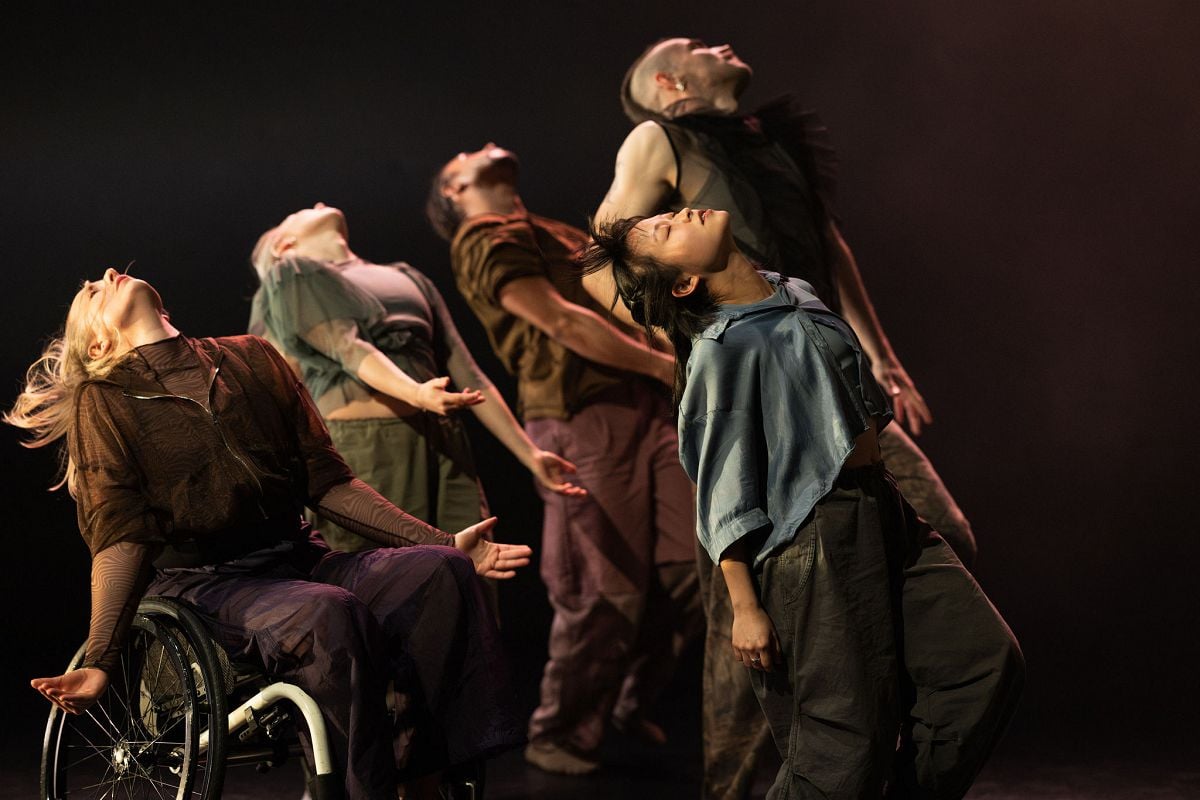
The work starts strong. The full group of five performers repeats a sequence of heavily accented movements, again to the preferred strong beat of the music, with their backs towards the audience. We see glimpses of their faces when they twist, and of their individuality when they break out from the established sequence. A sudden stop with a hand diagonally towards the audience is especially striking – again a sign that they are here, even if not fully visible, daring us to look at them and try to really see them.
Shortly after this sequence, we are treated to a solo by Lisa Chearles – soft, flowing, playing with the hiding of the face and curving of the upper back. A sense of vulnerability, of looking inwards, emerges here. Slowly, we see more of her face, also slightly obscured by the combination of a soft light and a long fringe, and we start to see the need for some support. This eventually transforms into a sequence of falls, which is stopped by another dancer, Alex Gosmore, on entering the stage. There is a little bit of ‘awkward’ and a little bit of performed ‘clumsy’, but a lot of accompanying each other in a beautiful, flowing duet. The movement, the crafting, the patterns, the expression, it all feels somehow familiar. This is contemporary dance that we know, and the familiarity makes it peaceful, homely, personal.
Gosmore’s solo follows, slightly more agitated, more falls, more jumps, more thrusting of limbs, showing us a process of becoming, of acceptance. It plays near indulgence, but this is not unwelcome – it all makes sense.


Perhaps one of the most striking moments follows: Conn Williams comes in and sits near Gosmore. And then they breathe. Together. Visibly. It is human, nuanced, heart-warming. Simple co-regulation in action. The peace doesn’t last long, though, when we move towards Williams’ solo, surrounded, threateningly, by the rest of the dancers. We move from invisible to overly seen. Overall, some of the scenes could have been a bit shorter, and the movement sequences were repeated just a tiny bit too long. This was an example of one, and so we breathe easier when they break away, to movement from all dancers, followed by the stunning solos of Maiya Leeke and Jordan Caldwell-Smith. Leeke’s beautiful integration of flow and sharpness in her movement is striking at this point, as is the companionship that builds between the two dancers when they come to move together. Caldwell-Smith somehow feels like the joyful glue which brings them together, something that will repeat in the final unison.
The work moves then towards an organised chaos of exuberant movement and glimpses of relationships and smiles between the dancers, especially driven again by Caldwell-Smith and her soft, hopeful presence. And this leads, rather suddenly, to another strong unison to a beat, indicating the impending end of the show. Here, the dancers face the audience and come near us. We are lit up – again a familiar device –and then just as the stage darkens, Caldwell-Smith hesitates and abandons the line, perhaps to hide, perhaps to let the vulnerability rest. I didn’t feel sad, though. I empathised and felt that the work wanted us to know that it is ok if we need to hide and rest at points, especially if you have been holding other people up.
The work is not without its flaws, but these do nothing but make us connect more to it, see ourselves in it, and perhaps feel invited to have the courage to be seen more openly and more honestly. The photographic exhibition in the lobby does exactly that: it invites us to see, to be seen, to be vulnerable, and to accept it all as part of what this work does best – humanity.

Lucía Piquero Álvarez was born in Asturias, Spain, where she trained in Classical Ballet and read for a BSc in Psychology. She moved to London where she trained in contemporary dance (LCDS), also getting an MA in Choreography (Middlesex University). Lucía has been an independent dancer and choreographer since 2007, her choreographies have been presented internationally and she has been commissioned by choreographic centres, national companies and festivals.
She was lecturer and head of the Dance Studies Department at the University of Malta, and Senior Lecturer at Dance City (Newcastle), and is currently lecturing at Trinity Laban and English National Ballet School. She completed her PhD at the University of Roehampton. Her main research interest is on embodied emotion and cognition in dance, she has presented in conferences and directed workshops and practice research projects internationally, and published articles and chapters in diverse platforms as well as her own monograph.