Review: Simone Grøtte’s GLEMT / FORGOTTEN – potent and powerful

Matthew Paluch sees Simone Grøtte’s GLEMT / FORGOTTEN at the Oslo Opera House – the kind of calibre we’d love to see in London on a more regular basis.
| Title | GLEMT / FORGOTTEN |
| Company | Simone Grøtte |
| Venue | Oslo Opera House |
| Date | 25 May 2025 |
| Reviewer | Matthew Paluch |
It’s always a pleasure to see new work in a new theatre, and that was most definitely the case with GLEMT / FORGOTTEN by Simone Grøtte at the Norwegian National Opera.
The performance took place on the second stage – the classic black box – and doesn’t have anything to do with the main house company. However, it’s a very fine example of the standard of independent contemporary choreography currently available in Norway.
The work features quite a lot of (recorded) spoken text, so it’s difficult to give a full reading of the experience. And forgive the arrogant Englishman, but I don’t think well-placed subtitles would hinder the overall impact of the production.
Grøtte looks at the impact of WWII on the Northern Norway inhabitants, and even with the language barrier her work speaks clearly and with obvious depth. The blurb suggests it’s a personal exploration as Grøtte has spoken to her grandfather about his experience of being forcibly evacuated onto the German ship Karl Arp, and this personal account simply adds to the gravitas of the work.


The production is superbly balanced, from the lighting to the connection between scenes, and the eclectic musical score. As confirmed, I’m unfamiliar with Grøtte’s work/language, but there is a lot to take in and appreciate from this first viewing.
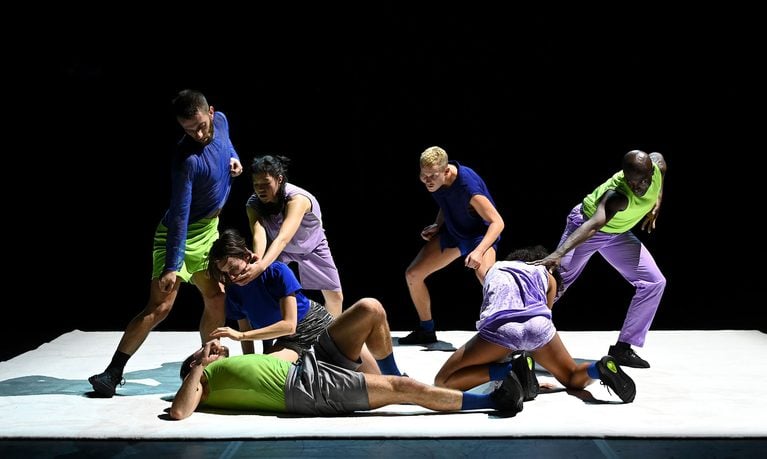
First and foremost, none of the language feels superfluous. Everything speaks, whether through large, unbridled physicality or total stillness (with very deep waters). She uses floor work in a way reminiscent of Graham, with deep connection and weight. The duo work feels far more about body connectivity than distanced partnering, and the language also speaks strongly of gender without being predictable or patronising.
The two men have a duo that taps directly into male emotion and communication. As in, things can’t necessarily be said with ease, but they can be shown through the body, be that tender jostling or surprise embraces.
Grøtte gives her women equal measures of agency and vulnerability, and the whole concoction allows the dancers to take their execution of the work to some pretty deep places.
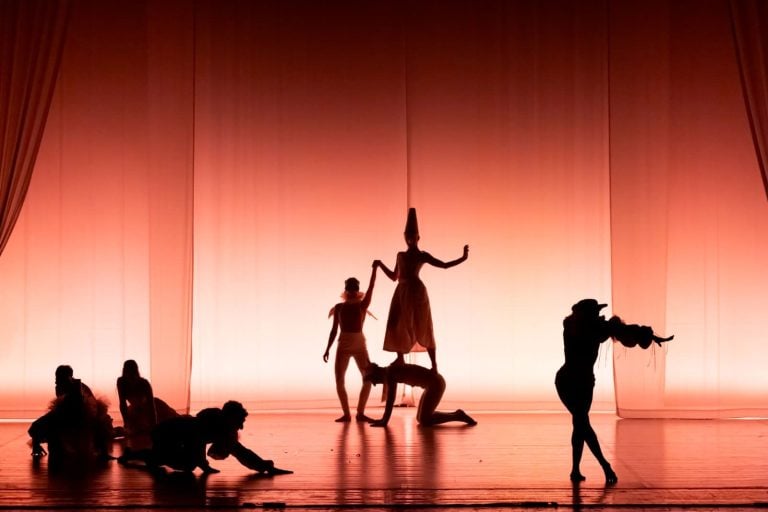
Pre-performance, I’d visited the Munch Museum, so I still had his work at the forefront of my mind. Seeing Grøtte directly afterwards, I felt even more aware of the Norwegian sense of emotional communication, specifically difficult feelings that can be problematic to discuss. Grøtte explored many things in GLEMT / FORGOTTEN, but the language most clearly inhabited the notion of trauma for me. Whether revisited through recollection, exorcised via thrashing and throwing, or emoted through barely visible and barely moving restrained tableaux, the work is potent and powerful, and the kind of calibre we’d love to see in London on a more regular basis.
The Oslo Opera House, home of the Norwegian National Opera and Ballet and designed by Norwegian architectural firm Snøhetta, opened in 2008.

PS I went on a tour of the new Opera House before the performance, and what an amazing set-up they have. I look forward to returning and seeing something in the main house, hopefully sooner rather than later!