Review: Ballet Nights continues to ‘educate, entertain and impress’ with Decadance

Graham Watts sees Decadance, the tenth iteration of Ballet Nights – a high-end brand that hits the mark every time.
| Title | Decadance |
| Company | Ballet Nights |
| Venue | Cadogan Hall, London |
| Date | 4 February 2026 |
| Reviewer | Graham Watts |
The tenth iteration of Ballet Nights in London maintained the high quality of all the Nights that had gone before. Founder and dapper compere, Jamiel Devernay-Laurence, has built a high-end brand that needs to hit the mark every time and, once again, his backstage team, dancers and musicians have succeeded. Devernay-Laurence is building a rapport with his audience, even asking his Insta followers to vote for which shirt he should wear! His charismatic introductions to each piece are given with confidence and those brief explanations help to break down barriers and make the works more accessible.
As always, this was a cabaret ballet variety show, prefaced by a couple of musical introductions. The Ballet Nights concert pianist, Viktor Erik Emanuel, has been ever-present from show one and he kick-started proceedings with a sensitive rendition of Debussy’s popular Clair de Lune. Just right to set the mood. The second act was also opened musically with an effervescent, virtuoso Viola Sonata by Paul Hindemith, played with gusto by Dominic Stokes, his long hair flailing in time with the music.
Ballet Nights continued its policy of bringing dancers from unfamiliar companies to make their mark in London. The first act concluded with an enigmatic duet, performed in second-skin Lycra, by Lou Beyne and Jaat Benoot of Les Ballets de Monte Carlo. This extract from Jean-Christophe Maillot’s Dov’è La Luna was a hypnotic capsule of a longer ensemble work, created in Maillot’s unique blend of classical and contemporary styles. This outstanding couple whetted my appetite to see the whole ballet.
The programme ended with another explosive burst of classical virtuosity, in the Diana & Acteon pas de deux, danced by Laura Rodríguez Quesada and Gael Ventura of Ballet De Monterrey, directed by former ENB Principal Yosvani Ramos. Rodríguez Quesada previously danced with Acosta Danza, and it was a pleasure to be reminded of her elegant stage presence. Her partner, visiting the UK for the first time, presented the fireworks of his variation with evident nobility.


Another first came with the performance of AE, a world premiere choreographed by Ballet Nights regulars, Pett Clausen-Knight and danced by Travis Clausen-Knight and Isabelle Evans to original music by Sean Pett. The piece explores boundaries between humanity and artificial intelligence, through an intense duet that left memories of the sculptured shapes of these two closely coordinated bodies. PCK is building a strong catalogue in a unique style, and Evans is a real find.
Another breathtaking duet was, appropriately, George Liang’s Out of Breath, performed by Northern Ballet’s Alessandra Bramante and Joseph Taylor, formerly of that parish but now established with London City Ballet. Liang’s thoughtful and magnetic pas de deux focused on the need to find a slower pace in a hectic world, an intention well matched by the music of Olafur Arnalds.
Yorke Dance Project is a regular at Ballet Nights, and the programme featured another opportunity to see Lacrymosa, recently performed at the Linbury Theatre. Amy Thake and Edd Mitton brought palpable emotional intensity to Sir Robert Cohan’s impassioned duet about separation and reunion.


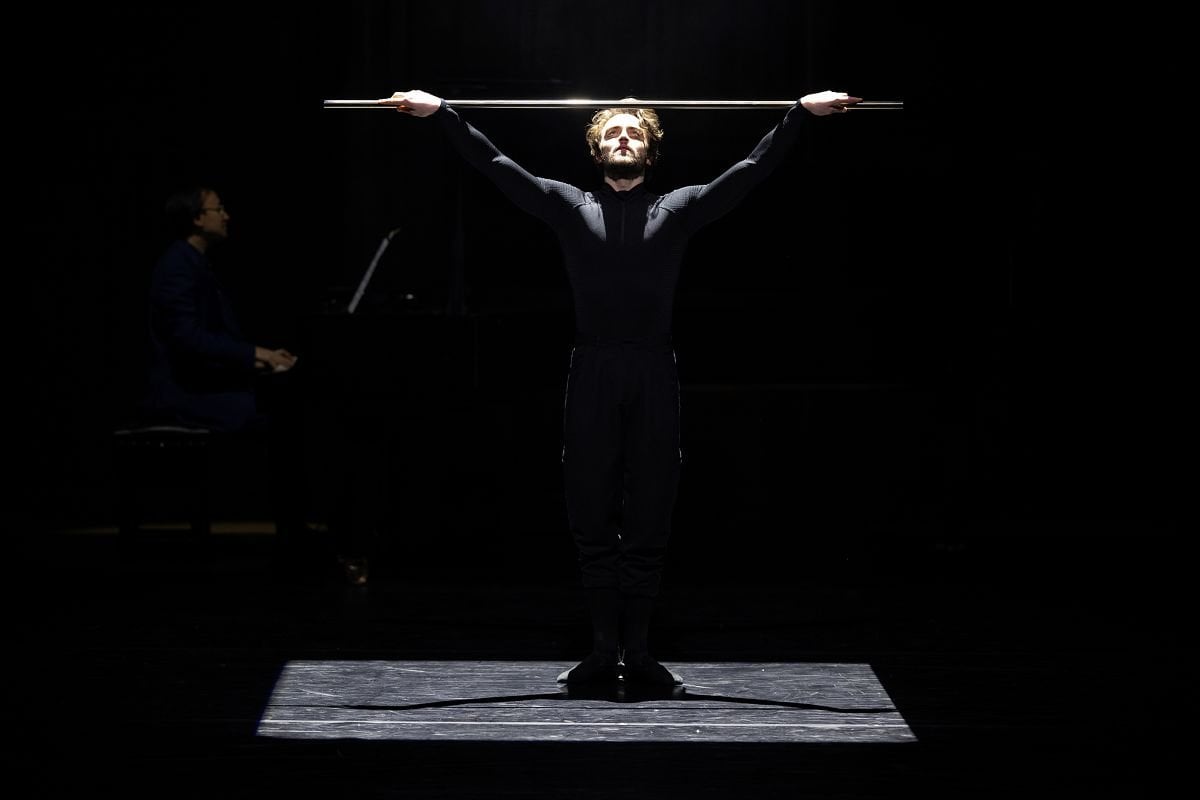


Leading dancers from The Royal Ballet were prominent throughout the programme, beginning with Sae Maeda and Harris Bell performing Vasily Vainonen’s Moszkowski Waltz, a vintage concert showpiece danced with exceptional verve and virtuosity by this charming couple. Joshua Junker danced his solo 324A, which has a history with Ballet Nights but had not previously been danced by its creator. The title was Junkers’ address during lockdown, and the solo expresses his frustration and anguish in those difficult times. Another solo with Royal Ballet credentials was Matthew Ball‘s The Measure of Things, danced to the live accompaniment of Emanuel playing a Beethoven piano sonata. Ball’s self-choreographed duet with a steel measuring pole of almost his own height required precise timing and considerable manual dexterity. It could qualify for Cirque du Soleil!
Counterbalancing the many revivals of vintage choreography by established dancers, Ballet Nights also provides opportunities to showcase emerging talent. Devernay-Laurence took great pleasure in introducing students from his Alma Mater, Central School of Ballet, performing an extract from Ashley Page‘s Times Square Ballet to music from Leonard Bernstein‘s On the Town. The students took their opportunity with alacrity, and in a programme otherwise full of solos and duets, it was refreshing to see the stage full of dancers.
Chrysanthi Nicolau and Django Bates-Blower, final year students from Rambert School, are new names to me, and they seem destined for successful careers. Their self-choreographed duet, Atlas, was an intense burst of mutual physicality and it (and they) stood shoulder to shoulder with the choreographic and performance quality of their much more experienced peers. I look forward to seeing more of them.
Ballet Nights continues to educate, entertain and impress with a fine and diverse variety of dance and music.


Graham Watts is a freelance writer and dance critic. He writes for The Spectator, Tanz, Shinshokan Dance Magazine (Japan), Ballet Magazine (Romania), BachTrack and the Hong Kong International Arts Festival and has previously written for the Sunday Express, Dancing Times, Dance Europe, DanceTabs, London Dance, the Edinburgh International Festival and Pointe magazine (USA). He has also written the biography of Daria Klimentová (The Agony and the Ecstasy) and contributed chapters about the work of Akram Khan to the Oxford Handbook of Contemporary Ballet and on Shobana Jeyasingh for the third edition of Routledge’s Fifty Contemporary Choreographers.
He is Chairman of the Dance Section of The Critics’ Circle and of the UK National Dance Awards and regularly lectures on dance writing and criticism at The Royal Academy of Dance, The Place and (until the war) for Balletristic in Kyiv. He was a nominee for the Dance Writing Award in the 2018 One Dance UK Awards and was appointed OBE in 2008.