
Review: English National Ballet’s The Sleeping Beauty with Emma Hawes and Aitor Arrieta

Graham Watts sees the opening night of The Sleeping Beauty at the Royal Albert Hall but is disappointed by a staging that militates against the magic.
| Title | The Sleeping Beauty |
| Company | English National Ballet |
| Venue | Royal Albert Hall, London |
| Date | 25 June 2026 |
| Reviewer | Graham Watts |
I readily recall being enthralled in June 2018 by several casts from English National Ballet in Kenneth MacMillan‘s production of The Sleeping Beauty, performed at the London Coliseum. This revival, exactly eight years later, was less fulfilling; not for the quality of the dancing, or the musicians or any of the other creative elements, but simply because of a staging that militated against the magic.
ENB’s summer visits to the Royal Albert Hall are as much a part of the annual programme as is The Nutcracker at Christmas. In that venue, they have pioneered the art of large-scale in-the-round performances, of which Derek Deane‘s Swan Lake is the great exemplar, but The Sleeping Beauty was performed as if under a proscenium arch, although one was not there, with a ridiculously wide but not deep stage without wings or curtains. The stage was virtually bare, with the only appreciable set design being the impactful projections by MacMillan’s daughter, Charlotte. Entrances and exits were made either from side stairs or through doors cut into those back projections. The orchestra was heard but not seen.

There is magic in The Sleeping Beauty, but it was muted by the cavernous dullness of the setting and the continual distraction of people walking in and out of the seating. I missed virtually the whole of the Carabosse mime in the Prologue because people were late arriving and others (understandably) were reluctant to stand up to let them pass, so consequently the latecomers just stood in front of the audience behind. The RAH front-of-house staff should not be letting latecomers in at critical points in the ballet.
MacMillan’s production was made for American Ballet Theatre and first staged by ENB, in 2005. It had the dual benefits of Nicholas Georgiadis’ sumptuous costumes and the gorgeous green and gold colours in Peter Farmer’s painted sets, which were necessarily but unfortunately absent from this revival. The projections were a reasonable alternative, with the designs changing as if ink running through blotting paper.
The ENB dancers at this opening night performance seemed on good form, albeit I suspect that the dancing is more challenging on this wide-open space than in a more traditional staging. There were, unfortunately, a couple of bumps and a missed lift along the way.
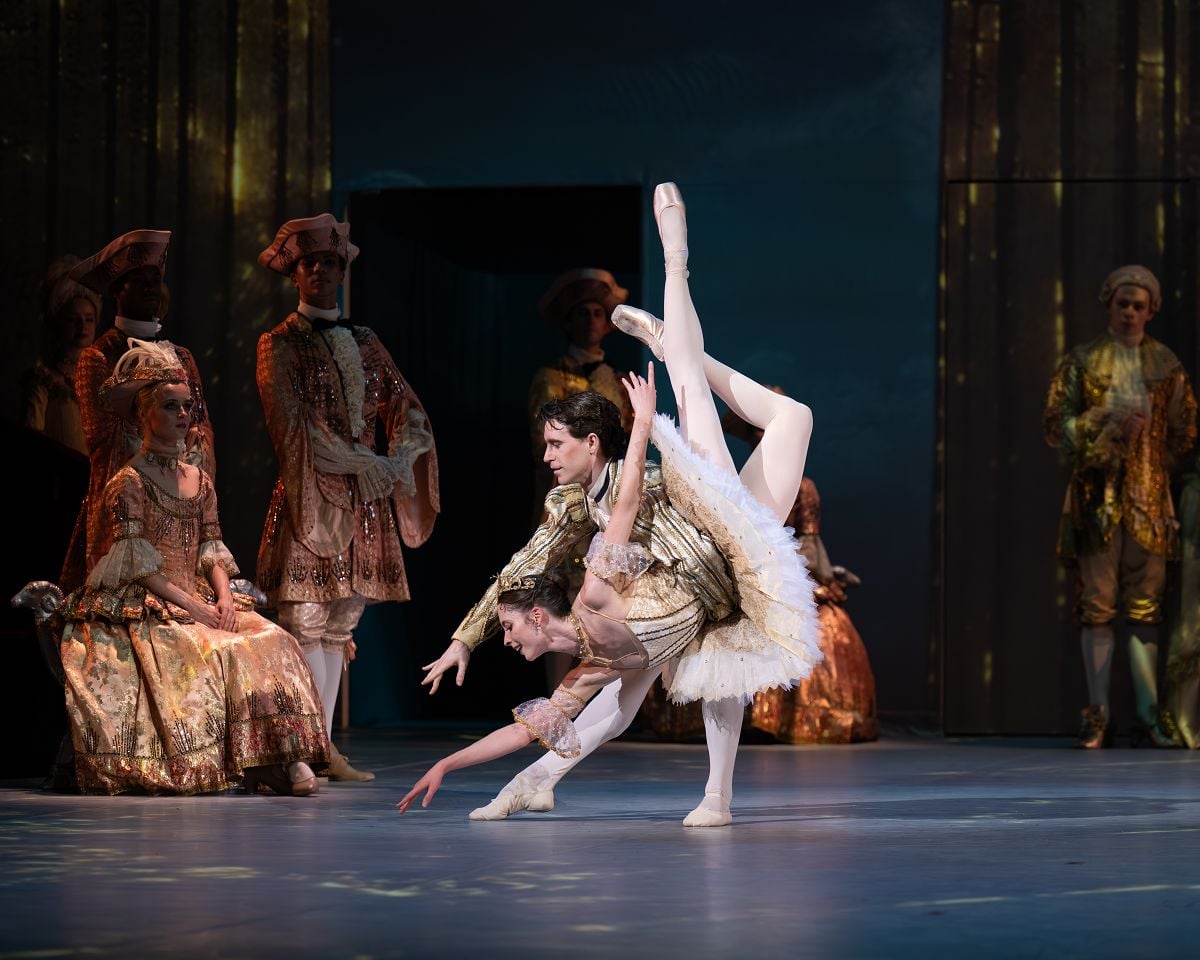
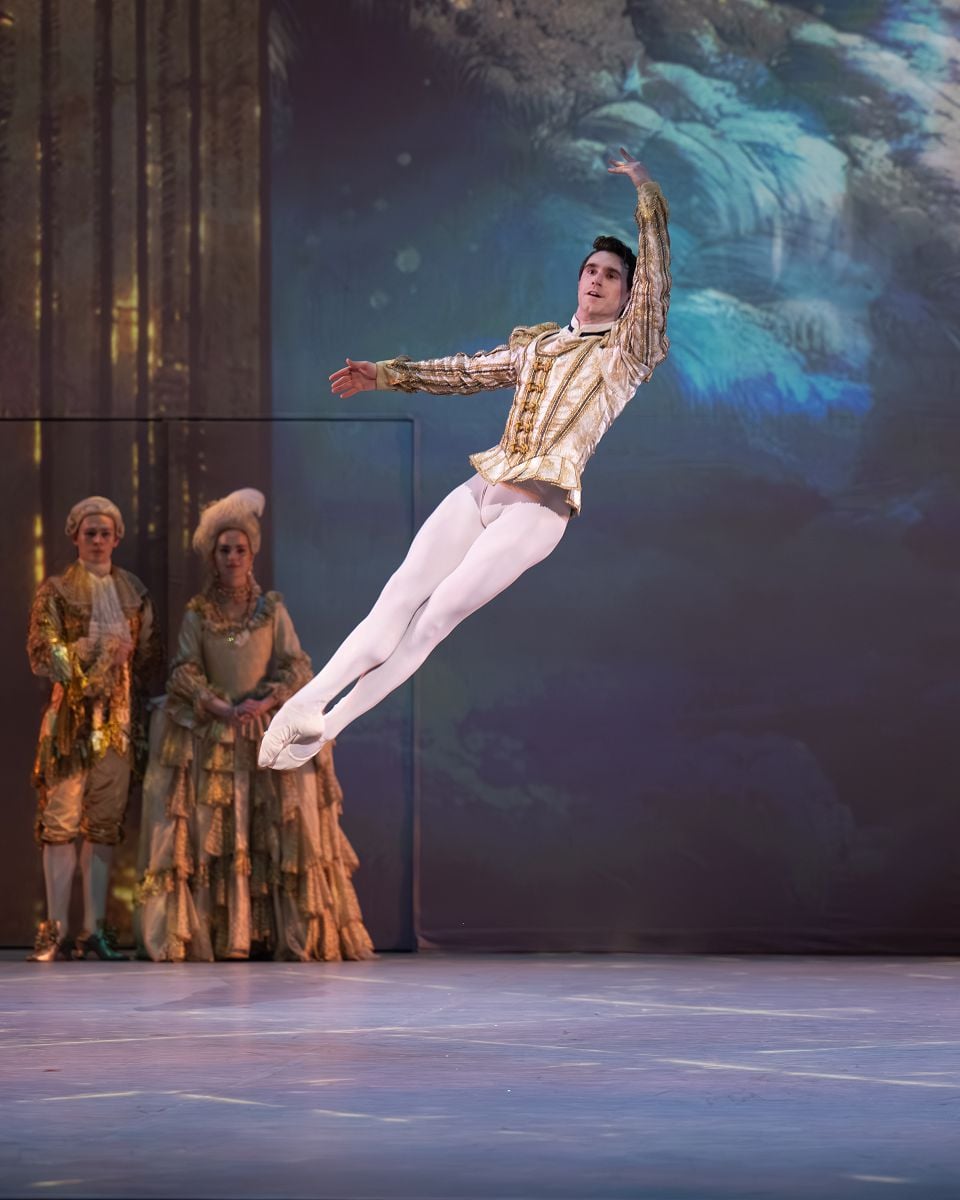
Emma Hawes was excellent as Princess Aurora and Aitor Arrieta was a noble Prince Désiré. Both danced their solos and variations exceptionally well, but I felt little chemistry between them. This is a woman who awakens after a 100-year sleep and falls immediately in love with the stranger whose kiss is responsible for her awakening (a dodgy scenario these days). That did not register true. When en pointe there is a significant height differential between the two and whilst I acknowledge this as another old-fashioned view, it didn’t give me the right feeling about their partnership. And some technical aspects of the partnering didn’t flow as they should with, for example, the mechanics of the fish dives being laboured rather than smooth.
That said, Hawes projected the ideal of a young princess with a heady mix of excitement, wonder and vulnerability, and she danced with joy, delicacy and grandeur. Her Rose Adagio was excellent, strongly supported by the four suitors. Arrieta oozed chivalry in every movement, and he delivered his solo dancing with unbounded flair.
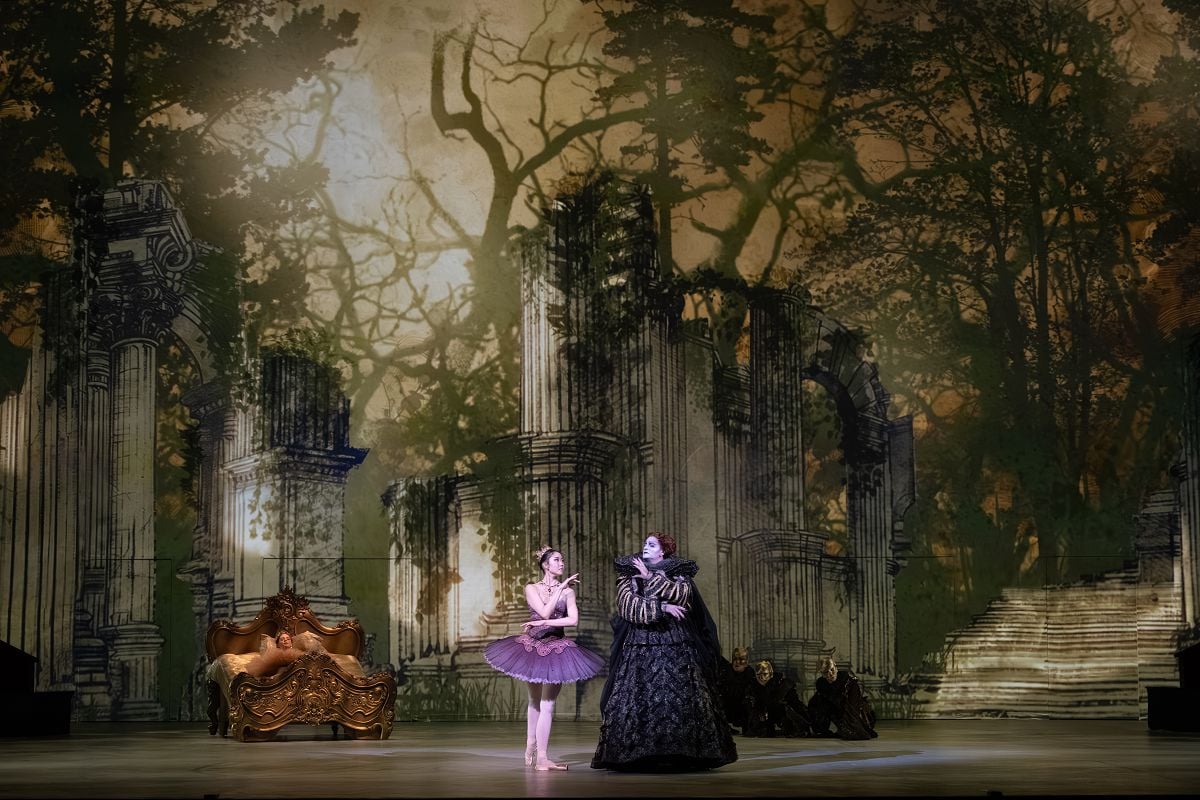
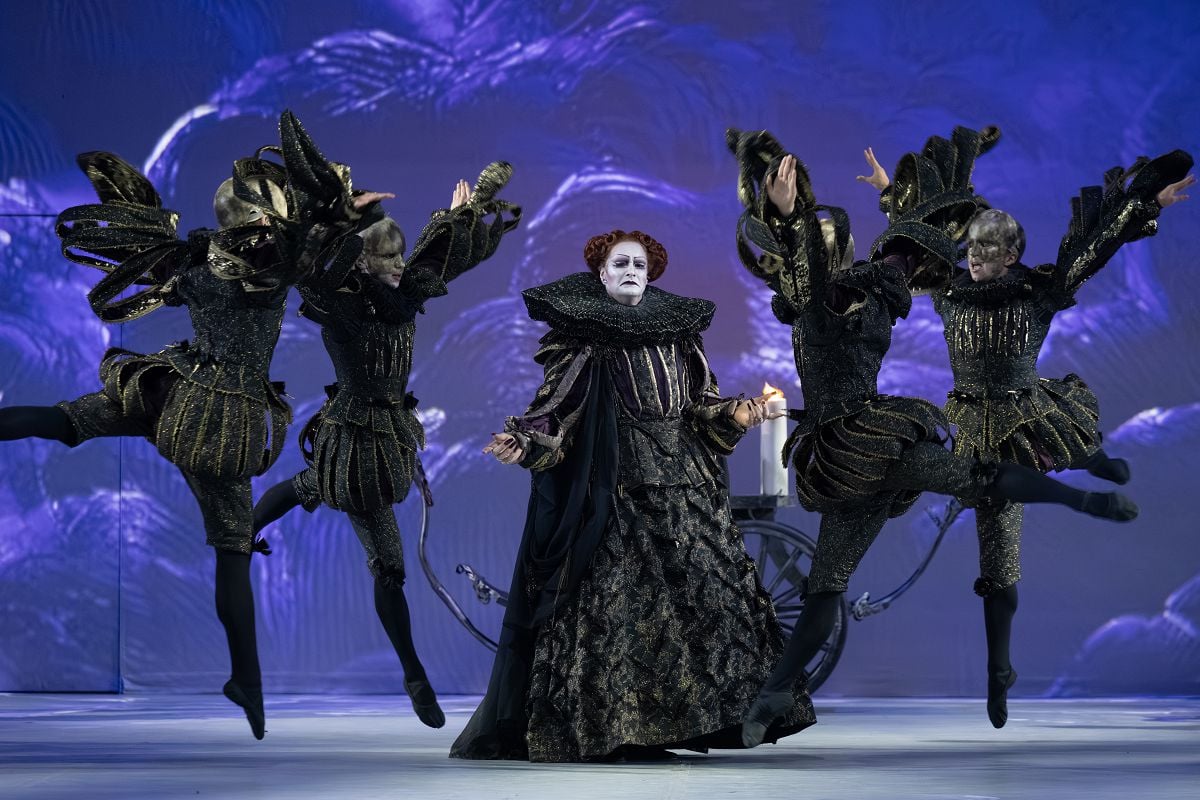
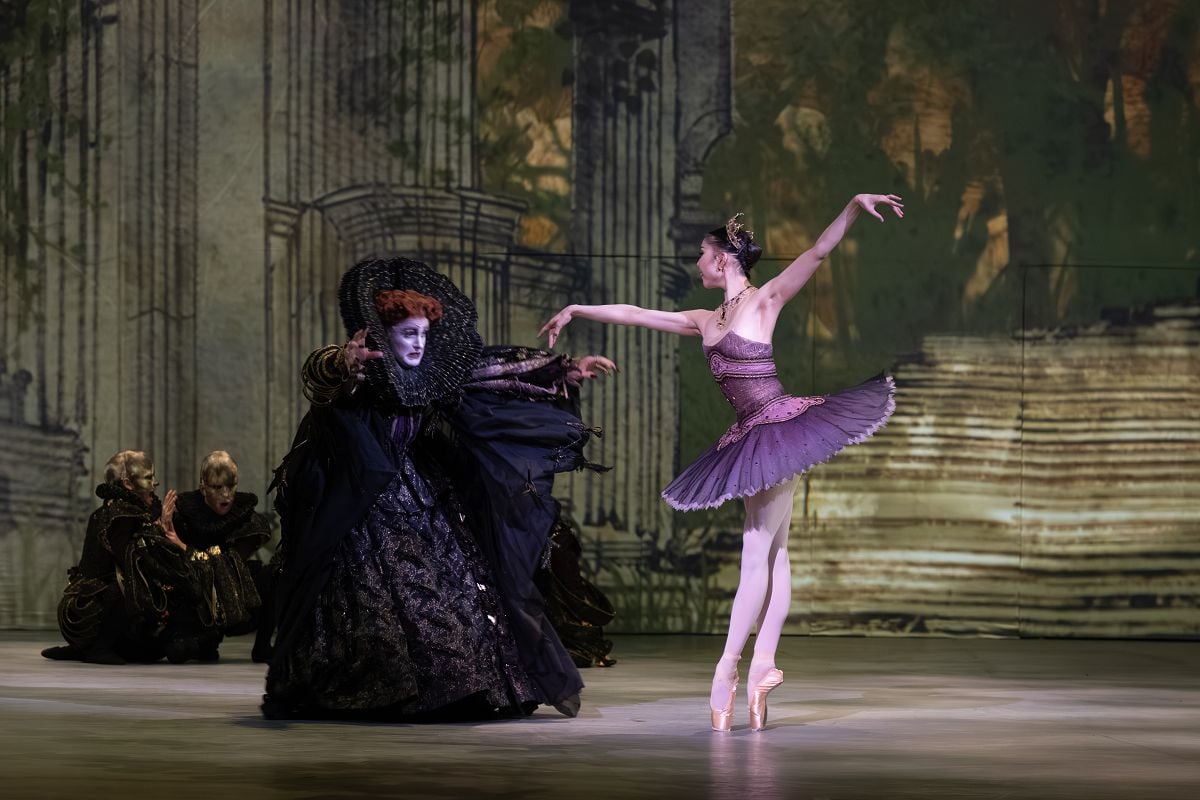
Anri Sugiura is a relatively new ENB dancer, to me at least, and her Lilac Fairy mime was a little anonymous in this large venue, although her dancing was assured. James Streeter was an outstanding, malevolent Carabosse, dressed incongruously in the manner of Queen Elizabeth I, with fiery red hair and a ruff. He was perhaps the only performer to really command the auditorium. The six fairies at Aurora’s christening each delivered their gifts with grace. Katja Khaniukova and Rentaro Nakaaki recovered from the fluffed lift at the end of their pas de deux as Princess Florine and The Bluebird to deliver excellent variations; Ken Saruhashi and Julia Conway were memorable as the Wedding scene’s Gold and Silver. Throughout the cast, characterful, sublime performances carried the fairy tale along with conviction, despite the staging challenges.
The greatest credit should go to the performers we couldn’t see since the musicians of the ENB Philharmonic Orchestra under the baton of Maria Seletskaja, fresh from winning a National Dance Award for her work, gave a stirring account of one of the most popular of all classical scores. When the perambulating audience became too much of a distraction, it was a relief just to close one’s eyes and listen.


Graham Watts is a freelance writer and dance critic. He writes for The Spectator, Tanz, Shinshokan Dance Magazine (Japan), Ballet Magazine (Romania), BachTrack and the Hong Kong International Arts Festival and has previously written for the Sunday Express, Dancing Times, Dance Europe, DanceTabs, London Dance, the Edinburgh International Festival and Pointe magazine (USA). He has also written the biography of Daria Klimentová (The Agony and the Ecstasy) and contributed chapters about the work of Akram Khan to the Oxford Handbook of Contemporary Ballet and on Shobana Jeyasingh for the third edition of Routledge’s Fifty Contemporary Choreographers.
He is Chairman of the Dance Section of The Critics’ Circle and of the UK National Dance Awards and regularly lectures on dance writing and criticism at The Royal Academy of Dance, The Place and (until the war) for Balletristic in Kyiv. He was a nominee for the Dance Writing Award in the 2018 One Dance UK Awards and was appointed OBE in 2008.



A generous and honest review. I live in a distant land and am unable to see this production, but if I may add my few words.
My thoughts-
As far as the dancers are concerned, Sleeping Beauty is the biggest test for any Classical Ballet Dancer; the technique is exacting and prescriptive… for the dancer’s technique to be examined “in the round” would appear to be a nightmare. I suspect that it would have been an ordeal for them.
Thank you, Graham Watts, for your detailed reviews.
Maggie