Review: English National Ballet’s The Sleeping Beauty with Ivana Bueno and Lorenzo Trossello

Matthew Paluch sees The Sleeping Beauty at The Royal Albert Hall – good dancing with a digital backdrop that brings the story and score to life even more.
| Title | The Sleeping Beauty |
| Company | English National Ballet |
| Venue | Royal Albert Hall, London |
| Date | 27 June 2026 |
| Reviewer | Matthew Paluch |
Call me old-fashioned… but I’m not sure why we’re watching dance at the Royal Albert Hall if it isn’t in the round.
Since 1997, English National Ballet has been producing in-the-round productions at the iconic venue, yet in 2026, they’re offering Kenneth MacMillan‘s The Sleeping Beauty in a proscenium production without the physical framing and sets.
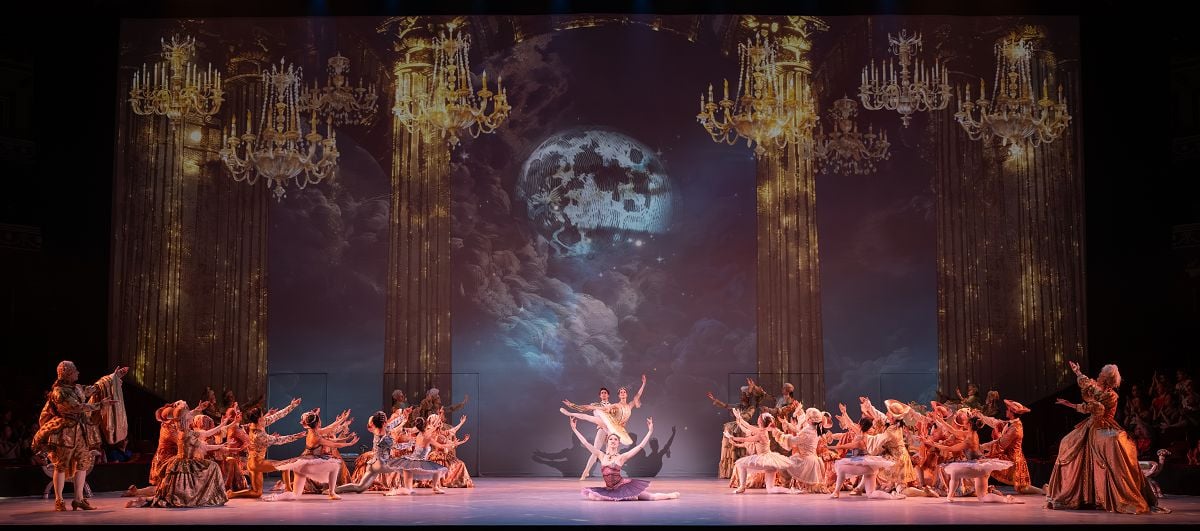
The saving grace of the production is some good dancing and the digital backdrop by Charlotte MacMillan (Kenneth’s daughter). Digital can be problematic – screensaver territory – but C MacMillan has brought balance and taste. Too much movement is off-putting, and none is a waste of time, but C MacMillan has found exactly the right balance. Celestial clouds barely move, purple storms swirl into black holes, and flora collages build flower by flower. The overall feel is a mix of Renaissance and Rococo styles, and everything C MacMillan has done brings the story and score to life even more.
The production has been tinkered with. A four-act ballet with two intervals is now a two-act work with one interval. I can understand the thinking, trying to make the duration more palatable… but it still felt like we were in the chair for a long time. Especially between Acts Two and Three, where we basically sat watching no dance, listening to the music from the Awakening pas de deux. Weird choice.
When you edit, there are compromises. The key story doesn’t suffer, but nuances are lost – both narrative and choreographically. The Sleeping Beauty with no Lilac Attendants dance… imagine that; well, we don’t have to anymore. A second act with no Hunt scene… all that beautiful music gone, and the one chance for Prince Florimund’s character to have some backstory.
And the final sacrilegious decision: cutting Little Red Riding Hood and the Wolf and keeping Puss in Boots and the White Cat. Kill the cats already!
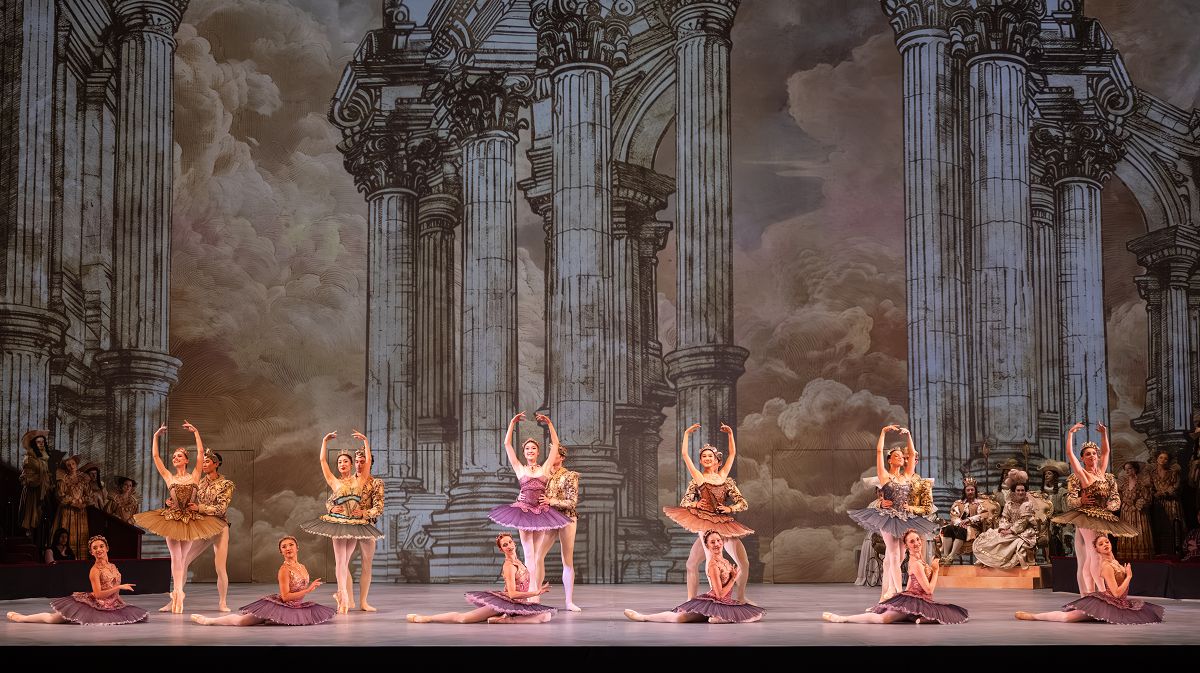
Overall, the dancing was to a high standard, but if I were being very picky, I’d say some of the ladies need to feel more rotation in bourrée and work the underneath foot in allegro. The Fairies in the Prologue all brought confident execution, and Hatice Çağla Ertürk as the Lilac Fairy is majestic indeed. I look forward to seeing her in more expansive roles. Junor Souza definitely had fun playing Carabosse, and it was infectious. Though I’d question some walking choices moving forward.
Of the Act Three diverts, Rentaro Nakaaki as the Bluebird was the one to watch. What a dancer. This might be the first time I’ve seen a Bluebird actually look like they’re flying as they execute the famously exhausting solo. And he finished his double tour to the knee with the most expressive arms, like vivid wings coming to an artistic rest. Absolutely loved it.
Lorenzo Trossello did elegant work as Prince Florimund. He suits the adagio style of Act Two, and his Act Three solo had evident clarity. He’s absolutely a Danseur Noble and, with more experience, will undoubtedly continue to improve.
I’ve always been interested in Ivana Bueno’s dancing, so it was a pleasure to see her Aurora. Bueno is a very capable dancer, so the performance goes without any serious glitches. She’s the kind of performer who lets you sit back and relax. Throughout, she showed clear, precise footwork and total ease in the upper body. She turns so naturally, whether solo or partnered, and her interpretation of Aurora is unaffected. She tells the story subtly, as if it’s happening in real-time to her. I realise this analysis sounds obvious, but it’s actually very hard to do. So often, dancers can become caricatures in roles.
My only advice would be to heed the score, which was beautifully played by the English National Ballet Philharmonic conducted by Music Director Maria Seletskaja.
Aurora, of all the foundational roles, is about musicality. Petipa choreographs to the Tchaikovsky and vice versa. There is room for interpretation, of course, but not to leave the actual dance/music relationship. Individuality is what makes a dancer, but certain ballets demand choreographic adherence, and Beauty is definitely one of those, specifically Aurora. It may sound militant on paper, but in practice, everybody wins. I’ll step off the balletomane soapbox now.
Note: I hope the seats behind the Thrones were sold with a warning. I don’t think I’ve ever seen seats with such bad sightlines. Proscenium productions in any space need seating configurations that reflect the experience. The current Beauty/Royal Albert Hall one doesn’t. At all.


Matthew Paluch was awarded a place at The Royal Ballet School in 1990 where he graduated in 1997. His first four years as a professional dancer were spent working with London City Ballet, Scottish Ballet, K-Ballet and English National Ballet, becoming a full-time member of ENB until leaving in 2006.
Matthew graduated from the Royal Academy of Dance, Professional Dancers’ Teaching Diploma in 2007, and was formerly on faculty at The Royal Ballet School. He completed his Masters in Ballet Studies at Roehampton University in 2011, has been a freelance writer since 2010 and currently works in the Law Sector.
He is a member of the Dance Section of The Critics’ Circle.