Review: Rocío Molina’s Calentamiento – Flamenco Festival London 2026

Jonathan Gray sees “idiosyncratic and hugely talented” Rocío Molina in Calentamiento, bringing something new and entirely individual to the world of Flamenco.
| Title | Calentamiento |
| Company | Rocío Molina |
| Venue | Sadler’s Wells, London |
| Date | 4 June 2026 |
| Reviewer | Jonathan Gray |
Rocío Molina is one of the world’s most adventurous dance stars, and any new show devised by this unconventional Flamenco diva is always going to be a must-see. The theatre was packed for Calentamiento, Molina’s latest production at Sadler’s Wells, presented – for one night only – as part of London’s Flamenco Festival.
Calentamiento, which in Spanish means “warming up”, or “heating up”, found Molina on superlative form. Now in her early forties, she is a small, compact dancer, with strong legs and a supple body, and a quite astounding technique. She is also a maverick performer, who takes the art of Flamenco into very different directions. In addition, she can be incredibly witty and funny. On stage throughout the performance, even before the lights are lowered, the audience sees Molina literally “warming up”, her yoga and Pilates exercises, complete with yoga mat and rubber bands, demonstrating her strength, flexibility and physicality, but that is only the start of it.

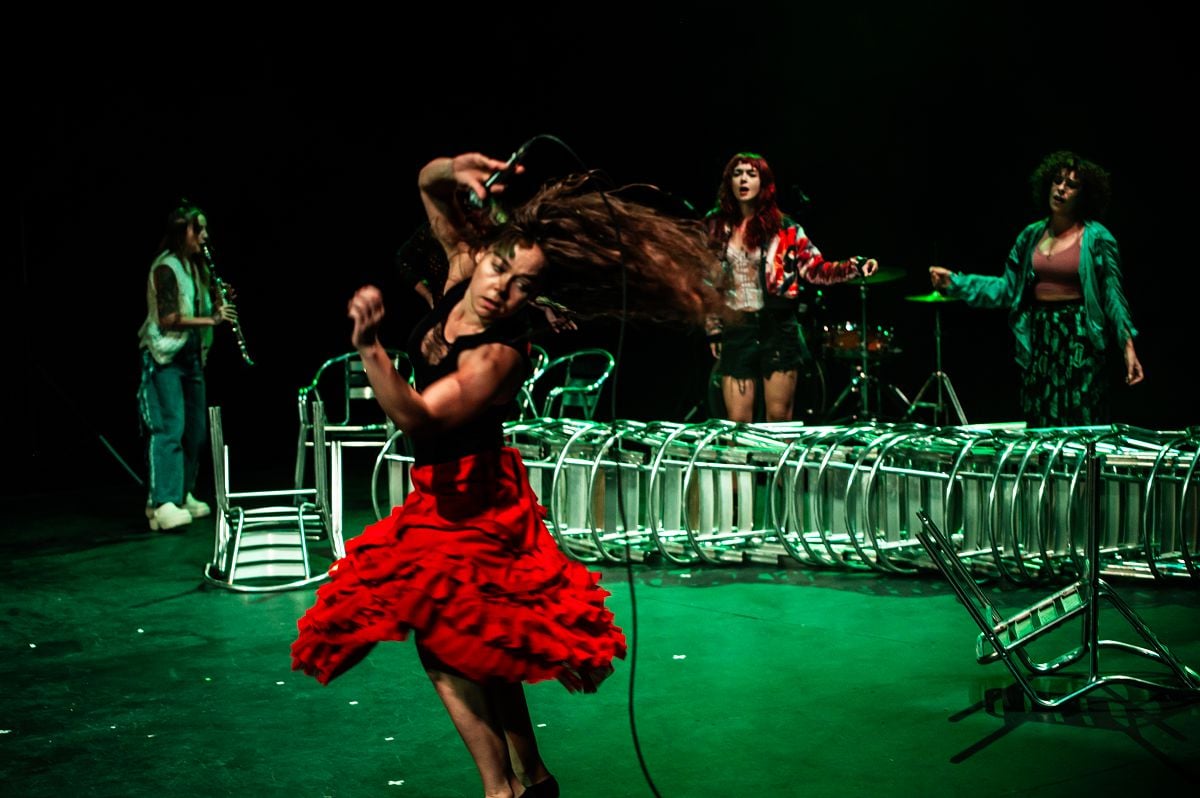
Taking up a microphone, she describes to the audience her warm-up routine before a performance, talking and demonstrating how she begins to increase the rapidity of her zapateado (footwork) from 120 beats per minute to 140 and 180. Her voice becomes the soundtrack to the percussive taps of her heels and toes and tells us this is an exercise she has been carrying out since she was seven years old.
So accomplished and technically brilliant is Molina, that she makes every step and movement seem casual and easy. It is a surprise when she reveals she thinks her right foot is weaker than her left, so she has to pay it extra attention, and also that she does these exercises continuously for at least 35 minutes – which is pretty much the exact time she spends on this section of the show.
“Dancing hurts!”, Molina exclaims, but she needs to be “sweaty and tired” before she starts dancing for real. Listening to her, you can hear how her breaths quicken and then slow as the rhythms of her zapateado speed up and then begin to subside. Molina also tells the audience she always needs to begin again, begin again, begin again, otherwise she thinks she will be weak. When she is later joined on stage by four female singers – Ana Polanco, Ana Salazar, María del Tango and Gara Hernández – all contained in a kind of see-through lit box, she says of them, “If they don’t warm-up, they will be weak”.
Molina is also joined by singer and dancer José Manuel Ramos “Oruco”, who could be her teacher, her confidante, her dance partner or her lover, and the audience are reminded that Calentamiento could also be interpreted as becoming feverish, or excited or aroused by someone. The couple’s relationship becomes intimate; they kiss, and their breaths and sniffs provide a new rhythm to the performance. The dancing slows, and later Molina sits and listens to the women singing again, before joining them in the box, and then dragging towering stacks of metal chairs onto the stage, and also a drum kit.
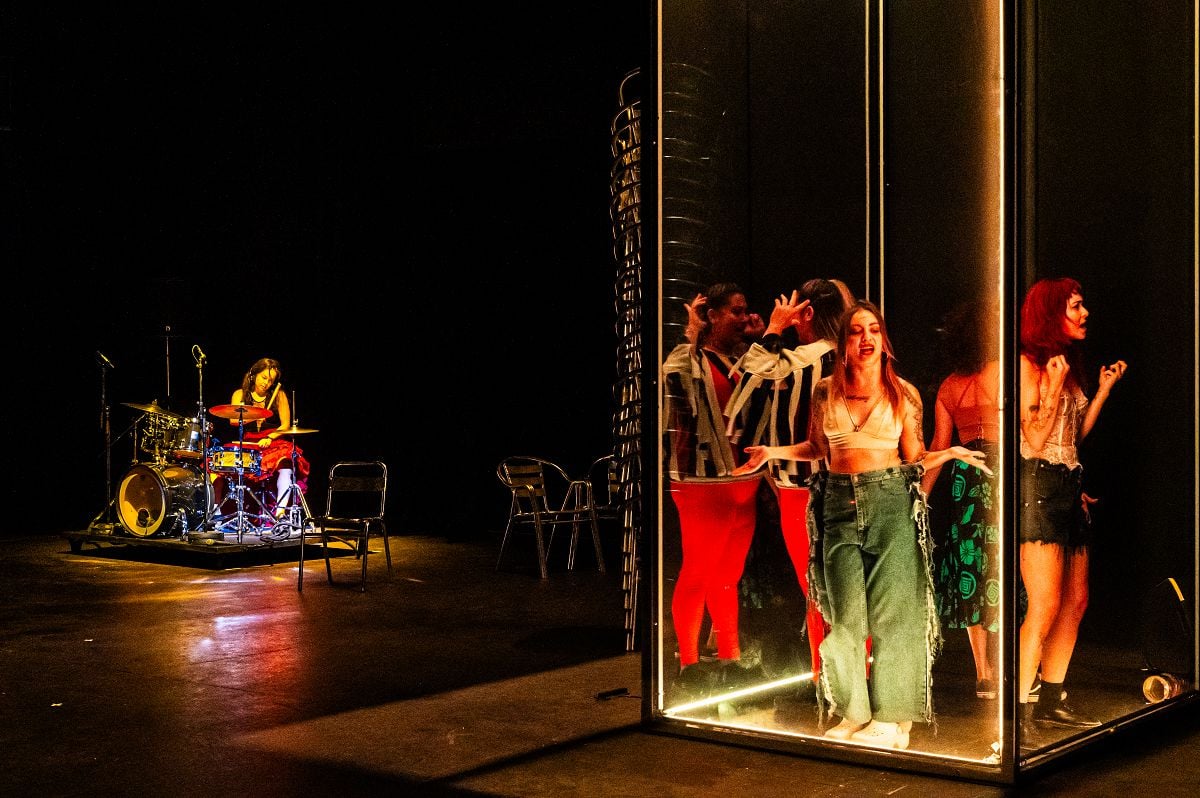
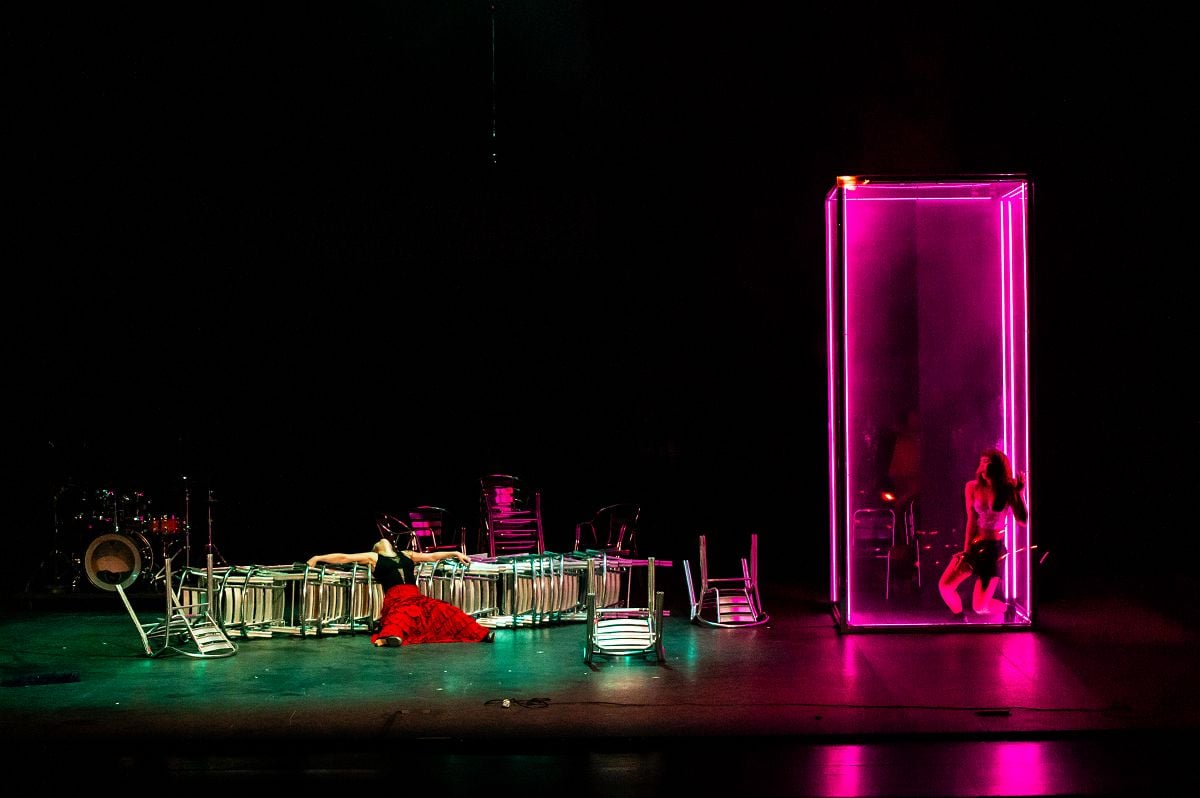
Up to this point, I had been with Molina and the concept of the show all the way, but thereafter, I felt Calentamiento began to sag in spirit and become just a bit too self-indulgent. As the drumbeats quickened into the kind of anarchy of excess at a shit-hot night club, the singers gyrated as furiously as demons, and Molina toppled the stacks of chairs with a crash onto the floor, dancing through, around and on top of them until she seemed to collapse in exhaustion.
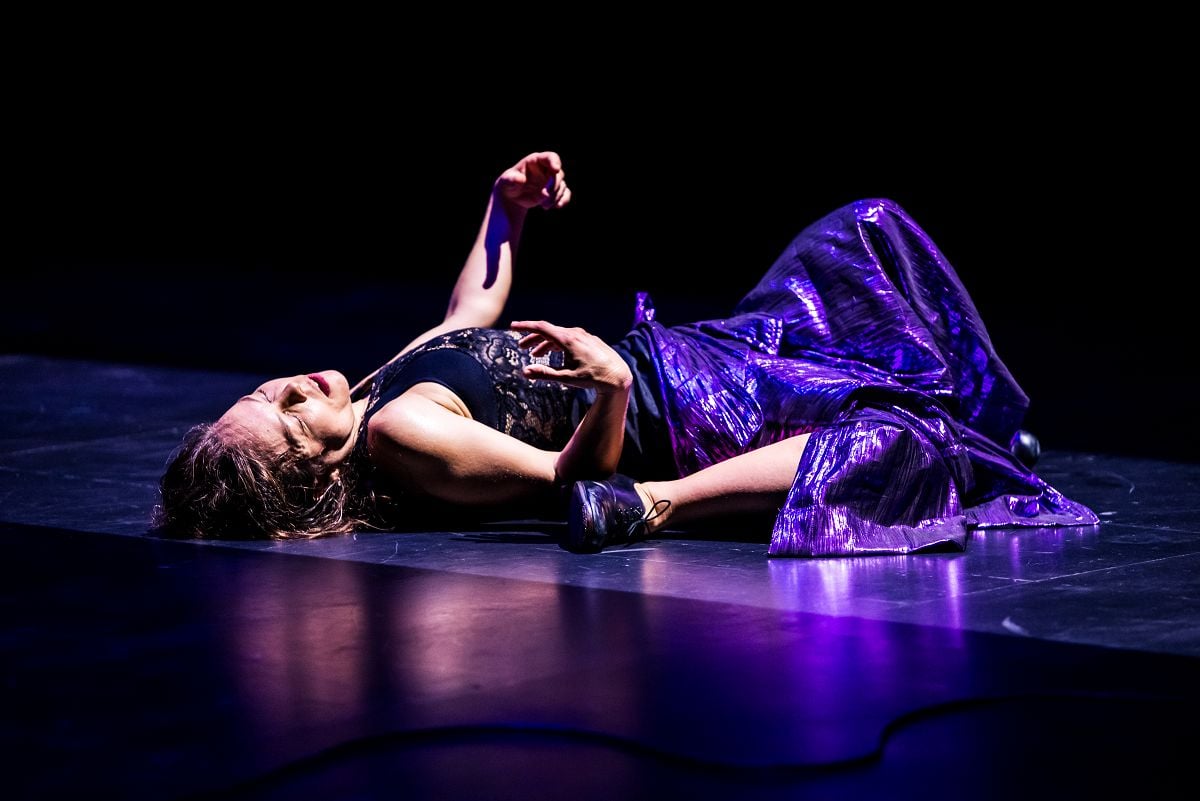
The show didn’t end there, however, as Molina cleared a space on the floor and waited as her fellow performers loaded chairs onto her body in a great pile, causing the audience to laugh. She then proceeded to tap madly away until the chairs fell away from her. Even during the curtain calls, with the audience roaring and cheering their approval, Molina continued to perform and – it is said – kept on dancing until the very last member of the audience left the auditorium.
Molina pushes herself to exhaustion in Calentamiento (it is no wonder there was only one scheduled performance of the show at the festival), and you can readily forgive her indulgences as her artistry, her skill, her humour and irreverence, her pluck and her sheer charisma are all completely admirable. Idiosyncratic and hugely talented, Rocío Molina brings something new and entirely individual to the world of Flamenco. There is nobody quite like her.

Jonathan Gray was editor of Dancing Times from 2008 to 2022.
He studied at The Royal Ballet School, Leicester Polytechnic, and Wimbledon School of Art where he graduated with a BA Hons in Theatre Design. He was on the Curatorial Staff of the Theatre Museum, London, from 1989 to 2005, assisting on a number of dance-related exhibitions, and helping with the recreation of original designs for a number of The Royal Ballet’s productions including Danses concertantes, Daphnis and Chloë, and The Sleeping Beauty.
Jonathan Gray has also contributed to the Financial Times and The Guardian, written programme articles for The Royal Ballet and Birmingham Royal Ballet, and is co-author of the book Unleashing Britain: Theatre gets real 1955-64, published in 2005. He is a member of the Dance Section of The Critics’ Circle.