Review: Ballet Central mixed bill – Central School of Ballet’s graduate company
Graham Watts sees Ballet Central perform four works: Solitaire, BOLERO 18, REPLICA, and Times Square Ballet.
| Title | Solitaire | BOLERO 18 | REPLICA | Times Square Ballet |
| Company | Ballet Central |
| Venue | Britten Theatre, London |
| Date | 17 July 2026 |
| Reviewer | Graham Watts |
It is commonplace for dance conservatoires and university-level schools to provide their graduating students with a pre-professional performance experience, and the UK summer is full of such shows, but I doubt that any go quite so far as Central School of Ballet. Its graduate company, Ballet Central, has toured to nine venues all over England – from Darlington to Brighton – beginning on 19 May and concluding with this performance in London, almost two months later.
The repertoire is centred upon a revival of Kenneth MacMillan‘s early one-act ballet, Solitaire, which he created in 1956 as a late replacement for a cancelled John Cranko ballet, for which Desmond Heely’s designs had already been made for MacMillan to inherit.
The remainder of the programme comprised three brief works: BOLERO 18 by Cameron McMillan; REPLICA by Monique Jonas of Jona Dance and New Adventures; and a brief excerpt from Leonard Bernstein‘s On the Town entitled Times Square Ballet, choreographed by Ashley Page. It was a satisfying mix, although it would have worked better to end with Solitaire since it was like hors d’oeuvres following a filling main meal.


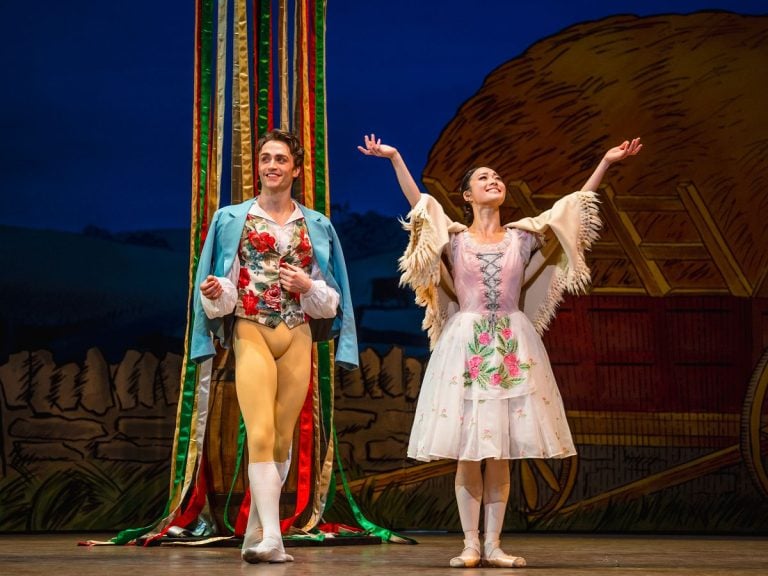
The Ballet Central dancers captured the many moods of Solitaire beautifully, and the performance was a credit to them, their teachers and to the ballet’s stager, Lynn Wallis. Solitaire is a game for one, and that has always been the ballet’s sub-title and sub-text. In a series of divertissements, one character remains ever-present, as a partner, in an ensemble or simply as an observer. MacMillan’s lifelong interest in representing psychology through dance is evident in this early work since the ever-present woman is essentially a loner, seeking friendship and company but always ending alone. Haruka Kawamura brought an enthusiastic adventurousness, humour and a certain poignancy to her excellent portrayal of MacMillan’s sense of expressive theatre through dance.
The work is performed to a recording of Sir Malcolm Arnold’s Eight English Dances, which include several popular tunes. A supporting cast of a dozen dancers swept through the sequences with a joie de vivre, with four excellent soloists – Kirit Devani, Michael Hawkins, Midori Saito and Shin Kurokawa – offering various possible associations with Kawamura’s outsider. All were excellent, but I was especially impressed by Kurokawa’s virtuoso dancing, strong jumps and a very centred core that provided exceptional balance throughout.


It is hard to associate Maurice Ravel’s Boléro in dance without thinking of Maya Plisetskaya, Jorge Dunn or Sylvie Guillem performing Maurice Béjart‘s choreography on that round table or Torvill and Dean’s gold-medal ice dance in Sarajevo. So, hats off to Cameron McMillan for having the courage to give us alternative movement to the driving momentum of that astonishing music in BOLERO 18.
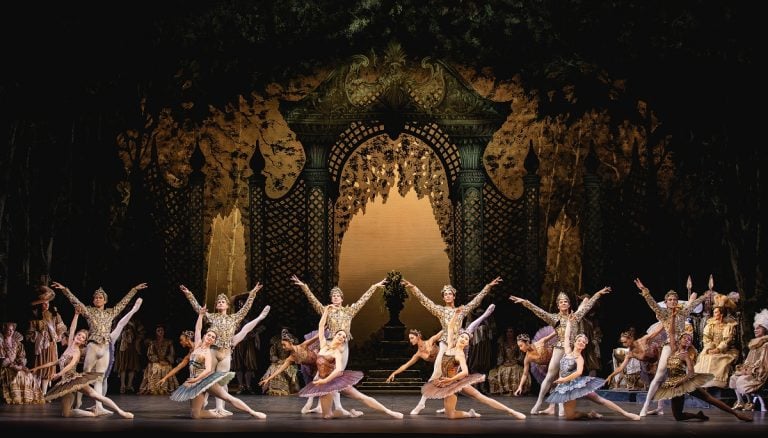
Fifteen dancers provided an egalitarian ensemble, moving in groups and layers to Ravel’s insistent rhythms, but also often counter-intuitive to the continuous, repeated melodies with their percussive beat and gradual orchestral crescendo. McMillan’s choreography was generally more intricate than the gradual build in the music. The dancers were uniformly excellent, with the group being the star rather than any individuals, although I felt that it ended with a whimper rather than a bang.
Monique Jonas’ REPLICA brought live music to the performance as Philip Feeney played his own piano composition for another large group, twenty by my count, almost all of whom were returning from one of the earlier works. The stage of the Britten Theatre is not large, and credit is due to dancers and stagers for enabling such a large group to perform without any obvious mishap in this constrained space. A large mirror was the only set device, and the abstract choreography was apparently the product of task-based development to explore mirror images and reversed reflections. Feeney’s music was the highlight, and the ensemble performance was again strong.


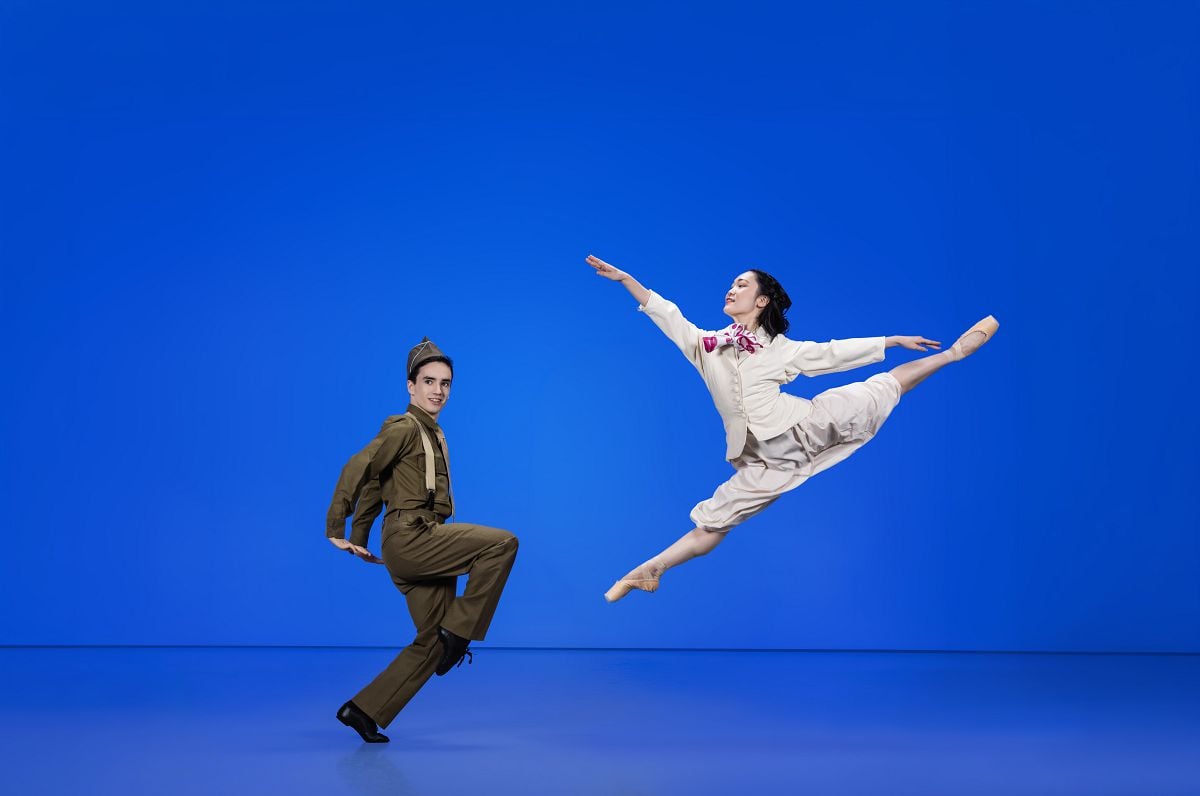
The evening ended with a very brief blast of Bernstein’s On the Town, turned into Times Square Ballet by Ashley Page. It gave the dancers, again twenty but clearly split into ten pairs, a chance to enjoy a fun exercise in balletic musical theatre. The synopsis declares that the fleet ‘is in’ and the mini ballet began with a US naval rating declaring that the town belongs to the navy. However, the excellent US-40s-vintage costumes (by Chloe Ivey-Ray) were not very representative of the fleet since there appeared to be only one or two sailors amongst the crowd! Page does well to capture the hustle and bustle of a busy Times Square, but it is way too brief to be of any great consequence.
I do hope that all these 33 young people will find work in the sector, preferably as dancers, but I fear that this is unlikely to be the case, simply due to the over-proliferation of dance graduates each year. The Ballet Central experience appears to be excellent preparation for a professional career, and I really hope that it doesn’t become the only such experience to look back upon.