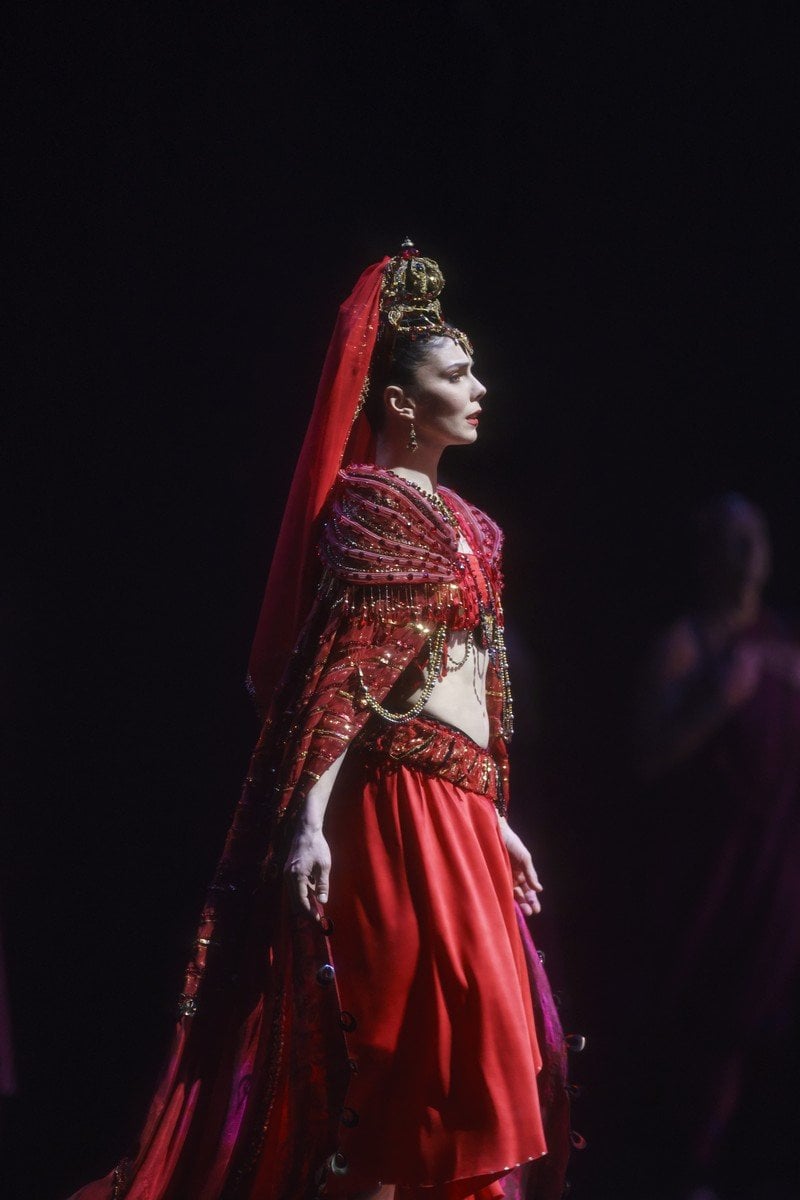
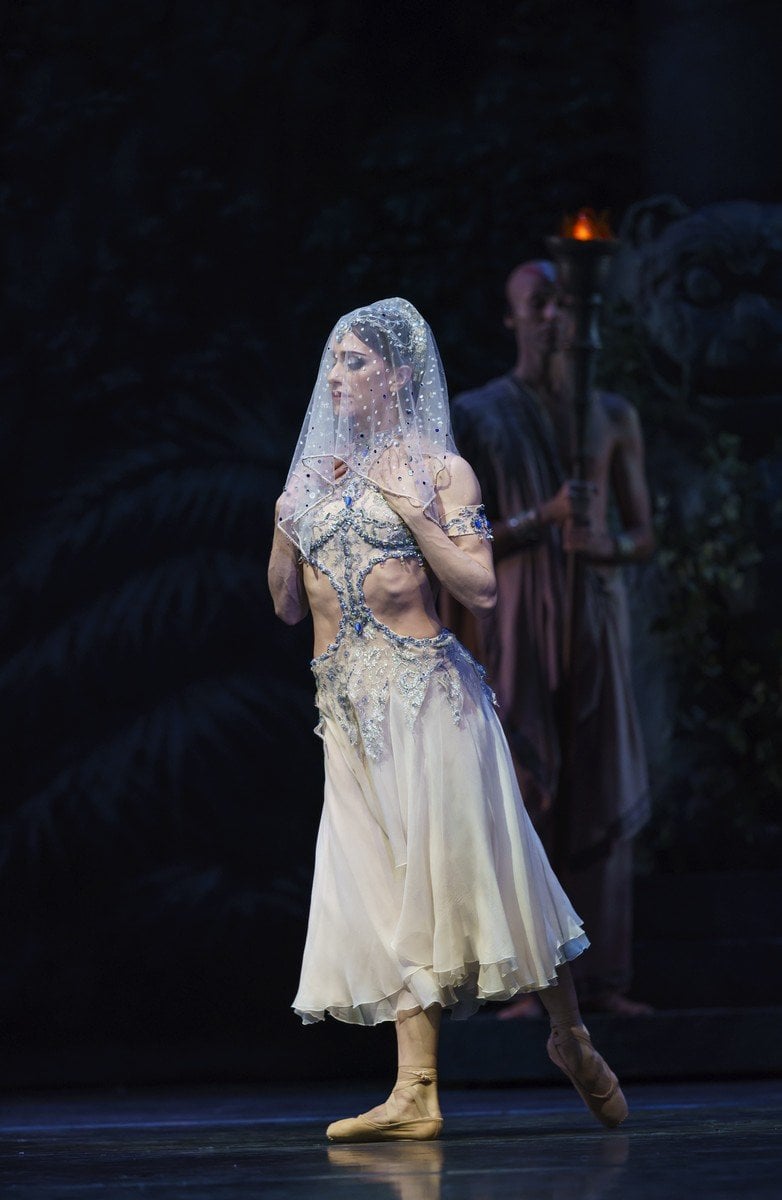
An iconic 19th-century Russian ballet, La Bayadère was originally performed at the Bolshoi Theatre in St Petersburg in 1877, and was regularly performed within the former Soviet Union throughout the 20th century. However, it remained unknown in the West until the Kirov Ballet toured with the Kingdom of the Shades scene in 1961. Natalia Makarova saw La Bayadère as a child in Leningrad and created this production in 1980, which was first performed by The Royal Ballet in 1989.
The excellent Petipa Society site says this about the The Kingdom of the Shades scene:
… The Entrance of the Shades was inspired by Gustav Doré’s illustrations for Dante’s Paradiso from The Divine Comedy, with each dancer of the thirty-two strong corps de ballet clad in white tutus with veils stretched about their arms. Each of the dancers made her entrance one by one down a long winding ramp from upstage right with a simple arabesque (fondu) and into cambré, followed by an arching of the torso with arms in fifth position, followed by two steps forward. With the last two steps, she made room for her sister shade and the combination would continue thus in a serpentine pattern until the entire corps de ballet had filled the stage in eight rows of four. Then followed simple movements en adage to the end, where the ballerinas split into two rows and lined opposite sides of the stage in preparation for the following dances. Petipa left the Entrance of the Shades free of technical complexity – the unison of the whole and the effect of the descending ballerinas was the challenge, as a mistake from one dancer would spoil the entire scenario.
For his 1900 revival, Petipa changed the setting for The Kingdom of the Shades scene from an enchanted castle in the sky on a fully lighted stage to a dark and rocky set on the starlit peaks of the Himalayas. He also increased the number of dancers in the corps de ballet from thirty-two to forty-eight, making the illusion of descending spirits all the more effective in the Entrance of the Shades.
One very interesting passage that has been changed in modern times is the Variation of Nikiya with the Scarf, which is known today as The Scarf Duet. Today, this piece is danced by Nikiya with Solor holding the ends of a tulle scarf before the latter exits with the scarf, leaving Nikiya to complete her solo alone. In the original variation by Petipa, Solor never took part in this passage – Nikiya entered the stage holding one end of a long tulle scarf, while the other end was attached to a wire in the rafters above the stage. When Nikiya released the scarf, it flew away across the stage and disappeared into the rafters, as if it were “supernaturally guided”. The original Nikiya, Ekaterina Vazem briefly mentions this effect in her memoirs:
I had a great success, in the variation, accompanied by [Leopold] Auer’s violin solo, with the veil which flies upwards at the end.
The Kingdom of the Shades was the first scene from La Bayadère to be staged in the West. In the 1920s, Anna Pavlova attempted to stage the scene for her company’s repertoire, but alas, her attempts were unsuccessful. It was not until 1961 that The Kingdom of the Shades made its Western début when it was staged for the Teatro Municipal in Rio de Janeiro, Brazil by Eugenia Feodorova on the 12th April. That same year, on the 4th July, the Kirov/Mariinsky Ballet performed The Kingdom of the Shades on the Palais Garnier in Paris and it was this staging that won the scene widespread interest and recognition as, at that time, La Bayadère was unknown in the West. In 1963, Sir Frederick Ashton commissioned Rudolf Nureyev to stage The Kingdom of the Shades for the Royal Ballet, as Nureyev was very familiar with the scene having danced in the full-length ballet in Russia. Sir John Lanchberry re-orchestrated and arranged Minkus’s score. The Royal Opera House première of The Kingdom of the Shades was a huge success and is considered to be one of the most important events in the history of ballet.
Graham Spicer, aka ‘Gramilano’, is a writer, director and photographer based in Milan. He was a regular columnist for Opera Now magazine and wrote for the BBC until transferring to Italy. His articles have appeared in various publications from Woman’s Weekly to Gay Times, and he wrote the Danza in Italia column for Dancing Times magazine. Graham was the historical advisor on Codice Carla, the 2023 documentary on Italian ballerina Carla Fracci.
Graham also works as a dance photographer, and his photos have appeared in many books, theatre programmes, and magazines, including Dancing Times, Dance Spirit and Ballet2000, as well as all the major Italian newspapers.
He is a member of the Dance Section of The Critics’ Circle.