[Review] Royal Ballet’s ‘The Winter’s Tale’ – “a ballet of remarkable dramatic power”

Jonathan Gray sees Chrisopher Wheeldon’s remarkable ‘The Winter’s Tale’ at The Royal Opera House
| Title | The Winter’s Tale |
| Company | The Royal Ballet |
| Venue | The Royal Opera House, London |
| Date | 3 May 2024 |
| Reviewer | Jonathan Gray |
Ten years ago, when first performed by The Royal Ballet, I attended the premiere of Christopher Wheeldon‘s The Winter’s Tale at Covent Garden with caution and even a little anxiety. Just the idea of adapting William Shakespeare’s play into a ballet made me extremely nervous, especially as it had a reputation for being very difficult to stage successfully. I couldn’t imagine how Wheeldon was going to manage it.
The choreographer, however, received intelligent advice from Nicholas Hytner, the remarkable theatre director and, together with his composer, Joby Talbot, devised a scenario that drew out the essence of the play and transformed it into a ballet of remarkable dramatic power. The long first act establishes the main characters and explains the dark, complicated plot, which is conveyed with clarity through expressionistic gestures and is aided by Bob Crowley‘s spare yet effective sets and costumes and Natasha Katz’s lighting. The second act is a kind of danced idyll, where Perdita and Florizel express their love amidst the support of their friends, and the short last act swiftly resolves the loose ends of the plot without quite giving the audience a happy conclusion. Talbot’s music, although rarely memorable, does sterling work in highlighting the ballet’s drama.
By the end of the first night in 2014, I felt that Wheeldon, with this combination of explicit drama and gorgeous dancing, had achieved almost the impossible and transformed The Winter’s Tale into an original and successful three-act ballet. A decade on, and following several revivals by the company, the work has now settled into the repertory and will, I predict, be the ballet for which Wheeldon will be best remembered in the future.

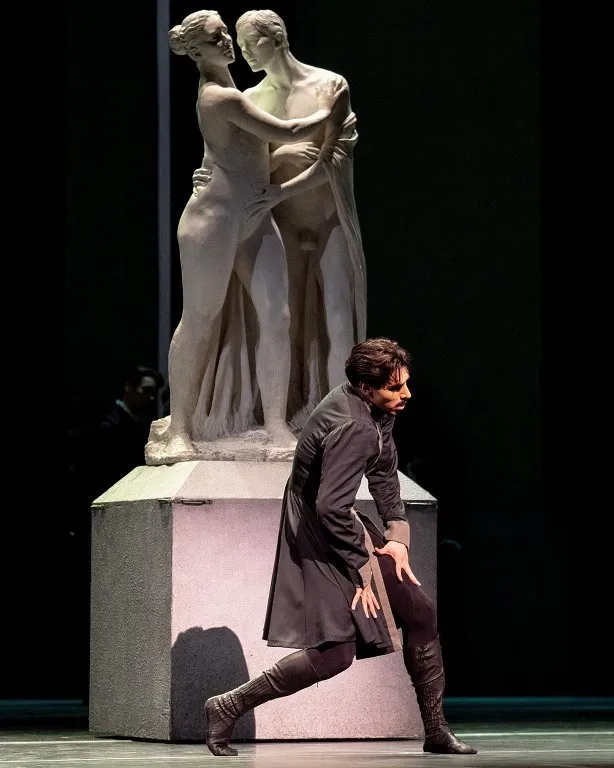


It was good to see The Winter’s Tale back at Covent Garden again this spring, where it opened a run of 11 performances on 3 May, conducted by The Royal Ballet’s music director, Koen Kessels. With only Lauren Cuthbertson as Hermione and Gary Avis as Father Shepherd remaining in their original roles, the ballet has been freshly cast and proved it can live on through the interpretation of a new generation of artists. One of the outstanding performances on opening night was the Leontes of Cesar Corrales. Unlike the tensely-knotted Edward Watson, who created the role of the King of Sicilia, or the malevolent, spidery Thiago Soares, who followed him, Corrales portrayed Leontes as a hot-blooded king, explosive, autocratic and likely to rise to his jealous and irrational thoughts. Corrales was frightening in his intensity, and he made it no surprise that Leontes could turn upon his wife, Hermione, and his friend Polixenes, King of Bohemia, with violence and cruelty. This was a vivid, headstrong, angry and magnetic performance from Corrales, whose twisted, constricted body movements were only eventually calmed through the quiet influence of Paulina, the ballet’s personification of moral integrity, in a magnificent performance by Melissa Hamilton. At the end of the ballet, when Leontes realises the terrible injustice he has inflicted upon his wife and daughter, Corrales shows the audience a broken man with no right to expect forgiveness, whilst Hamilton’s whole body seems to sigh with sadness and resignation.
Lauren Cuthbertson offered a gentle portrait of Hermione, the limbs of her body reaching outwards in long, questioning lines of disbelief at her suffering. I especially admired her grace, as well as the way she conveyed the wronged queen’s ambivalence towards her husband at the end – this was in no way a happy reconciliation.
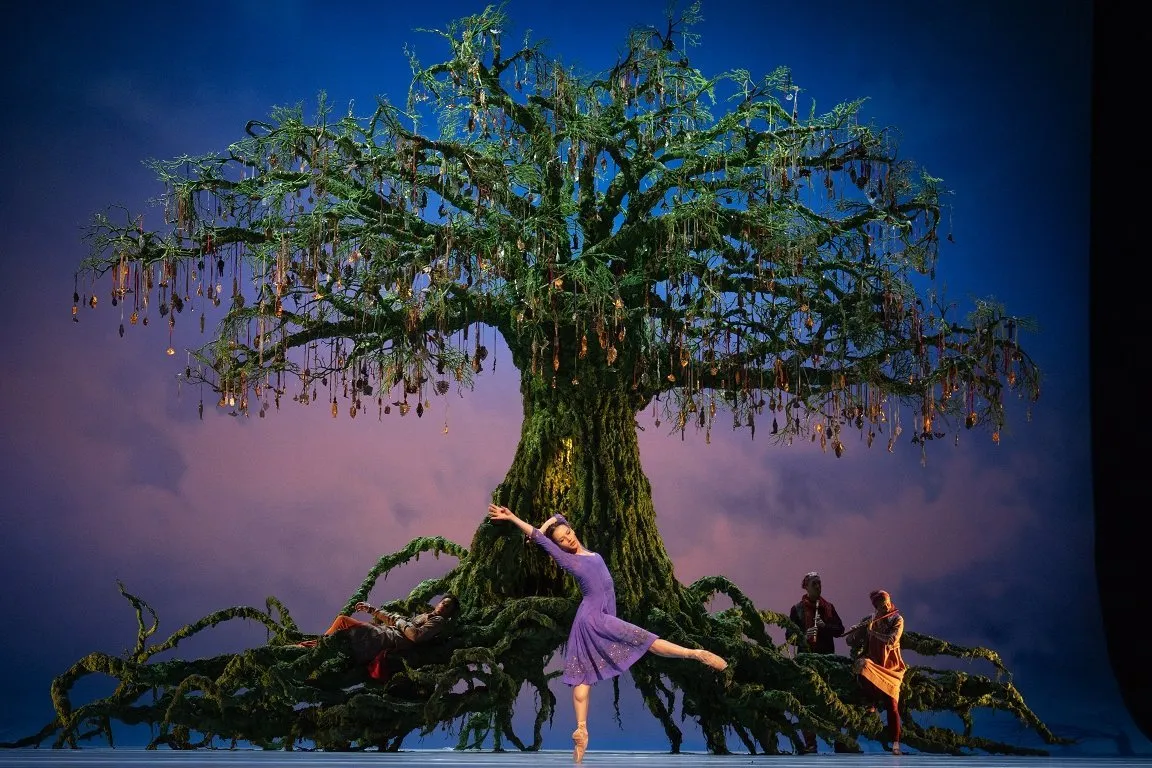


Calvin Richardson gave an authoritative account of Polixenes, a king almost as foolish and headstrong as Leontes, but the dancing honours of the evening went to Francesca Hayward and Marcelino Sambé as Perdita and Florizel. They were glorious, expressing their choreography with musicality, warmth and a golden radiance that made me long for their upcoming performances in Frederick Ashton’s The Dream next month. Equally enjoyable was Marco Masciari as Brother Clown, whose exciting dancing and animated personality marked him out as an exceptional young talent. I will certainly be looking out for him in the future.

Jonathan Gray was editor of Dancing Times from 2008 to 2022.
He studied at The Royal Ballet School, Leicester Polytechnic, and Wimbledon School of Art where he graduated with a BA Hons in Theatre Design. He was on the Curatorial Staff of the Theatre Museum, London, from 1989 to 2005, assisting on a number of dance-related exhibitions, and helping with the recreation of original designs for a number of The Royal Ballet’s productions including Danses concertantes, Daphnis and Chloë, and The Sleeping Beauty.
Jonathan Gray has also contributed to the Financial Times and The Guardian, written programme articles for The Royal Ballet and Birmingham Royal Ballet, and is co-author of the book Unleashing Britain: Theatre gets real 1955-64, published in 2005. He is a member of the Dance Section of The Critics’ Circle.