[Review] The Royal Ballet in Ashton Celebrated – Les Rendezvous, The Dream, Rhapsody

Jonathan Gray sees The Royal Ballet in Ashton Celebrated – Les Rendezvous, The Dream, and Rhapsody – an evening of musicality and daring.
| Title | Les Rendezvous, The Dream, Rhapsody |
| Company | The Royal Ballet |
| Venue | The Royal Opera House, London |
| Date | 6-7 June 2024 |
| Reviewer | Jonathan Gray |
Although The Royal Ballet describes Frederick Ashton as its founder choreographer, its audiences today are lucky if they see more than a handful of his works in a year. This great British choreographer has been a little neglected by the company he helped shape of late, so it’s good to know that The Royal Ballet is making more of an effort to perform some mixed programmes of his works this summer in Ashton Celebrated, part of Ashton Worldwide, a festival aiming to encourage more companies to present his marvellous creations. The programmes feature a true masterpiece, The Dream, based on Shakespeare’s A Midsummer Night’s Dream and now celebrating its 60th anniversary, as well as Rhapsody, danced to music by Rachmaninoff, a series of Divertissements and a new production of Ashton’s 1934 ballet, Les Rendezvous, which has been absent from the repertoire for nearly 20 years.
The first thing to be said about the “new look” for Les Rendezvous is that it is a vast improvement on the previous staging that included cartoon-like designs by Anthony Ward. The new designer, Jasper Conran, has retained the park gates and railings that for many years featured as part of William Chappell’s original setting at Covent Garden, but behind them Conran depicts a misty, hilly landscape – which could be the Cotswolds – rather than the more usual bright blue sky. His costumes, beautifully cut, evoke the fashions of the 1830s, and are coloured in muted tones of grey, mauve, mustard and white, almost as if the dancers are dressed in semi-mourning. They look lovely, although perhaps the costumes are a bit too sophisticated for a ballet that is essentially about a group of young people meeting up and dancing in a park.
The choreography, staged by Vanessa Palmer, is a reminder of how scintillating from early on in his career Ashton expected his dancers to perform. The leading roles, created on Alicia Markova and Stanislas Idzikowski, two of the most brilliant dancers of the period, are astonishing in their complexity, bravura and piquant musicality, and the cheeky, yet fiendishly difficult pas de trois was first danced by Ninette de Valois, Robert Helpmann and Stanley Judson. The ballet is danced to music from Auber’s opera L’Enfant prodigue. It’s telling that the dancers of today continue to find Rendezvous demanding, but The Royal Ballet, I thought, made a good attempt at tackling the work without entirely masking its challenges. The leads were taken by Marianela Nuñez and Reece Clarke, both much taller artists than the originals, and they brought authority and glamour if not enough speedy aplomb to the dancing. Nuñez relished the deep backbends and tangy port de bras of her choreography without quite letting the audience forget that she is a prima ballerina, and Clarke was impressive in his dynamic solo full of entrechat six and tours en l’air. Isabella Gasparini was vivacious in the pas de trois, alongside Leo Dixon and Harrison Lee, but all three could afford to bring even more fun to the dance than they did.


Both Rhapsody and The Dream are more familiar to audiences, especially as they are not only danced by The Royal Ballet but performed by companies abroad. Rhapsody, which Ashton made nearly 40 years after Les Rendezvous, was originally created on Mikhail Baryshnikov and Lesley Collier and requires the same kind of brilliance of execution and musicality. Over the two evenings it was possible to view dancers who understood the “Ashton” style and those who are only just beginning to get to grips with it.
On 6 June, the talented young soloist Yaisuke Nakao made his debut in the “Baryshnikov” role. He certainly has the stamina to dazzle in all of the dizzying pirouettes, jumps and turns required of him, but he was far too smoothly efficient – the role requires more light and shade, and the choreography demands a greater emphasis on musical and rhythmic dynamics. The following evening another promising male dancer, first artist Daichi Ikarashi, didn’t quite match Nakao’s brilliance, but he made the choreography more exciting to watch because he projected greater spontaneity and attack. In the “Collier” role, Anna Rose O’Sullivan, dancing with Nakao, displayed a golden virtuosity and ballerina authority, especially in the rapid footwork and changes of directions in her choreography, but she sometimes overdid the jumps, which were too forceful, especially towards the end of the ballet. Sae Maeda, another talented young soloist, gave a sweetly promising account of the same role but, like Nakao, needs to project more light and shade in her dancing. The ensemble cast was neat and precise on 6 June, but less disciplined on 7 June.


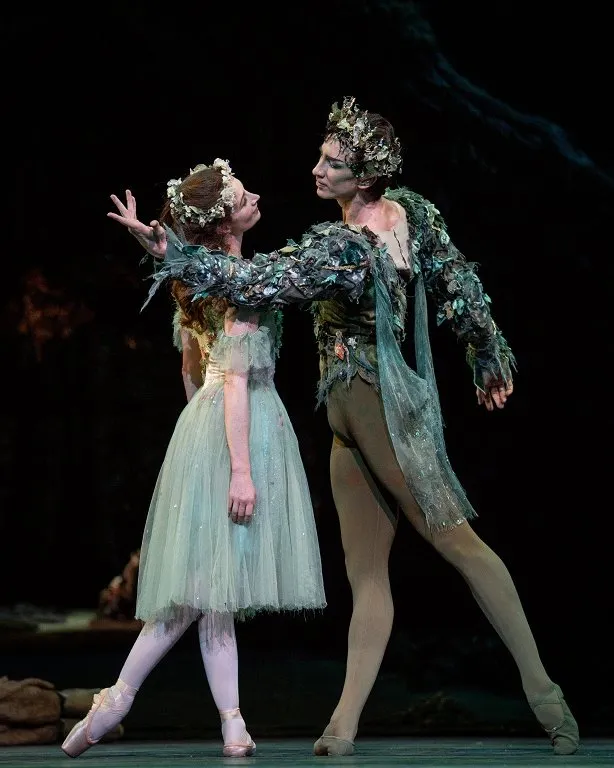
The Dream came up very well and, as a special bonus, on 6 June the original Titania and Oberon, Antoinette Sibley and Anthony Dowell, who have never been surpassed in the roles, came on stage to take a curtain call to mark the ballet’s 60th anniversary. They received an ovation from the audience. Although some of the current crop of Royal Ballet dancers could afford to make more of the comedy ingrained into Ashton’s choreography, it was good to see how some roles that had been dull one night were transformed the next. Ikarashi was all smiles and brilliance as Puck on 6 June, but the following evening Liam Boswell made the character cheekier, funnier and full of personality. Likewise, Joshua Junker made a good attempt at bringing out the pathos of the character of Bottom, but it took the depth of experience and understanding of principal character artist Thomas Whitehead on 7 June to make one shed a tear for the simple Rustic transformed, briefly, into an Ass.
The first night of The Dream was dominated by the performances of Titania and Oberon given by Francesca Hayward and Marcelino Sambé. The couple, who are very well matched in style and temperament, seem to understand Ashton instinctively, dancing with a musicality and daring that allows the ballet to bloom into life. I was thrilled at the way they imbued the king and queen of the fairies with a feral, hot-blooded aristocracy that was also sexually charged, and by the intensity with which they danced the choreography. I was a little disappointed in the dancing of Vadim Muntagirov as Oberon the following night, as he seemed a little under par, but I admired the warmth and femininity Lauren Cuthbertson brought to Titania – she had a light touch that was highly appealing.


There will be more to write on these Ashton Celebrated performances in the coming days, and I shall be reporting back to you on the series of Ashton divertissements performed by both The Royal Ballet and Sarasota Ballet at Covent Garden very soon.

Jonathan Gray was editor of Dancing Times from 2008 to 2022.
He studied at The Royal Ballet School, Leicester Polytechnic, and Wimbledon School of Art where he graduated with a BA Hons in Theatre Design. He was on the Curatorial Staff of the Theatre Museum, London, from 1989 to 2005, assisting on a number of dance-related exhibitions, and helping with the recreation of original designs for a number of The Royal Ballet’s productions including Danses concertantes, Daphnis and Chloë, and The Sleeping Beauty.
Jonathan Gray has also contributed to the Financial Times and The Guardian, written programme articles for The Royal Ballet and Birmingham Royal Ballet, and is co-author of the book Unleashing Britain: Theatre gets real 1955-64, published in 2005. He is a member of the Dance Section of The Critics’ Circle.