Review: Seke Chimutengwende’s The Last Quartet – the future exists in the past
Watching The Last Quartet at The Place, Matthew Paluch found himself drawn into Seke Chimutengwende’s world of improvisation – live music, shifting light and an idea borrowed from T.S. Eliot.
| Title | The Last Quartet |
| Company | Seke Chimutengwende |
| Venue | The Place, London |
| Date | 25 September 2026 |
| Reviewer | Matthew Paluch |
Seke Chimutengwende and team will perform The Last Quartet three times at The Place. Yet if you were to watch all three shows…you’d see something different each time.
Welcome to the world of improvisation.
My experience of improvisation is limited. Very. We’d need to go all the way back to Morecambe in the 1980s. Our local dance festival had an improv section. We’d all enter the stage individually and dance to the provided track. It wasn’t for me. A combination of lack of education and personality meant it was a one-time wonder.
A background in classical ballet means I’m used to set choreography. Masses of room for interpretation, I’d like to think, but set work nonetheless.
As a dance writer, one feels unsure how to connect with improvisation as something that can be analysed and valued. I don’t mean as in good or bad, but rather how something lands.
I don’t normally stay for post-show talks, as a critic I really respect said: they don’t. On reflection, this made sense to me. We’re aiming to have the same experience as the average theatregoer with the work. Nowadays programmes can be absolute tombs, and if you don’t research enough pre-show, you can be totally in the dark.
They had a post-show talk on the night I was there and I weakened. Why? Because improvisation really isn’t my scene, and I was genuinely interested to hear what Chimutengwende and team had to say.
Lots was discussed, and some salient points definitely stuck:
- This is Chimutengwende’s most improvisational (group) piece to date.
- He gathered the specific group together so he would have to spend very little time as choreographer and far more as participant.
- The Dramaturg, Efrosini Protopapa, actively had to move away from conventional dramaturgical practice as they didn’t want the work to be set or influenced by expectation – theirs or ours.
- Chimutengwende used a paraphrased sentence by T.S. Eliot as the initial inspiration: “the future exists in the past”.
The work’s title comes from Eliot’s Four Quartets, and Chimutengwende included the following in the programme notes:
“We shall not cease from exploration
And the end of all our exploring
Will be to arrive where we started
And know the place for the first time”
Chimutengwende has been making work for a long time, and has focused on improvisation over the last 10+ years. The loose premise of this piece is the idea of the “last work” or a “last attempt”, and I imagine this to be a liberating starting point… even if tongue in cheek.
What/how would we all do something if we knew it was our last go at it…?
Would it be a precious, overthought approach or one of total liberation and abandon?
Chimutengwende and friends don’t really know, as each iteration is a totally new thing. Post-show, Chimutengwende was asked what he thinks when executing the piece, or his opinion of it as a whole. He said he tries not to think, so what happens is authentic in the moment. As a way of explaining, he posed a question back: “What does a plant think?” – indeed!
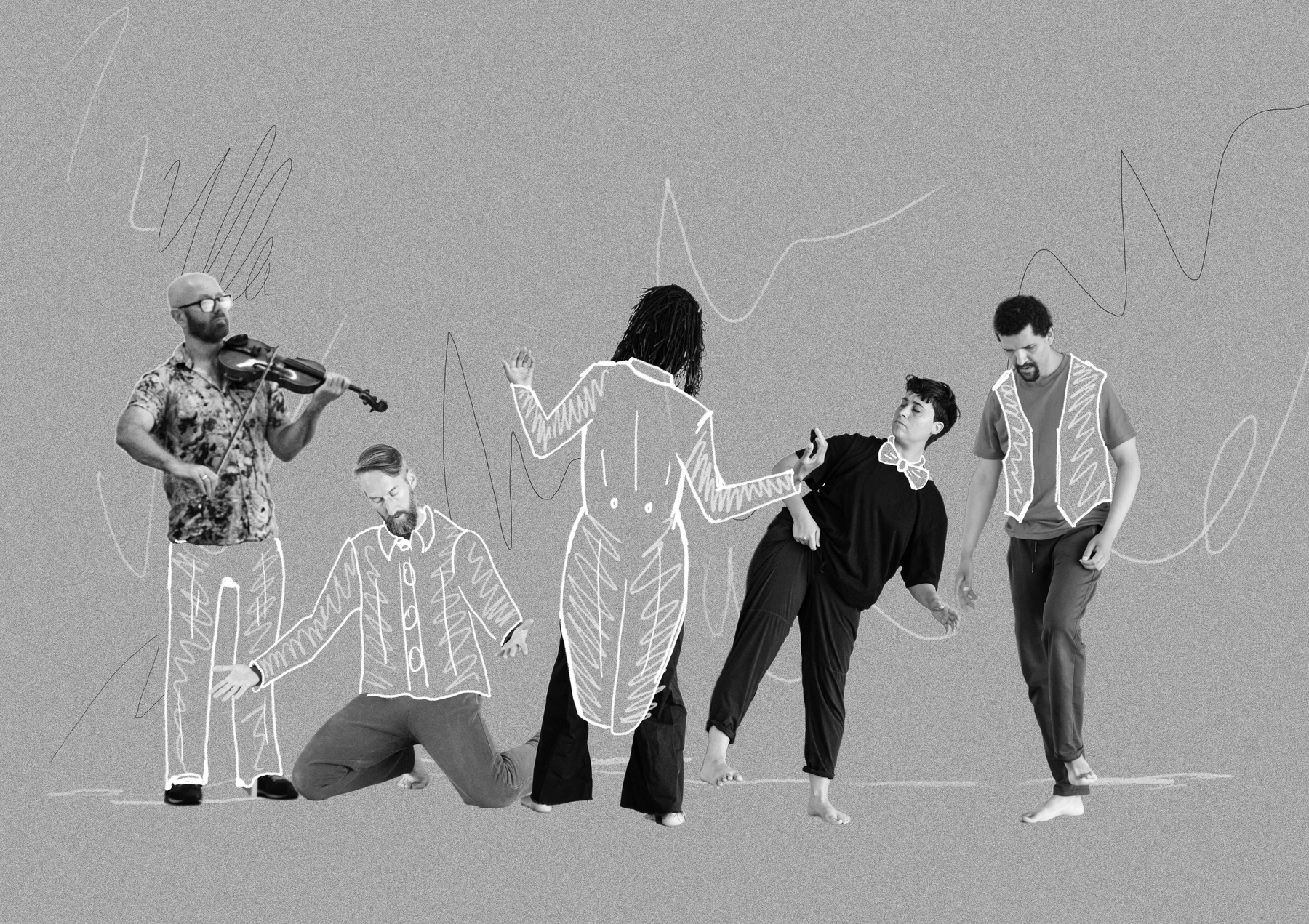
The experience is one of a happening. Elegant drapes, a proscenium, audience on three sides, gaps for the dancers to enter and exit the large stage space. When not on stage, they stand in pools of light on the periphery.
The live music provided by Jamie McCarthy feels cinematic. Atmospheric, with an undertone of urgency and suspense. A strings and synth mashup. The lights by Marty Langthorne are wondrous. Dusk, dawn, pools, gentle flashes – they envelop the movement in a mystical manner. Both the music and lighting are unset, either working in tandem or in counterpoint to what’s presented.
The movement is all and everything. Periods of sedate exploration to frenzied pathways. Individuals show lyricism, articulation, expression and a sense of the unknown. I can recognise improvisation in the feet. They seem so present in the movement as they don’t know where they’re going next. It all takes ‘agile’ to another level. I only saw two moments of physical connection – hands touching – which says a lot. The dancers are connected in the space, no doubt… but the larger journey is an individual one. Philosophical stuff.
I won’t be awarding stars for this review. In fact, I’m not sure it’s even a review, more of a musing. Chimutengwende mentioned wanting the work to include space for the observer, and I felt the same. I was focused, and then sometimes my thoughts would wander to the work’s bigger idea or issues I’m dealing with personally – and none of that felt wrong. As the movement continued, washing over all of us, ready to be received however you wanted.
I’ve come a long way since Morecambe festival, and I’m happy about that. But to quote Eliot via Chimutengwende: “the future exists in the past”.

Matthew Paluch was awarded a place at The Royal Ballet School in 1990 where he graduated in 1997. His first four years as a professional dancer were spent working with London City Ballet, Scottish Ballet, K-Ballet and English National Ballet, becoming a full-time member of ENB until leaving in 2006.
Matthew graduated from the Royal Academy of Dance, Professional Dancers’ Teaching Diploma in 2007, and was formerly on faculty at The Royal Ballet School. He completed his Masters in Ballet Studies at Roehampton University in 2011, has been a freelance writer since 2010 and currently works in the Law Sector.
He is a member of the Dance Section of The Critics’ Circle.