
A Guide to Manon – MacMillan’s biographer, Jann Parry, observes Natalia Osipova as Manon, with Reece Clarke

Jann Parry – author of the Kenneth MacMillan biography “Different Drummer: The Life of Kenneth MacMillan” – comments on Natalia Osipova’s Manon and directing ballet for film.
| Title | Manon |
| Company | The Royal Ballet |
| Venue | The Royal Opera House, London |
| Date | Broadcast as a live performance from the Royal Opera House, 7 February 2024 |
| Reviewer | Jann Parry |
Ross MacGibbon is by far the best recorder of the Royal Ballet‘s performances, and of many other theatrical productions. He was a dancer himself with the Royal Ballet from 1973 to 1986 and learnt his film-making craft with the late Derek Bailey, whose documentary about Kenneth MacMillan‘s Mayerling was a classic of its kind. MacGibbon can be relied upon to capture the key moments of a live performance – though inevitably some details will elude his cameras.
He knows how best to reveal choreography and its musical phrasing, and how to cover up banal sequences with cutaways. Royal Ballet dancers always provide him with convincing reactions to whatever is taking place centre stage: they have learnt to be actors, not bystanders, in narrative works. Part of the pleasure for experienced ballet-goers is spotting the goings-on in the periphery – provided they don’t distract from the principal action.
In the opening scene of Manon, for example, MacGibbon makes sure we see the miserable parade of deported women while the Parisian demi-monde divert themselves in the foreground. Lescaut forces his mistress to watch her possible fate (and that of Manon, yet to arrive). Easily overlooked by first-time viewers, the whole story has been foretold, with the sinister figure of the rat-catcher half-hidden among the merry-making crowd. Des Grieux’s presence can go unnoticed, kept deliberately low-key so that Manon will be the centre of attention when she steps down from the post-chaise.
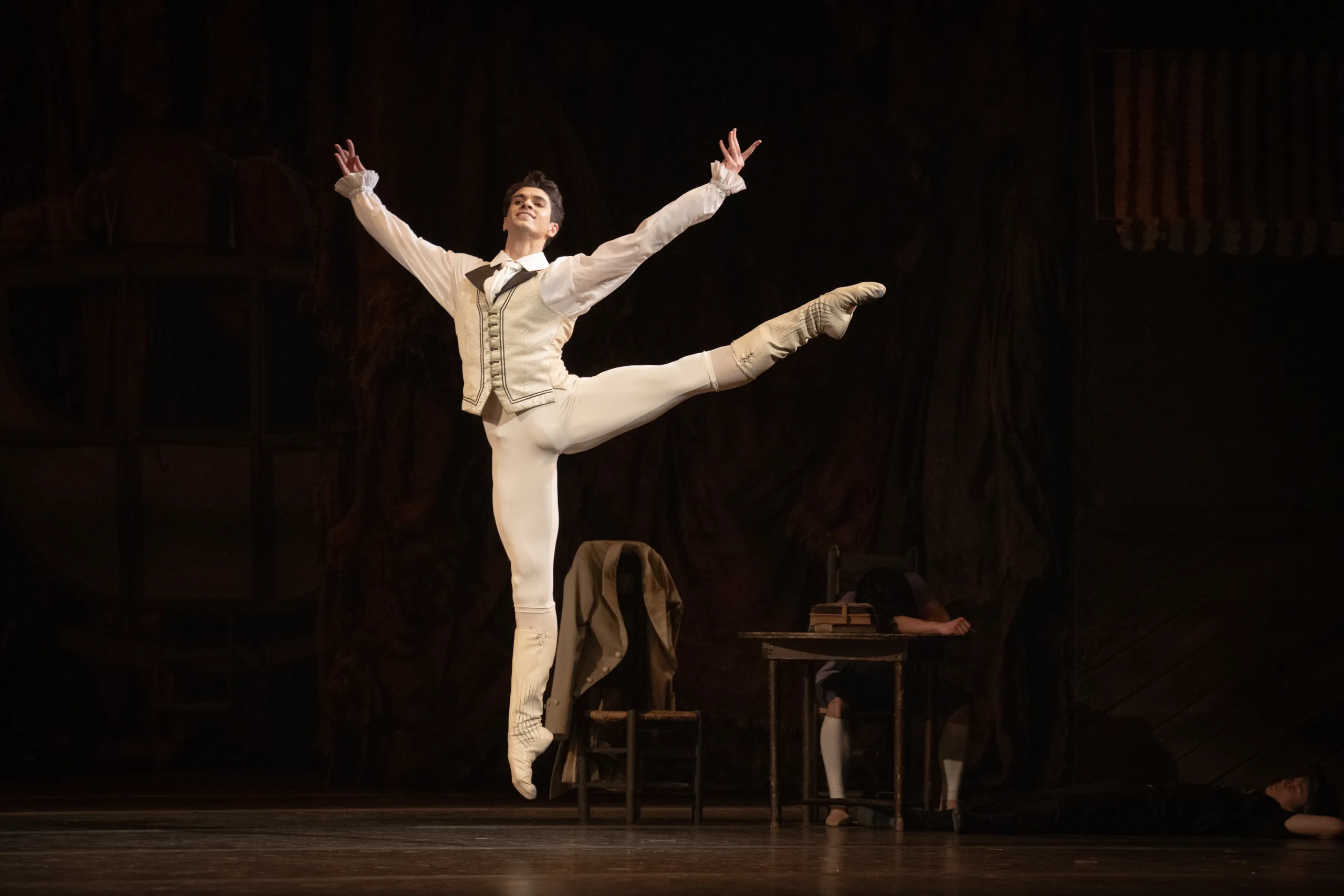
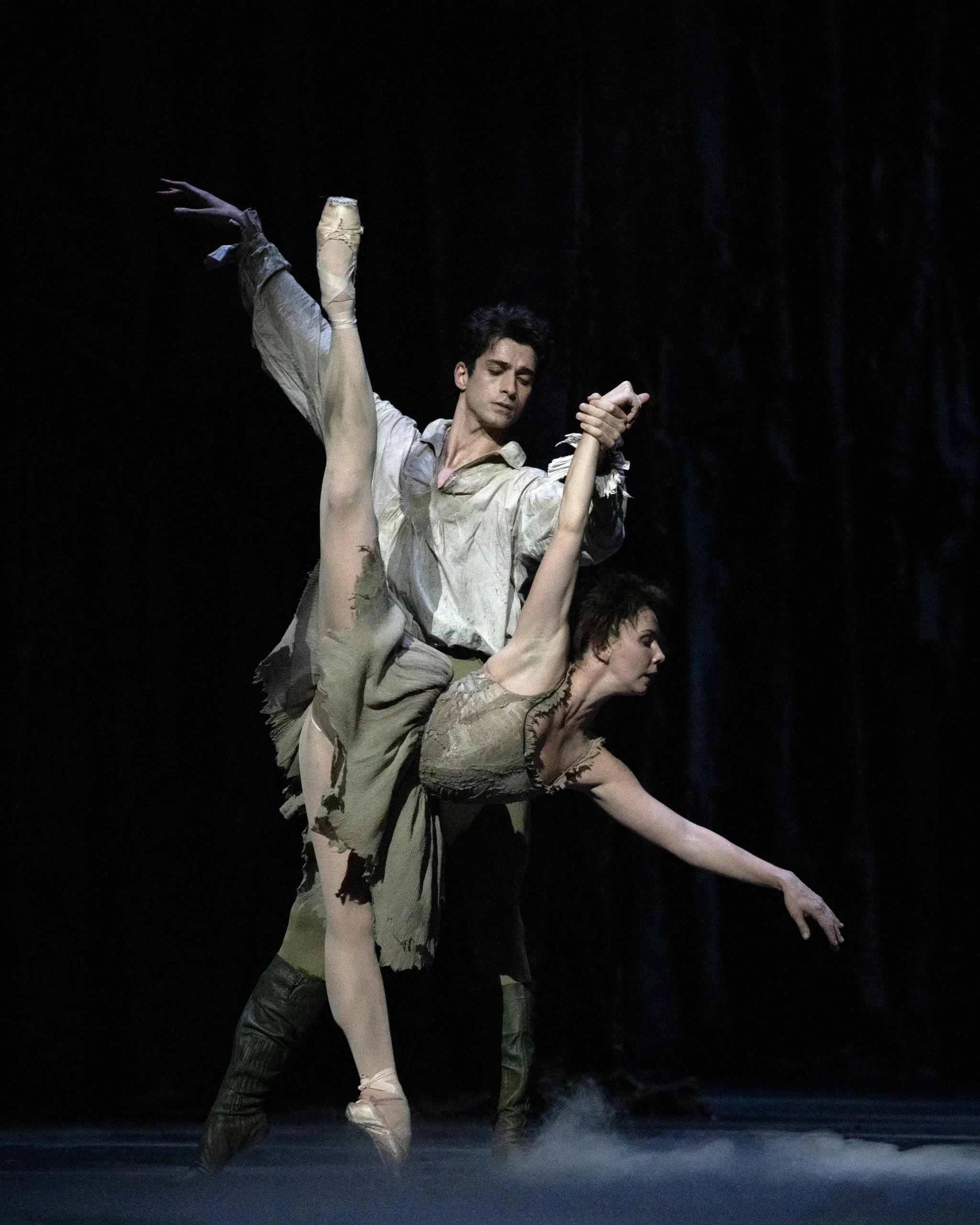
Natalia Osipova‘s Manon was never going to continue her journey to a convent. She’s bright-eyed with excitement at meeting her brother and his ‘friends’, without appreciating how venal they are. But she’s immediately recognised by Elizabeth McGorian’s Madame as a potential courtesan – as she will prove to be in Act II. For now, however, she is about to discover what love can feel like, as she basks in the glow of Des Grieux’s adoration. Reece Clarke as the smitten seminarian entrances her with his solo, carving out his developpés and arabesques as a declaration of his infatuation.
Osipova tumbles into his arms and delights, childishly, in running away with him. In the bedroom scene that follows, she takes fearless pleasure in being swung around in ecstatic lifts. She’s unabashedly available, lying down for him with her arms stretched invitingly above her head. Frustrated by his departure, she flings herself on the bed they’ve recently shared. No sooner has she left it, disconcerted by Monsieur GM’s arrival, than she discovers other sensual thrills – the warm embrace of a fur coat, the cool sparkle of diamonds. Egged on by her brother (Alexander Campbell as Lescaut), she indulges GM’s licentious cravings. Close-ups show her eyes becoming calculating, with moments of disgust at what she’s exposing herself to. We see her return briefly to the edge of her bed, apologising: ‘I’m sorry but I’m sold’. She leaves in her finery without further regret. In a fine piece of acting, Osipova makes the abrupt transition from girl in love to harlot entirely persuasive.
In Act II, she plays the role of a trophy courtesan, flaunting what she has become. The revellers in Madame’s hotel particulier seem to be having a good time – there’s not much hint of putting a brave face on sexual trading. MacMillan’s low-life whores (as in the brothel scene in Mayerling) execute banal routines, here interrupted by McGibbon’s cutaways to their clients’ reactions and naughtiness on the sidelines. A camera helpfully picks out Des Grieux’s distress at Manon’s brazen behaviour: he has to watch, lost in the crowd, while she disports herself, to be rewarded with a diamond bracelet by Monsieur GM (Gary Avis).
Osipova’s Manon taunts the men who handle her, as if to say they can touch her but not have her – she’s too expensive for them. Avis’s debauched GM is a haughty aristocrat who enjoys slumming among the demi-monde: he’s probably already had Madame and Lescaut’s mistress (Mayara Magri). Why on earth does Magri’s very engaging mistress put up with Lescaut’s loutish behaviour? She is clearly another Manon who’s had the bad luck to lose her protector. For her, Lescaut is a bad bet, a drunken chancer likely to gamble away the money he got for selling his sister. In Campbell’s portrayal, he’s not attractive in any way (however well he performed his opening solo in Act I).
Why does Osipova’s Manon change her heart about spurning Des Grieux in favour of yet another piece of jewellery? It must be the purity of his dancing when he’s on his own, extending his limbs in longing for her – and Clarke has very elegant long legs. He has already embraced her, briefly, while she was being passed among the men in the ballroom. Then she responded to him against her will: now she melts as she runs to him to be enfolded once again. How could she resist his ardour? She’s as impulsive as she was when she first ran away with him, though this time she sets up a plan to gain money that was never going to work.
In the next bedroom scene, she is teasingly loving but won’t renounce her finery. Ospova mimes emphatically: ‘I earned these earrings and this bracelet, so don’t you dare take it away’. She pulls apart from him, more like a spoilt child than a greedy courtesan. Before their row can escalate, Lescaut is dragged in and shot by Monsieur GM. The filming doesn’t make the shooting clear because of Health and Safety issues with firing guns on stage. (The sound has to be done remotely, often out of sync with the action.)
In the pause before scenes in the last act, the orchestra’s leading cellist, Christopher Vanderspar, plays a heart-rending solo preparing us for Manon’s fate. Osipova, barely recognisable in a shorn-haired wig, tattered dress and battered pointe shoes, was traumatised with exhaustion on her arrival with Des Grieux from the convict ship. He is not much use to her until after her rape by the vile gaoler (Lukas B Brændsrød, still a novice brute). She sparks into fury after Des Grieux has stabbed the gaoler, spitting on his corpse.
Her spirit is smothered in the final scene as she suffers hallucinations in the swamp, reliving incidents from the past as she is dying in despair. Osipova’s death throes are harrowing as she flails in Clarke’s arms. He comes into his own as a man desperately trying to keep her alive, his stomach churning in distress. She’s not fighting death but being agonisingly consumed by it. He is as broken as she is by the end.
As Laura Morera commented during an interval talk, the leading performers have to look into each other’s souls – for dancers, a brave place to be, especially when being filmed. We see the trust and understanding between Osipova and Clarke, who have been frequent partners for five years. Yet this was only his second performance as Des Grieux this season, as he strove to match Osipova’s spontaneity – and to accomplish the challenging choreography. The screening of their joint interpretations has been hugely rewarding for audiences wanting to experience how emotionally powerful a great ballet can be. It is to be hoped that the recording will become widely available in a permanent form.
Different Drummer: The Life of Kenneth MacMillan
Jann Parry, former dance critic of The Observer (1983-2004), has written for many publications as a freelance, and has contributed to radio and TV documentaries about dancers.
She is the author of the award-winning biography Different Drummer, the life of Kenneth MacMillan (2009).


Excellent work Ms Parry. How much have I not noticed? I will now watch Manon with new eyes.